





Template:Redirect Template:Redirect
Template:Use Canadian English Template:Multiple image
Education is the transmission of knowledge, skills, and character traits. There are many debates about its precise definition, for example, about which aims it tries to achieve. A further issue is whether part of the meaning of education is that the change in the student is an improvement. Some researchers stress the role of critical thinking to distinguish education from indoctrination. These disagreements affect how to identify, measure, and improve forms of education. The term can also refer to the mental states and qualities of educated people. Additionally, it can mean the academic field studying education.
There are many types of education. Formal education happens in a complex institutional framework, like public schools. Non-formal education is also structured but happens outside the formal schooling system. Informal education is unstructured learning through daily experiences. Formal and non-formal education are divided into levels. They include early childhood education, primary education, secondary education, and tertiary education. Other classifications focus on the teaching method, like teacher-centered and student-centered education. Forms of education can also be distinguished by subject, like science education, language education, and physical education.
Education socializes children into society by teaching cultural values and norms. It equips them with the skills needed to become productive members of society. This way, it stimulates economic growth and raises awareness of local and global problems. Organized institutions affect many aspects of education. For example, governments set education policies. They determine when school classes happen, what is taught, and who can or must attend. International organizations, like UNESCO, have been influential in promoting primary education for all children.
Many factors influence whether education is successful. Psychological factors include motivation, intelligence, and personality. Social factors, like socioeconomic status, ethnicity, and gender, are often linked to discrimination. Further factors include educational technology, teacher quality, and parent involvement.
The main field investigating education is called education studies. It examines what education is and what aims it has. It also studies how it happens, what effects it has, and how to improve it. It has many subfields, like philosophy of education, psychology of education, sociology of education, economics of education, and comparative education. It also discusses the history of education. In prehistory, education happened informally through oral communication and imitation. With the rise of ancient civilizations, writing was invented, and the amount of knowledge grew. This caused a shift from informal to formal education. Initially, formal education was mainly available to elites and religious groups. The invention of the printing press in the 15th century made books more widely available. This increased general literacy. Beginning in the 18th and 19th centuries, public education became more important. It led to the worldwide process of making primary education available to all, free of charge, and compulsory up to a certain age.
Definitions
Template:Main The definition of education has been explored by theorists from various fields.Template:SfnTemplate:SfnTemplate:Sfn Many agree that education is a purposeful activity aimed at achieving certain goals, which include the transmission of knowledge, skills, and character traits.Template:SfnTemplate:SfnTemplate:Sfn However, there is extensive debate regarding its exact nature beyond these general features. Some theorists view education primarily as a process that occurs during educational events such as schooling, teaching, and learning.Template:SfnTemplate:SfnTemplate:Sfn Others perceive it not as a process but as the product resulting from this process, emphasizing the mental states and dispositions of educated persons.Template:SfnTemplate:SfnTemplate:Sfn Additionally, the term may also refer to an academic field that studies the methods, processes, and social institutions involved in teaching and learning.Template:Sfn The term "education" is derived from the Latin words Template:Lang, meaning "bring up, rear, educate", primarily related to the mind, and Template:Lang, meaning "bring out, lead forth", and refers to the bodily level.Template:Sfn
Some theorists provide precise definitions by identifying the specific features that are exclusive to all forms of education. R. S. Peters, for instance, outlines three essential features for education:Template:SfnTemplate:SfnTemplate:Sfn
- It is concerned with the transmission of knowledge and understanding.
- This transmission is worthwhile.
- It is done in a morally appropriate manner in tune with the student's interests.Template:SfnTemplate:SfnTemplate:Sfn
Such precise definitions often succeed at characterizing the most typical forms of education. But they are criticized because there are counterexamples.Template:SfnTemplate:SfnTemplate:Sfn These difficulties have led some theorists to develop less precise concepts. Some of them are based on family resemblance. This means that all the forms of education are similar to each other. But they need not share a set of essential features that all of them have in common.Template:SfnTemplate:SfnTemplate:Sfn Some theorists claim that the term "education" is context-dependent. This implies that its meaning varies depending on the situation in which it is used.Template:Sfn Having a clear idea of what the term means is important to correctly identify forms of education. It also matters when trying to measure or improve them.Template:SfnTemplate:SfnTemplate:Sfn
There is disagreement in the academic literature on whether education is an evaluative concept. This means that being good in some sense is part of the definition of education. So-called thick definitions affirm this. They may claim, for example, that an improvement of the learner is a requirement of education. Different thick definitions may still disagree among themselves on what kind of improvement is needed. Thin definitions, on the other hand, try to give a value-neutral account of education.Template:SfnTemplate:Sfn A closely related distinction is that between descriptive and prescriptive conceptions. Descriptive conceptions aim to describe how the term is actually used by regular speakers. Prescriptive conceptions try to express what good education is or how it should be done.Template:SfnTemplate:Sfn
Many thick and prescriptive conceptions rely on the aims of education to explain their view. This means that they see education as an activity that tries to achieve certain aims.Template:SfnTemplate:SfnTemplate:Sfn These aims can be classified into different categories. There is one category for epistemic goods, like knowledge and understanding. Another category covers skills, like rationality and critical thinking. Additionally, there are character traits, like kindness and honesty.Template:Sfn
Some theorists focus on a single overarching purpose of education and see the more specific aims as means to this end.Template:SfnTemplate:Sfn For example, they may claim that socialization is the aim of education. This means that education is seen as the process of transmitting accumulated knowledge from one generation to the next. This process helps the student to function in society as a regular citizen.Template:SfnTemplate:SfnTemplate:Sfn More person-centered definitions focus on the well-being of the student instead. For them, education is a process that helps them lead a good life or the life they wish to lead.Template:SfnTemplate:SfnTemplate:Sfn Various scholars stress critical thinking to distinguish education from indoctrination.Template:SfnTemplate:SfnTemplate:Sfn For them, mere indoctrination is only interested in instilling beliefs in the student, independent of whether they are rational.Template:SfnTemplate:Sfn Education, on the other hand, should also foster the rational ability to critically reflect on those beliefs and question them.Template:Sfn But some theorists contend that some forms of indoctrination may be necessary in the early stages of education. It may be needed until the child's mind is sufficiently developed.Template:Sfn
Education can be characterized from the teacher's or the student's perspective. Teacher-centered definitions focus on the perspective and role of the teacher. They may claim, for example, that education is the transmission of knowledge and skills in a morally appropriate way.Template:SfnTemplate:SfnTemplate:Sfn Student-centered definitions, on the other hand, see education from the student's experience in the learning process. For example, they may define it as a process that transforms and enriches their subsequent experience.Template:SfnTemplate:SfnTemplate:Sfn Definitions taking both perspectives into account are also possible. This can take the form of describing the process as the shared experience of a common world. This shared experience involves discovery as well as posing and solving problems.Template:SfnTemplate:SfnTemplate:Sfn
Types
There are many classifications of education. It depends on the institutional framework whether education is formal, non-formal, or informal. Levels of education are distinguished based on factors like the student's age and the complexity of the content. Some classifications focus on the learner or the topic. Others rely on the teaching method, the medium used, or the funding.[1]
Formal, non-formal, and informal
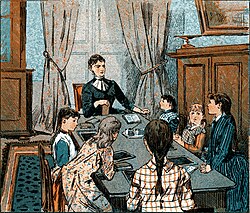
Template:Multiple image Education is often divided into types. The most common division is between formal, non-formal, and informal education.[2] However, some theorists only distinguish between formal and informal education.Template:Sfn Formal education happens in a complex institutional framework. Such frameworks have a chronological and hierarchical order. For instance, the modern schooling system has classes based on the student's age and progress, all the way from primary school to university. Formal education is usually controlled and guided by the government. It is normally compulsory up to a certain age.Template:SfnTemplate:Sfn
Non-formal and informal education take place outside the formal schooling system. Non-formal education is a middle ground. Like formal education, it is organized, systematic, and carried out with a clear purpose in mind. Examples are tutoring, fitness classes, and the scouting movement.[3] Informal education, on the other hand, happens in an unsystematic way through daily experiences and exposure to the environment. Unlike formal and non-formal education, there is usually no designated authority figure responsible for teaching.Template:Sfn Informal education is present in many settings. It happens throughout one's life, mostly in a spontaneous way. This is how children learn their mother tongue from their parents or how people learn to prepare a dish by cooking together.Template:SfnTemplate:SfnTemplate:Sfn
Some theorists distinguish the three types based on the location of learning. Formal education takes place in school. Informal education occurs in places of everyday routines. Non-formal education happens in places that are occasionally visited.Template:Sfn There are also differences in the source of motivation. Formal education is mainly driven by extrinsic motivation for external rewards. Non-formal and informal education are closely linked to intrinsic motivation because the learning itself is enjoyed.Template:Sfn The distinction between the three types is normally clear for the typical cases. But some forms of education do not easily fall into one category.Template:SfnTemplate:Sfn
Formal education plays a central role in modern civilization. But in primitive cultures, most of the education happened on the informal level.Template:SfnTemplate:SfnTemplate:Sfn This usually means that there is no distinction between activities focused on education and other activities. Instead, the whole environment acts as a form of school and most adults act as teachers. However, informal education is often not efficient enough to pass on large quantities of knowledge. To do so, a formal setting and well-trained teachers are usually required. This was one of the reasons why in the course of history, formal education became more and more important. In this process, the experience of education became more abstract and removed from daily life. More emphasis was put on grasping general patterns instead of observing and imitating behavior.Template:SfnTemplate:Sfn
Levels
Types of education are often divided into levels or stages. The most influential framework is the International Standard Classification of Education. It is maintained by the United Nations Educational, Scientific and Cultural Organization (UNESCO). It covers both formal and non-formal education. It distinguishes levels based on the student's age, the duration of learning, and the complexity of the discussed content. Further criteria include entry requirements, teacher qualifications, and the intended outcome of successful completion. The levels are grouped together into early childhood education (level 0), primary education (level 1), secondary education (levels 2-3), post-secondary non-tertiary education (level 4), and tertiary education (levels 5-8).Template:SfnTemplate:SfnTemplate:Sfn

Early childhood education is also known as preschool education or nursery education. It is the stage of education that begins with birth and lasts until the start of primary school. It follows the holistic aim of fostering early child development at the physical, mental, and social levels. It plays a key role in socialization and personality development. It includes various basic skills in the areas of communication, learning, and problem-solving. This way, it prepares children for their entry into primary education.[4]
Primary (or elementary) education usually starts at the age of five to seven and lasts for four to seven years. It does not have any further entry requirements. Its main goal is to teach the basic skills in the fields of reading, writing, and mathematics. But it also covers the core knowledge in other fields, like history, geography, the sciences, music, and art. A further aim is to foster personal development.Template:SfnTemplate:SfnTemplate:Sfn Today, primary education is compulsory in almost all countries. Over 90% of all primary-school-age children worldwide attend primary school.Template:Sfn
Secondary education is the stage of education following primary education. It usually covers the ages of 12 to 18 years. It is commonly divided into lower secondary education (middle school or junior high school) and upper secondary education (high school, senior high school, or college depending on the country). Lower secondary education normally has the completion of primary school as its entry requirement. It aims to extend and deepen the learning outcomes. It is more strongly focused on subject-specific curricula and teachers are specialized in only one or a few specific subjects. One of its aims is to familiarize students with the basic theoretical concepts in these fields. This helps create a solid basis for lifelong learning. In some cases, it also includes vocational training.Template:SfnTemplate:SfnTemplate:Sfn In many countries, it is the last stage of compulsory education.Template:SfnTemplate:Sfn

Upper secondary education aims to provide students with the skills and knowledge needed for employment or tertiary education. Its requirement is usually the completion of lower secondary education. Its subjects are more varied and complex. The students can often choose between a few subjects. Its successful completion is commonly tied to a formal qualification in the form of a high school diploma.Template:SfnTemplate:SfnTemplate:Sfn There are some types of education after secondary education that do not belong to tertiary education. They are often similar in complexity to secondary education. But they tend to focus more on vocational training to prepare students for the job market.Template:SfnTemplate:Sfn

Tertiary education is also referred to as higher education. It expands upon the foundations of secondary education but has a more narrow and in-depth focus on a specific field or subject. Its completion leads to an academic degree. It can be divided into four levels: short-cycle tertiary, Bachelor's, Master's, and doctoral level education. They often form a hierarchical structure with later levels depending on the completion of previous levels.Template:SfnTemplate:SfnTemplate:Sfn
Short-cycle tertiary education focuses on practical matters. It includes advanced vocational and professional training to prepare students for the job market in specialized professions.Template:SfnTemplate:SfnTemplate:Sfn Bachelor's level education is also referred to as undergraduate education. It tends to be longer than short-cycle tertiary education. It is usually offered by universities and results in an intermediary academic certification in the form of a Bachelor's degree.Template:SfnTemplate:SfnTemplate:Sfn Master's level education is more specialized than undergraduate education. Many programs require independent research in the form of a Master's thesis as a requirement for successful completion.Template:SfnTemplate:SfnTemplate:Sfn Doctoral level education leads to an advanced research qualification, normally in the form of a doctor's degree. It usually requires the submission of a substantial academic work, such as a dissertation.Template:SfnTemplate:SfnTemplate:Sfn
Others
Many other types of education are discussed in the academic literature, like the distinction between traditional and alternative education. Traditional education concerns long-established and mainstream schooling practices. It uses teacher-centered education and takes place in a well-regulated school environment. Regulations cover many aspects of education, such as the curriculum and the timeframe when classes start and end.Template:SfnTemplate:Sfn

Alternative education is an umbrella term for forms of schooling that differ from the mainstream traditional approach. For example, they may use a different learning environment, teach different subjects, or promote a different teacher-student relationship. Alternative schooling is characterized by voluntary participation, relatively small class and school sizes, and personalized instruction. This often results in a more welcoming and emotionally safe atmosphere. It encompasses many types like charter schools and special programs for problematic or gifted children. It also includes homeschooling and unschooling. For instance, Montessori schools, Waldorf schools, and Round Square schools are alternative schools. Further examples are Escuela Nueva schools, free schools, and democratic schools.[5] Alternative education also includes indigenous education. It focuses on the transmission of knowledge and skills from an indigenous heritage. Its method gives more emphasis to narration and storytelling.Template:SfnTemplate:SfnTemplate:Sfn
Other distinctions are based on who receives education. Categories by the age of the learner are childhood education, adolescent education, adult education, and elderly education.Template:SfnTemplate:SfnTemplate:Sfn Special education is education that is specifically adapted to meet the unique needs of students with disabilities. It covers various forms of impairments on the intellectual, social, communicative, and physical levels. It aims to overcome the challenges posed by these impairments. This way, it provides the affected students with access to an appropriate education. When understood in the broadest sense, it also includes education for very gifted children who need adjusted curricula to reach their fullest potential.Template:SfnTemplate:SfnTemplate:Sfn
Some classifications focus on the teaching method. In teacher-centered education, for example, the teacher takes center stage in providing students with information. It contrasts with student-centered education, in which students take on a more active and responsible role in shaping classroom activities.Template:Sfn For conscious education, learning and teaching happen with a clear purpose in mind. Unconscious education, on the other hand, occurs on its own without being consciously planned or guided.Template:Sfn This may happen in part through the personality of teachers and adults. Their personality can have indirect effects on the development of the student's personality.Template:Sfn
Autodidacticism or self-education is self-directed learning. It happens without the guidance of teachers and institutions. It mainly occurs in adult education. It is characterized by the freedom to choose what and when to study. For this reason, it can be a more fulfilling learning experience. However, the lack of structure and guidance can result in aimless learning. Due to the absence of external feedback, autodidacts may develop false ideas and inaccurately assess their learning progress.[6] It is closely related to lifelong education, which is an ongoing learning process throughout a person's entire life.Template:SfnTemplate:Sfn
Forms of education can also be categorized by the subject and the medium used. Types based on the subject include science education, language education, art education, religious education, and physical education.Template:SfnTemplate:SfnTemplate:Sfn Special mediums, such as radio or websites, are usually used in distance education. Examples include e-learning (use of computers), m-learning (use of mobile devices), and online education. They often take the form of open education, in which the courses and materials are made available with a minimal amount of barriers. They contrast with regular classroom or onsite education.[7]
A further distinction is based on the type of funding. Public education is also referred to as state education. It is education funded and controlled by the government. It is available to the general public. It normally does not require tuition fees and is thus a form of free education. It contrasts with private education, which is funded and managed by private institutions. Private schools often have a more selective admission process. Many offer paid education by charging tuition fees.[8] A more detailed classification focuses on the social institution responsible for education. It includes categories for institutions like family, school, civil society, state, and church.Template:SfnTemplate:Sfn
Compulsory education is education that people are legally required to receive. It concerns mainly children who need to visit school up to a certain age. It contrasts with voluntary education, which people pursue by personal choice without a legal requirement.Template:SfnTemplate:SfnTemplate:Sfn
Evidence-based education uses well-designed scientific studies to determine which methods of education work best. Its goal is to maximize the effectiveness of educational practices and policies. This is achieved by ensuring that they are informed by the best available empirical evidence. It includes evidence-based teaching, evidence-based learning, and school effectiveness research.Template:SfnTemplate:SfnTemplate:Sfn
Role in society
Education plays various roles in society, including in social, economic, and personal fields. On a social level, education makes it possible to establish and sustain a stable society. It helps people acquire the basic skills needed to interact with their environment and fulfill their needs and desires. In modern society, this involves a wide range of skills like being able to speak, read, and write as well as to solve problems and to perform basic arithmetic tasks. It also includes the ability to handle information and communications technology. Children are socialized into society by acquiring these skills. Another key part of socialization is to learn how to live in social groups and interact with others by coming to understand social and cultural norms and expectations. This requires an understanding of what kinds of behavior are considered appropriate in different contexts. This way, new members are introduced to the culture, norms, and values that are dominant in their society. Socialization happens throughout life but is of special relevance to early childhood education. It enables a form of social cohesion, stability, and peace needed for people to productively engage in their daily business. Education plays a key role in democracies by increasing civic participation in the form of voting and organizing and through its tendency to promote equal opportunity for all.[9]
A further issue is to enable people to become productive members of society by learning how to contribute to it. Through education, individuals acquire the technical and analytical skills needed to pursue their profession, produce goods, and provide services to others. In early societies, there was little specialization and each child would generally learn most of the tasks relevant to help their group. Modern societies are increasingly complex and many professions are only mastered by relatively few people who receive specialized training in addition to general education. Some of the skills and tendencies learned to function in society may conflict with each other and their value depends on the context of their usage. For example, fostering a questioning mind is necessary to develop the ability of critical thinking but in some cases, obedience to an authority is required to ensure social stability.Template:SfnTemplate:SfnTemplate:Sfn
By helping people become productive members of society, education can stimulate economic growth and reduce poverty. It helps workers become more skilled and thereby increases the quality of the produced goods and services, which in turn leads to prosperity and increased competitiveness.[10] In this regard, public education is often understood as a long-term investment to benefit society as a whole. The rate of return is especially high for investments in primary education.Template:SfnTemplate:Sfn Besides increasing economic prosperity, it can also lead to technological and scientific advances as well as decrease unemployment while promoting social equity.Template:Sfn
Education can prepare a country to adapt to changes and successfully face new challenges. For example, it can help raise awareness and contribute to the solution of contemporary global problems. Examples are climate change and sustainability as well as the widening inequalities between the rich and the poor.Template:SfnTemplate:SfnTemplate:Sfn By making students aware of how their lives and actions affect others, it may inspire some to work toward realizing a more sustainable and fair world.Template:Sfn This way, education serves not just the purpose of reproducing society as it is but can also be an instrument of development by realizing social transformation to improve society.Template:Sfn This applies also to changing circumstances in the economic sector. For example, due to technological advances and increased automation, many jobs may be lost in the coming decades.[11] This may render currently taught skills and knowledge redundant while shifting the importance to other areas. Education can be used to prepare people for such changes by adjusting the curriculum. This way, subjects involving digital literacy and skills in handling new technologies can be promoted.Template:SfnTemplate:SfnTemplate:Sfn Another example is online education in the form of massive open online courses.Template:Sfn
On a more individual level, education promotes personal development. This can include factors such as learning new skills, developing talents, fostering creativity, and increasing self-knowledge as well as improving problem-solving and decision-making abilities.Template:SfnTemplate:Sfn It further has positive effects on health and well-being.Template:Sfn While education is of high relevance in childhood, it does not end with adulthood and continues throughout life. This phenomenon is known as lifelong learning. It is of specific significance in contemporary society due to the rapid changes on many levels and the need for people to adjust to them.Template:SfnTemplate:SfnTemplate:Sfn
The social importance of education is recognized in the annual International Day of Education on January 24. The year 1970 was declared International Education Year.Template:SfnTemplate:Sfn
Role of institutions

Organized institutions play a key role for various aspects of education. Institutions like schools, universities, teacher training institutions, and ministries of education make up the education sector. They interact both with each other and with other stakeholders, such as parents, local communities, and religious groups. Further stakeholders are NGOs, professionals in healthcare, law enforcement, media platforms, and political leaders. Many people are directly involved in the education sector. They include students, teachers, and school principals as well as school nurses and curriculum developers.Template:SfnTemplate:Sfn
Many aspects of formal education are regulated by the policies of governmental institutions. They determine at what age children need to attend school and at what times classes are held as well as issues pertaining to the school environment, like infrastructure. Regulations also cover the exact requirements for teachers and how they are trained. An important aspect of education policy concerns the curriculum used for teaching at schools, colleges, and universities. A curriculum is a planned sequence of instructions or a program of learning that intends to guide the experience of learners to achieve the aims of education. The topics are usually selected based on their importance and depend on the type of school. For example, the goals of public school curricula are usually to offer a comprehensive and well-rounded education while vocational trainings focus more on specific practical skills within a field. The curricula also cover various aspects besides the topic to be discussed, such as the teaching method, the objectives to be reached, and the standards for assessing progress. By determining the curricula, governmental institutions have a strong impact on what knowledge and skills are transmitted to the students.[12]
International organizations also play a key role in education. For example, UNESCO is an intergovernmental organization that promotes education in many ways. One of its activities is to advocate education policies. One example is the treaty UNCRC. It states that education is a human right of all children and young people. Another is the Education for All initiative. It aimed to offer basic education to all children, adolescents, and adults by the year 2015. It was later replaced by the initiative Sustainable Development Goals as goal 4.[13] Related policies include the Convention against Discrimination in Education and the Futures of Education initiative.Template:SfnTemplate:Sfn
Some influential organizations are not intergovernmental but non-governmental. For example, the International Association of Universities promotes the exchange of colleges and universities around the world. The International Baccalaureate offers international diploma programs.Template:SfnTemplate:SfnTemplate:Sfn Many institutions, like the Erasmus Programme, facilitate student exchanges between countries.Template:Sfn
Factors of educational success
Many factors influence educational achievement. They include psychological factors, which concern the student as an individual, and sociological factors, which pertain to the student's social environment. Further factors include access to educational technology, teacher quality, and parent involvement. Many of these factors overlap and influence each other.[14]
Psychological
On a psychological level, relevant factors include motivation, intelligence, and personality.Template:Sfn Motivation is the internal force propelling people to engage in learning.Template:SfnTemplate:SfnTemplate:Sfn Motivated students are more likely to interact with the content to be learned by participating in classroom activities like discussions, which often results in a deeper understanding of the subject. It can also help students overcome difficulties and setbacks. An important distinction is between intrinsic and extrinsic motivation. Intrinsically motivated students are driven by an interest in the subject and the learning experience itself. Extrinsically motivated students seek external rewards. They may strive for good grades and recognition by their peers. It is often claimed that intrinsic motivation is more beneficial by leading to increased creativity and engagement as well as long-term commitment.[15] Educational psychologists try to discover how to increase motivation. This can be achieved by encouraging some competition among students. Another factor is to balance positive and negative feedback in the form of praise and criticism.Template:SfnTemplate:Sfn
Intelligence is another important factor in how people respond to education. It is a mental quality linked to the ability to learn from experience, to understand, and to employ knowledge and skills to solve problems. Those who have higher scores in intelligence metrics tend to perform better at school and go on to higher levels of education.[16] Intelligence is often primarily associated with the so-called IQ, a standardized numerical metric for assessing intelligence. However, it has been argued that there different types of intelligences pertaining to distinct areas. According to Howard Gardner, some affect the areas of mathematics, logic, and spatial cognition. Others concern language and music. There are also distinct types for interacting with other people and with oneself. These forms are largely independent of each other. This means that someone may excel at one type while scoring low on another.Template:SfnTemplate:Sfn
A closely related factor concerns learning styles. A learning style is a preferred form of acquiring knowledge and skills. For example, students with an auditory learning style find it easy to follow spoken lectures and discussions while visual learners benefit if information is presented visually in diagrams and videos. For efficient learning, it is often beneficial to include a wide variety of learning modalities.Template:SfnTemplate:SfnTemplate:Sfn The learner's personality may also affect educational achievement. For example, the features of conscientiousness and openness to experience from the Big Five personality traits are linked to academic success.Template:Sfn Further mental factors include self-efficacy, self-esteem, and metacognitive abilities.Template:SfnTemplate:Sfn
Sociological
Unlike psychological factors, sociological factors focus not on the mental attributes of learners but on their social status and environment. They include socioeconomic status, ethnicity, and cultural background as well as gender. They are of interest to researchers since they are associated with inequality and discrimination. For this reason, they play a key role in policy-making in attempts to mitigate their effects.[17]
Socioeconomic status depends on income but includes other factors as well, such as financial security, social status, and social class as well as quality of life attributes. Low socioeconomic status affects educational success in various ways. It is linked to slower cognitive developments in language and memory and higher dropout rates. Poor families may not have enough money to invest in educational resources like stimulating toys, books, and computers. Additionally, they may be unable to afford tuition at prestigious schools and are more likely to attend schools in poorer areas. Such schools tend to offer lower standards of teaching, for example, because of teacher shortages or because they lack educational materials and facilities, like libraries. Poor parents may also be unable to afford private lessons if their children lack behind. Students from a low socioeconomic status often have less access to information on higher education and may face additional difficulties in securing and repaying student loans. Low socioeconomic status also has many indirect negative effects because it is linked to lower physical and mental health. Due to these factors, social inequalities on the level of the parents are often reproduced in the children.Template:SfnTemplate:SfnTemplate:Sfn
Ethnic background is linked to cultural differences and language barriers, which make it more difficult for students to adapt to the school environment and follow classes. Additional factors are explicit and implicit biases and discrimination toward ethnic minorities. This may affect the students' self-esteem and motivation as well as their access to educational opportunities. For example, teachers may hold stereotypical views even if they are not overtly racist, which can lead them to grade comparable performances differently based on the child's ethnicity.[18]
Historically, gender has been a central factor in education since the roles of males and females were defined differently in many societies. Education tended to strongly favor males, who were expected to provide for the family. Females, on the other hand, were expected to manage the household and rear children, which severely hampered the educational opportunities available to them. And while these inequalities have improved in most modern societies, there are still gender differences in education. Among other things, this concerns biases and stereotypes linked to the role of gender in education. An example is that subjects like science, technology, engineering, and mathematics are often presented as male fields. This discourages female students to follow them.Template:SfnTemplate:SfnTemplate:Sfn
One aspect of many social factors is given by the expectations associated with stereotypes. On the one hand, they work on an external level based on how people react to a person belonging to a certain group. On the other hand, they also affect the internal level because the person internalizes them and acts accordingly. In this sense, the expectations may turn into self-fulfilling prophecies by causing the educational outcomes they anticipate. This can happen both for positive and for negative stereotypes.Template:SfnTemplate:Sfn
Technology and others
Technology plays another significant role in educational success. Educational technology is commonly associated with the use of modern digital devices, like computers. But understood in the broadest sense, it involves a wide range of resources and tools for learning, including basic aids that do not involve the use of machines, like regular books and worksheets.Template:SfnTemplate:Sfn

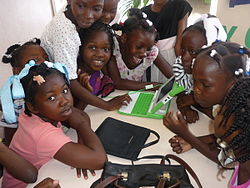
Educational technology can benefit learning in various ways. In the form of media, it often takes the role of the primary supplier of information in the classroom. This means that the teacher can focus their time and energy on other tasks, like planning the lesson and guiding students as well as assessing educational performance.Template:Sfn It can also make information easier to understand, for example, by presenting it using graphics and videos rather than through mere text. In this regard, interactive elements may be used to make the learning experience more engaging, for example, in the form of educational games. Technology can be employed to make educational materials accessible to many people, like when using online resources. It additionally facilitates collaboration between students and communication with teachers.Template:SfnTemplate:SfnTemplate:Sfn Lack of educational technology is an issue specifically in various developing countries and many efforts are made to address it, like the One Laptop per Child initiative.Template:SfnTemplate:SfnTemplate:Sfn
A closely related issue concerns the effects of school infrastructure. It includes various physical aspects of the school, like its location and size as well as the available school facilities and equipment. For example, a healthy and safe environment, well-maintained classrooms, and suitable classroom furniture as well as the availability of a library and a canteen tend to contribute to educational success.Template:SfnTemplate:Sfn The quality of the teacher also has an important impact on educational success. For example, skilled teachers are able to motivate and inspire students and are able to adjust their instructions to the students' abilities and needs. Important in this regard are the teacher's own education and training as well as their past teaching experience.[19] A meta-analysis by Engin Karadağ et al. concludes that, compared to other influences, factors related to the school and the teacher have the biggest impact on student achievement.Template:Sfn
An additional factor to boost educational achievement is parent involvement. It can make children more motivated and invested if they are aware that their parents care about their educational efforts. This tends to lead to increased self-esteem, better attendance rates, and more constructive behavior at school. Parent involvement also includes communication with teachers and other school staff, for example, to make other parties aware of current issues and how they may be resolved.Template:SfnTemplate:SfnTemplate:Sfn Further relevant factors sometimes discussed in the academic literature include historical, political, demographic, religious, and legal aspects.Template:SfnTemplate:Sfn
Education studies

The main discipline investigating education is called education studies, also referred to as education sciences. It tries to determine how people transmit and acquire knowledge by studying the methods and forms of education. It is interested in its aims, effects, and value as well as the cultural, societal, governmental, and historical contexts that shape education.[20] Education theorists integrate insights from many other fields of inquiry, including philosophy, psychology, sociology, economics, history, politics, and international relations. Because of these influences, some theorists claim that education studies is not an independent academic discipline like physics or history since its method and subject are not as clearly defined.Template:SfnTemplate:Sfn Education studies differs from regular training programs, such as teacher training, since its focus on academic analysis and critical reflection goes beyond the skills needed to be a good teacher. It is not restricted to the topic of formal education but examines all forms and aspects of education.Template:SfnTemplate:SfnTemplate:Sfn
Various research methods are used to study educational phenomena. They can roughly be divided into quantitative, qualitative, and mixed-methods approaches. Quantitative research emulates the methods found in the natural sciences by using precise numerical measurements to gather data from many observations and employs statistical tools to analyze it. It aims to arrive at an objective and impersonal understanding. Qualitative research usually has a much smaller sample size and tries to get an in-depth insight into more subjective and personal factors, like how different actors experience the process of education. Mixed-methods research aims to combine data gathered from both approaches to arrive at a balanced and comprehensive understanding. Data can be gathered in various ways, like using direct observation or test scores as well as interviews and questionnaires.Template:SfnTemplate:Sfn Research can be employed to study basic factors affecting all forms of education, examine specific applications, look for solutions to concrete problems, and evaluate the effectiveness of projects.Template:Sfn
Subfields
Education studies encompasses various subfields like philosophy of education, pedagogy, psychology of education, sociology of education, economics of education, comparative education, and history of education.Template:SfnTemplate:Sfn The philosophy of education is the branch of applied philosophy that examines many of the basic assumptions underlying the theory and practice of education. It studies education both as a process and as a discipline while trying to provide exact definitions of its nature and how it differs from other phenomena. It further studies the purpose of education and its types as well as how to conceptualize teachers, students, and their relation.[21] It includes educational ethics, which examines various moral issues in relation to education, for example, what ethical principles underlie it and how teachers should apply them to specific cases. The philosophy of education has a long history and was already discussed in ancient Greek philosophy.Template:SfnTemplate:SfnTemplate:Sfn
The term "pedagogy" is sometimes used as a synonym for education studies but when understood in a more restricted sense, it refers to the subfield interested in teaching methods.[22] It studies how the aims of education, like the transmission of knowledge or fostering skills and character traits, can be realized.Template:SfnTemplate:SfnTemplate:Sfn It is interested in the methods and practices used for teaching in regular schools and some researchers restrict it to this domain. But in a wider sense, it covers all types of education, including forms of teaching outside schools.Template:Sfn In this general sense, it explores how teachers can bring about experiences in learners to advance their understanding of the studied topic and how the learning itself takes place.Template:SfnTemplate:Sfn
The psychology of education studies how education happens on the mental level, specifically how new knowledge and skills are acquired as well as how personal growth takes place. It studies the factors responsible for successful education and how these factors may differ from person to person. Important factors include intelligence, motivation, and personality. A central topic in this field is the interplay between nature and nurture and how it affects educational success. Influential psychological theories of education are behaviorism, cognitivism, and constructivism.Template:SfnTemplate:SfnTemplate:Sfn Closely related fields are the neurology of education and educational neuroscience, which are interested in the neuropsychological processes and changes brought about through learning.[23]
The sociology of education is concerned with how social factors influence education and how it leads to socialization. Social factors differ from mental factors studied by psychology and include aspects like socioeconomic status, ethnicity, and gender. The sociology of education studies how these factors, together with the dominant ideology in society, affect what kind of education is available to a person and how successful they are. Closely related questions include how education affects different groups in society and how educational experiences can form someone's personal identity. The sociology of education is interested in aspects that result in inequalities and is relevant to education policy, for example, when trying to identify what causes inequality and how to reduce it.Template:SfnTemplate:Sfn Two influential schools of thought are consensus theory and conflict theory. Consensus theorists hold that education benefits society as a whole by preparing people for their roles. Conflict theories have a more negative outlook on the resulting inequalities and see education as a force used by the ruling class to promote their own agenda.Template:SfnTemplate:Sfn
The economics of education is the field of inquiry studying how education is produced, distributed, and consumed. It tries to determine how resources should be used to improve education. An example is the question to what extent the quality of teachers is increased by raising their salary. Other questions are how smaller class sizes affect educational success and how to invest in new educational technologies. In this regard, it helps policy-makers decide how to distribute the limited resources most efficiently to benefit society as a whole. It also tries to understand what long-term role education plays for the economy of a country by providing a highly skilled labor force and increasing its competitiveness. A closely related issue concerns the economic advantages and disadvantages of different systems of education.Template:SfnTemplate:SfnTemplate:Sfn

Comparative education is the discipline that examines and contrasts systems of education. Comparisons can happen from a general perspective or focus on specific factors, like social, political, or economic aspects. It is often applied to different countries to assess the similarities and differences of their educational institutions and practices as well as to evaluate the consequences of the distinct approaches. It can be used to learn from other countries which education policies work and how one's own system of education may be improved.Template:SfnTemplate:SfnTemplate:Sfn This practice is known as policy borrowing. It comes with many difficulties since the success of policies can depend to a large degree on the social and cultural context of students and teachers. A closely related and controversial topic concerns the question of whether the educational systems of developed countries are superior and should be exported to less developed countries.Template:SfnTemplate:SfnTemplate:Sfn Other key topics are the internationalization of education and the role of education in transmitting from an authoritarian regime to a democracy.Template:SfnTemplate:Sfn
The history of education examines the evolution of educational practices, systems, and institutions. It discusses various key processes, their possible causes and effects, and their relations to each other.Template:Sfn
Aims and ideologies
A central topic in education studies concerns questions like why people should be educated and what goals should guide this process. Many aims of education have been suggested. On a basic level, education is about the acquisition of knowledge and skills but may also include personal development and fostering of character traits. Common suggestions encompass features like curiosity, creativity, rationality, and critical thinking as well as the tendency to think, feel, and act morally. Some scholars focus on liberal values linked to freedom, autonomy, and open-mindedness. But others prioritize qualities like obedience to authority, ideological purity, piety, and religious faith. An important discussion in this regard is about the role of critical thinking. It asks to what extent indoctrination forms part of education. On a social level, it is often stressed that education should socialize people. This way, it turns them into productive members of society while promoting good citizenship and preserving cultural values.[24] A controversial issue in this regard concerns who primarily benefits from education: the educated person, society as a whole, or dominant groups within society.Template:SfnTemplate:SfnTemplate:Sfn
Educational ideologies are systems of basic philosophical assumptions and principles. They cover various additional issues besides the aims of education, like what topics are learned and how the learning activity is structured. Other topics include the role of the teacher and how the results are to be assessed. They also include claims on how to structure the institutional framework and policies. There are many ideologies and they often overlap in various ways. For example, teacher-centered ideologies place the main emphasis on the teacher's role in transmitting knowledge to students. Student-centered ideologies give a more active role to the students in the process. Product-based ideologies discuss education from the perspective of the result to be achieved. They contrast with process-based ideologies, which focus on the processes of teaching and learning themselves. Another classification contrasts progressivism with more traditional and conservative ideologies. Further categories are humanism, romanticism, essentialism, encyclopaedism, and pragmatism. There are also distinct types for authoritarian and democratic ideologies.Template:SfnTemplate:SfnTemplate:Sfn
Learning theories and teaching
Learning theories try to explain how learning happens. Influential theories are behaviorism, cognitivism, and constructivism. Behaviorism understands learning as a change in behavior in response to environmental stimuli. This happens by presenting the learner with a stimulus, associating this stimulus with the desired response, and solidifying this stimulus-response pair. Cognitivism sees learning as a change in cognitive structures and focuses on the mental processes involved in storing, retrieving, and processing information. According to constructivism, learning is based on the personal experience of each individual. It puts more emphasis on social interactions and how they are interpreted by the learner. These theories have important implications for how to teach. For example, behaviorists tend to focus on drills while cognitivists may advocate the use of mnemonics and constructivists tend to employ collaborative learning strategies.[25]
An influential developmental theory of learning is due to Jean Piaget. He outlines four stages of learning through which children pass on their way to adulthood. They are the sensorimotor, the pre-operational, the concrete operational, and the formal operational stage. They correspond to different levels of abstraction. Early stages focus more on simple sensory and motor activities. Later stages include more complex internal representations and information processing in the form of logical reasoning.Template:SfnTemplate:Sfn Various theories suggest that learning is more efficient when it is based on personal experience. An additional factor is to aim at a deeper understanding by connecting new to pre-existing knowledge rather than merely memorizing a list of unrelated facts.Template:SfnTemplate:Sfn
The teaching method concerns the way the content is presented by the teacher, for example, whether group work is used instead of a focus on individual learning. There are many teaching methods available. Which one is most efficient in a case depends on various factors, like the subject matter as well as the learner's age and competence level.Template:SfnTemplate:SfnTemplate:Sfn This is reflected in the fact that modern school systems organize students by age, competence, specialization, and native language into different classes to ensure a productive learning process. Different subjects frequently use very different approaches. For example, language education often focuses on verbal learning. Mathematical education, on the other hand, is about abstract and symbolic thinking together with deductive reasoning.Template:SfnTemplate:Sfn One central requirement for teaching methodologies is to ensure that the learner remains motivated, for example, because of interest and curiosity or through external rewards.Template:SfnTemplate:Sfn
Further aspects of teaching methods include the instructional media used, such as books, worksheets, and audio-visual recordings, and having some form of test or assessment to evaluate the learning progress. An important pedagogical aspect in many forms of modern education is that each lesson is part of a larger educational enterprise governed by a syllabus. It often covers several months or years.Template:SfnTemplate:Sfn According to Herbartianism, teaching is divided into phases. The initial phase consists of preparing the student's mind for new information. Next, new ideas are first presented to the learner and then associated with ideas with which the learner is already familiar. In later phases, the understanding shifts to a more general level behind the specific instances and the ideas are then put into concrete practice.Template:SfnTemplate:Sfn
History
Template:Main The history of education studies the processes, methods, and institutions involved in teaching and learning. It tries to explain how they have interacted with each other and shaped educational practice until the present day.Template:SfnTemplate:Sfn Education began in prehistory, as adults trained the young in the knowledge and skills deemed necessary in their society. For the most part, there were no specialized teachers and most adults taught the youth, usually informally during everyday activities. Education was achieved through oral communication and imitation. It could take the form of storytelling and singing to pass knowledge, values, and skills from one generation to the next.Template:SfnTemplate:Sfn
The earliest ancient civilizations developed in the period from 3000 to 1500 BCE in Egypt, Mesopotamia, and North China. Ancient education was characterized by the invention of writing and the development of formal education.Template:SfnTemplate:Sfn The invention of writing had a significant influence on the history of education as a whole. Through writing, it was possible to store and preserve information and make it accessible to more people. This enabled various subsequent developments, for example, the creation of educational tools, like textbooks, and institutions, like schools.[26]

Another key aspect of ancient education was the establishment of formal education. This became necessary since the amount of knowledge grew as civilizations evolved and informal education proved insufficient to transmit all knowledge from one generation to the next. Teachers would act as specialists to impart knowledge and education became more abstract and further removed from daily life. Formal education was still quite rare in ancient societies and was restricted to the intellectual elites. It happened in the form of training scribes and priests and covered various subjects besides reading and writing, including the humanities, science, medicine, mathematics, law, and astrology.Template:SfnTemplate:Sfn Plato's Academy in Ancient Greece is often mentioned as one of the noteworthy achievements of ancient education. It is frequently described as the first institute of higher education.Template:SfnTemplate:SfnTemplate:Sfn Another achievement is the creation of the Great Library of Alexandria in Ancient Egypt. Many see it as the most prestigious library of the ancient world.Template:Sfn
In the medieval period, religious authorities had a lot of influence over formal education. This applied specifically to the role of the Catholic Church in Europe. But it is also seen in the Muslim world. Education there focused on the study of the Quran and its interpretations but also included knowledge of the sciences and the arts. Additionally, this period saw the establishment of universities as concentrated centers of higher education and research. The first universities were the University of Bologna, the University of Paris, and Oxford University.[27] Another key development was the creation of guilds. Guilds were associations of skilled craftsmen and merchants who controlled the practice of their trades. They were responsible for vocational education and new members had to pass through different stages on their way to masterhood.Template:SfnTemplate:Sfn

The invention and popularization of the printing press in the middle of the 15th century by Johann Gutenberg had a profound impact on general education. It significantly reduced the cost of producing books, which were hand-written before, and thereby augmented the dissemination of written documents, including new forms like newspapers and pamphlets. The increased availability of written media had a significant influence on the general literacy of the population.[28]
These changes prepared the rise of public education in the 18th and 19th centuries. This period saw the establishment of publicly funded schools with the aim of providing education for all. This contrasts with earlier periods, when formal education was primarily provided by private institutions, religious institutions, and individual tutors.[29] Aztec civilization was an exception in this regard since formal education was mandatory for the youth regardless of social class as early as the 14th century.Template:SfnTemplate:SfnTemplate:Sfn Closely related changes were to make education compulsory and free of charge for all children up to a certain age.Template:SfnTemplate:SfnTemplate:Sfn Initiatives to promote public education and universal access to education made significant progress in the 20th and the 21st centuries and were promoted by intergovernmental organizations like the UN. Examples include the Universal Declaration of Human Rights, the Convention on the Rights of the Child, the Education for All initiative, the Millennium Development Goals, and the Sustainable Development Goals.Template:SfnTemplate:SfnTemplate:Sfn These efforts resulted in a steady rise of all forms of education but affected primary education in particular. For example, in 1970, 28% of all primary-school-age children worldwide did not attend school while by 2015, this number dropped to 9%.Template:Sfn
A side effect of the establishment of public education was the introduction of standardized curricula for public schools as well as standardized tests to assess the students' progress. It also affected teachers by setting in place institutions and norms to guide and oversee teacher training, for example, by establishing certification standards for teaching at public schools.Template:SfnTemplate:SfnTemplate:Sfn
A further influence on contemporary education was the emergence of new educational technologies. For example, the widespread availability of computers and the internet dramatically increased access to educational resources and made new types of education possible, such as online education. This was of particular relevance during the COVID-19 pandemic. Schools all around the world had to close for extended periods. Many offered remote learning through video conferencing or pre-recorded video lessons to continue instruction.[30] A further contemporary factor is the increased globalization and internationalization of education.Template:SfnTemplate:Sfn
See also
- Template:Annotated link
- Template:Annotated link
- Template:Annotated link
- Template:Annotated link
- Template:Annotated link
- Template:Annotated link
- Template:Annotated link
- Template:Annotated link
- Template:Annotated link
References
Citations
- ↑ Template:Multiref2
- ↑ Template:Multiref2
- ↑ Template:Multiref2
- ↑ Template:Multiref2
- ↑ Template:Multiref2
- ↑ Template:Multiref2
- ↑ Template:Multiref2
- ↑ Template:Multiref2
- ↑ Template:Multiref2
- ↑ Template:Multiref2
- ↑ Template:Multiref2
- ↑ Template:Multiref2
- ↑ Template:Multiref2
- ↑ Template:Multiref2
- ↑ Template:Multiref2
- ↑ Template:Multiref2
- ↑ Template:Multiref2
- ↑ Template:Multiref2
- ↑ Template:Multiref2
- ↑ Template:Multiref2
- ↑ Template:Multiref2
- ↑ Template:Multiref2
- ↑ Template:Multiref2
- ↑ Template:Multiref2
- ↑ Template:Multiref2
- ↑ Template:Multiref2
- ↑ Template:Multiref2
- ↑ Template:Multiref2
- ↑ Template:Multiref2
- ↑ Template:Multiref2
Sources
- A Strategic Approach to Onsite Learning in the Era of SARS-Cov-2. SN Computer Science({Template:Date).
- Sociology of Education: An A-to-Z Guide{{#if:|, {{{last}}}}. Sage Publications(2013). ISBN 978-1-5063-5473-6
- The School Story: Young Adult Narratives in the Age of Neoliberalism{{#if:|, {{{last}}}}. University Press of Mississippi(4 February 2022). ISBN 978-1-4968-3764-6
- Homeschooling Black Children in the U.S.: Theory, Practice, and Popular Culture{{#if:|, {{{last}}}}. IAP(1 January 2022). ISBN 978-1-64802-784-0
- Measuring Personal Growth and Development in Context: Evidence of Validity in Educational and Work Settings. Journal of Happiness Studies({Template:Date).
- Classroom Teaching: An Introduction{{#if:|, {{{last}}}}. Peter Lang(2005). ISBN 978-0-8204-7858-6
- Bridges over troubled waters: Education and cognitive neuroscience. Trends in Cognitive Sciences({Template:Year).
- Education and Socioeconomic Status. American Psychological Association. Retrieved 28 April 2023.
- Understanding Minority Ethnic Achievement: Race, Gender, Class and 'Success'{{#if:|, {{{last}}}}. Routledge(2006). ISBN 978-1-134-19246-5
- Contributions to the History of Education: Volume 5, Secondary Education in the Nineteenth Century{{#if:|, {{{last}}}}. Cambridge University Press(2013). ISBN 978-1-107-62232-6
- An Overview of Alternative Education{{#if:|, {{{last}}}}. Urban Institute(2006)
- Teaching and Learning in the Health Sciences{{#if:|, {{{last}}}}. UP Press(2010). ISBN 978-971-542-573-5
- The Philosophy of Education: An Introduction{{#if:|, {{{last}}}}. Bloomsbury Publishing(2014). ISBN 978-1-4742-2899-2
- The Impact of School Infrastructure on Learning: A Synthesis of the Evidence{{#if:|, {{{last}}}}. World Bank Publications(2019). ISBN 978-1-4648-1378-8
- Education studies: essential issues{{#if:|, {{{last}}}}. Sage(2003). ISBN 0761940499
- Introduction to education studies{{#if:|, {{{last}}}}. Sage Publications(2007). ISBN 978-1-4129-2193-0
- Understanding the Influence of Race/Ethnicity, Gender, and Class on Inequalities in Academic and Non-Academic Outcomes among Eighth-Grade Students: Findings from an Intersectionality Approach. PLOS ONE({Template:Date).
- John Dewey's conception of education: Finding common ground with R. S. Peters and Paulo Freire. Educational Philosophy and Theory({Template:Date).
- R.s. Peters and the Concept of Education. Educational Theory({Template:Date).
- The Protection of the Right to Education by International Law: Including a Systematic Analysis of Article 13 of the International Covenant on Economic, Social and Cultural Rights{{#if:|, {{{last}}}}. Brill(2005). ISBN 978-90-474-1754-5
- The Protection of the Right to Education by International Law: Including a Systematic Analysis of Article 13 of the International Covenant on Economic, Social and Cultural Rights{{#if:|, {{{last}}}}. Brill(2005a). ISBN 978-90-474-1754-5
- How Students View the Boundaries Between Their Science and Religious Education Concerning the Origins of Life and the Universe. Science Education({Template:Year).
- What is Education For? On Good Education, Teacher Judgement, and Educational Professionalism. European Journal of Education({Template:Date).
- Ludwig Wittgenstein: 3.4 Language-games and Family Resemblance. The Stanford Encyclopedia of Philosophy. Metaphysics Research Lab, Stanford University(2021). Retrieved 11 February 2022.
- Economics of Education: A Selected Annotated Bibliography{{#if:|, {{{last}}}}. Elsevier(2014). ISBN 978-1-4831-8788-4
- Education. www.britannica.com(2023). Retrieved 30 April 2023.
- The Oxford Handbook of Philosophy of Education{{#if:|, {{{last}}}}(30 October 2009). ISBN 978-0195312881
- Evidence-Based Education in the Health Professions: Promoting Best Practice in the Learning and Teaching of Students{{#if:|, {{{last}}}}. Radcliffe Publishing(1 February 2005). ISBN 978-1-910227-70-1
- An Introduction to Sociology{{#if:|, {{{last}}}}. Polity(2011). ISBN 978-0-7456-5008-1
- The Internationalization of Higher Education: National Interpretations of a Global Model. Comparative Education Review({Template:Date).
- The 2nd Innovative and Creative Education and Teaching International Conference{{#if:|, {{{last}}}}(27 June 2019)
- Early Childhood Education and Adult Education: Bridging the Cultures. Journal of Early Childhood Teacher Education({Template:Date).
- Values in Education{{#if:|, {{{last}}}}. Routledge(2005). ISBN 978-1-134-72831-2
- Teaching for Excellence and Equity: Analyzing Teacher Characteristics, Behaviors and Student Outcomes with TIMSS{{#if:|, {{{last}}}}. Springer International Publishing(2019). ISBN 978-3-030-16151-4
- Seven year longitudinal study of the early prediction of reading achievement. Journal of Educational Psychology({Template:Year).
- Principles and Pedagogies in Jewish Education{{#if:|, {{{last}}}}. Springer International Publishing(2022). ISBN 978-3-030-83925-3
- Issues in Basic Education in Developing Countries: An Exploration of Policy Options for Improved Delivery. Journal of International Cooperation in Education({Template:Date).
- An analysis of internal and external feedback in self-regulated learning activities mediated by self-regulated learning tools and open learner models. International Journal of Educational Technology in Higher Education({Template:Date).
- International Journal of McLuhan Studies 2012–13: Education Overload. From Total Surround to Pattern Recognition{{#if:|, {{{last}}}}. Universidad Oberta de Catalunya, Barcelona(2014). ISBN 978-84-939995-9-9
- OECD Reviews of Evaluation and Assessment in Education: School Evaluation in the Flemish Community of Belgium 2011{{#if:|, {{{last}}}}. OECD Publishing(7 December 2011). ISBN 978-92-64-11672-6
- Child Labour in Global Society{{#if:|, {{{last}}}}. Emerald Group Publishing(30 May 2014). ISBN 978-1-78350-780-1
- Public and Private Education in America: Examining the Facts{{#if:|, {{{last}}}}. ABC-CLIO(23 September 2021). ISBN 978-1-4408-6375-2
- Research Methods in Education{{#if:|, {{{last}}}}. Routledge(2018). ISBN 978-1-315-45652-2
- private education. Collin's English Dictionary. Retrieved 7 May 2023.
- Evidence-Based Practices{{#if:|, {{{last}}}}. Emerald Group Publishing(6 June 2013). ISBN 978-1-78190-430-5
- Educational Ethics: Are we on the right track?. Educational Theory({Template:Date).
- Encyclopedia of Management{{#if:|, {{{last}}}}. Thomson Gale(15 August 2023). ISBN 978-0-7876-6556-2
- A Brief History of Education: A Handbook of Information on Greek, Roman, Medieval, Renaissance, and Modern Educational Practice{{#if:|, {{{last}}}}. Rowman & Littlefield(1976). ISBN 978-0-8226-0067-1
- The silent expansion of internationalisation: exploring the adoption of the International Baccalaureate in Madrid. Compare: A Journal of Comparative and International Education({Template:Date).
- Routledge Encyclopedia of Philosophy{{#if:Curren|, Curren}. Routledge(1996). ISBN 0415187109
- Education Studies: An Issue Based Approach{{#if:|, {{{last}}}}. Learning Matters(6 December 2013). ISBN 978-1-4462-9693-6
- Encyclopedia of Media and Communication{{#if:|, {{{last}}}}. University of Toronto Press(17 June 2013). ISBN 978-1442695535
- The Palgrave Handbook of Critical Thinking in Higher Education{{#if:|, {{{last}}}}. Palgrave Macmillan US(2015). ISBN 978-1-137-37805-7
- Adolescent Education: A Reader{{#if:|, {{{last}}}}. Peter Lang(2010). ISBN 978-1-4331-0504-3
- Democracy and Education{{#if:|, {{{last}}}}. Courier Corporation(2004). ISBN 978-0-486-43399-8
- Holistic Leadership: A New Paradigm for Today's Leaders{{#if:|, {{{last}}}}. Springer(2017). ISBN 978-1-137-55571-7
- Patient Education in Rehabilitation{{#if:|, {{{last}}}}. Jones & Bartlett Learning(2010). ISBN 978-0-7637-5544-7
- Studying education: an introduction to the key disciplines in education studies{{#if:|, {{{last}}}}. Open University Press(2011). ISBN 978-0335241071
- Library of Alexandria. www.britannica.com. Retrieved 3 May 2023.
- Teacher-Centered or Student-Centered Learning Approach to Promote Learning?. Jurnal Sosial Humaniora({Template:Date).
- Bridging In-school and Out-of-school Learning: Formal, Non-Formal, and Informal Education. Journal of Science Education and Technology({Template:Date).
- educate | Origin and meaning of educate by Online Etymology Dictionary. www.etymonline.com. Retrieved 2021-08-03.
- Investigating the relationship between school facilities and academic achievements through geographically weighted regression. Annals of GIS({Template:Date).
- Integrating Curricula With Multiple Intelligences: Teams, Themes, and Threads{{#if:|, {{{last}}}}. Corwin Press(2008). ISBN 978-1-4129-5553-9
- Building Global Education with a Local Perspective: An Introduction to Glocal Higher Education{{#if:|, {{{last}}}}. Springer(2015). ISBN 978-1-137-38677-9
- Encyclopedia of Education{{#if:|, {{{last}}}}. Macmillan Reference(2002). ISBN 978-0-02-865594-9
- Pedagogy of the Oppressed{{#if:|, {{{last}}}}. Herder and Herder(1970). ISBN 978-0-14-080331-0
- The Textbook and the Lecture: Education in the Age of New Media{{#if:|, {{{last}}}}. JHU Press(2017). ISBN 978-1-4214-2434-7
- Education sector responses to the use of alcohol, tobacco and drugs{{#if:|, {{{last}}}}. UNESCO Publishing(2017). ISBN 978-92-3-100211-3
- Internationalisation of higher education: new players in a changing scene. Educational Research and Evaluation({Template:Date).
- Philosophy of Education: The Key Concepts{{#if:|, {{{last}}}}. Routledge(2002). ISBN 978-1-134-69031-2
- Self-Directed Learning Strategies in Adult Educational Contexts{{#if:|, {{{last}}}}. IGI Global(5 April 2019). ISBN 978-1-5225-8019-5
- Why does democracy need education?. Journal of Economic Growth({Template:Date).
- Neuroscience and education: from research to practice?. Nature Reviews Neuroscience({Template:Year).
- International encyclopedia of the social sciences{{#if:|, {{{last}}}}. Macmillan Reference US. ISBN 0028659732
- Public Vs. Private: The Early History of School Choice in America{{#if:|, {{{last}}}}. Oxford University Press(2018). ISBN 978-0-19-064457-4
- Encyclopedia of education{{#if:|, {{{last}}}}. Macmillan Reference US(2003). ISBN 978-0028655949
- Encyclopedia of Education{{#if:|, {{{last}}}}. Macmillan Reference US(2003a). ISBN 978-0-02-865594-9
- Encyclopedia of Education{{#if:|, {{{last}}}}. Macmillan Reference USA(2003b). ISBN 978-0-02-865594-9
- Education and the Good Life. Philosophy({Template:Date).
- Understanding the role of digital technologies in education: A review. Sustainable Operations and Computers({Template:Date).
- The American Heritage Dictionary entry: education. www.ahdictionary.com. HarperCollins(2023). Retrieved 9 May 2022.
- The American Heritage Dictionary entry: special education. www.ahdictionary.com. HarperCollins(2023a). Retrieved 5 May 2023.
- The Church, the State, and the School. The North American Review({Template:Date).
- Education, inequality and social justice: A critical analysis applying the Sen-Bourdieu Analytical Framework. Policy Futures in Education({Template:Date).
- Reinventing Public Education: How Contracting Can Transform America's Schools{{#if:|, {{{last}}}}. University of Chicago Press(15 February 2009). ISBN 978-0-226-33653-4
- BTEC First Sport{{#if:|, {{{last}}}}. Nelson Thornes(2005). ISBN 978-0-7487-8553-7
- Religion and Academic Achievement: A Research Review Spanning Secondary School and Higher Education. Review of Religious Research({Template:Date).
- The Insistence of the Letter{{#if:|, {{{last}}}}. Routledge(2021). ISBN 978-0-429-84402-7
- An Introduction to the Philosophy of Methodology{{#if:|, {{{last}}}}. Sage(2012). ISBN 978-1-4462-9062-0
- The History of Human Resource Development: Understanding the Unexplored Philosophies, Theories, and Methodologies{{#if:|, {{{last}}}}. Springer(2016). ISBN 978-1-137-52698-4
- Health Care Education: The Challenge of the Market{{#if:|, {{{last}}}}. Springer(11 November 2013). ISBN 978-1-4899-3232-7
- Retraining and reskilling workers in the age of automation. www.mckinsey.com. Retrieved 27 April 2023.
- Indigenous Storytelling as Research. International Review of Qualitative Research({Template:Date).
- Factors Influencing Academic Motivation of Ethnic Minority Students: A Review. SAGE Open({Template:Date).
- What Is Education?{{#if:|, {{{last}}}}. University of Chicago Press(2011). ISBN 978-0-226-38939-4
- What Is Education?{{#if:|, {{{last}}}}. University of Chicago Press(2011a). ISBN 978-0-226-38939-4
- Indigenous Education: Language, Culture and Identity{{#if:|, {{{last}}}}. Springer(20 January 2015). ISBN 978-94-017-9355-1
- Handbook of Research on Pedagogical Models for Next-Generation Teaching and Learning{{#if:|, {{{last}}}}. IGI Global(2017). ISBN 978-1-5225-3874-5
- An International Dictionary of Adult and Continuing Education{{#if:|, {{{last}}}}. Routledge(2 October 2012). ISBN 978-1-134-97506-8
- Efficiency in education. Journal of the Operational Research Society({Template:Date).
- Education in World History{{#if:|, {{{last}}}}. Taylor & Francis(2022). ISBN 978-1-317-81337-8
- Education in the age of automation. The Japan Times(17 September 2018). Retrieved 6 May 2021.
- The Blackwell Encyclopedia of Sociology{{#if:|, {{{last}}}}. John Wiley & Sons, Ltd(2016). ISBN 978-1-4051-2433-1
- The Factors Effecting Student Achievement: Meta-Analysis of Empirical Studies{{#if:|, {{{last}}}}. Springer(2017). ISBN 978-3-319-56083-0
- Education Studies: Issues and Critical Perspectives{{#if:|, {{{last}}}}. McGraw-Hill Education(2006). ISBN 978-0-335-21973-5
- Encyclopedia of Psychology{{#if:|, {{{last}}}}. American Psychological Association(2000). ISBN 978-1-55798-187-5
- Understanding Education: History, Politics and Practice{{#if:|, {{{last}}}}. Springer(2017). ISBN 978-981-10-6433-3
- Learning theory. www.britannica.com. Retrieved 20 August 2022.
- Charter School Funding Considerations{{#if:|, {{{last}}}}. IAP(2022). ISBN 978-1-64802-835-9
- Education and "Thick" Epistemology. Educational Theory({Template:Date).
- Our education system is losing relevance. Here's how to update it. World Economic Forum. Retrieved 6 May 2021.
- Education for Growth: Why and for Whom?. Journal of Economic Literature({Template:Date).
- Formal, nonformal and informal education: A holistic perspective on lifelong learning. International Review of Education({Template:Date).
- Self-efficacy, self-esteem and their impact on academic performance. Social Behavior and Personality({Template:Date).
- From Older Adult Education to Social Service: The Transformation of Elderly Education Organizations. Journal of Social Service Research({Template:Date).
- Values Education for Citizens in the New Century{{#if:|, {{{last}}}}. Chinese University Press(2006). ISBN 978-962-996-153-4
- Aristotle's School; a Study of a Greek Educational Institution{{#if:|, {{{last}}}}. University of California Press(1972). ISBN 0-520-02194-0
- 'The Other Half' of Education: Unconscious education of children. Educational Philosophy and Theory({Template:Date).
- What the future of work will mean for jobs, skills, and wages: Jobs lost, jobs gained McKinsey. www.mckinsey.com. Retrieved 6 May 2021.
- The neurology of learning.. Comparative Psychology (Rev. Ed.).({Template:Date).
- The Meaning of the Concept of Education: Searching for the Lost Arc. Journal of Thought({Template:Date).
- An Introduction to the Study of Education{{#if:|, {{{last}}}}. Routledge(2014). ISBN 978-0-203-10545-0
- Comparative Studies in Special Education{{#if:|, {{{last}}}}. Gallaudet University Press(1994). ISBN 978-1-56368-027-4
- Motivation. Educational Psychology({Template:Date).
- Our Educational Emphases in Primitive Perspective. American Journal of Sociology({Template:Date).
- Students' goal orientations and cognitive engagement in classroom activities. Journal of Educational Psychology({Template:Date).
- The Good Teacher: Dominant Discourses in Teaching and Teacher Education{{#if:|, {{{last}}}}. Psychology Press(2004). ISBN 978-0-415-33564-5
- Civil Society, Social Change, and a New Popular Education in Russia{{#if:|, {{{last}}}}. Routledge(3 October 2018). ISBN 978-1-134-62568-0
- Gods & Goddesses of the Inca, Maya, and Aztec Civilizations{{#if:|, {{{last}}}}. The Rosen Publishing Group, Inc(2014). ISBN 978-1-62275-396-3
- Education Studies{{#if:|, {{{last}}}}. McGraw-Hill Education (UK)(2009). ISBN 978-0-335-23763-0
- Plato's Philosophy of Education and the Common Core Debate. Association for the Development of Philosophy Teaching - Spring Conference({Template:Date).
- Equity in the Classroom: Towards Effective Pedagogy for Girls and Boys{{#if:|, {{{last}}}}. Routledge(2003). ISBN 978-1-135-71682-0
- Compulsory Education. New England Journal of Education({Template:Date).
- Democracy's Schools: The Rise of Public Education in America{{#if:|, {{{last}}}}. JHU Press(2017). ISBN 978-1-4214-2322-7
- Successful Alternatives to Traditional School Structure: A Literature Review. BU Journal of Graduate Studies in Education({Template:Date).
- Early Childhood Education: An International Encyclopedia{{#if:|, {{{last}}}}. Greenwood Publishing Group(2007). ISBN 978-0-313-34143-4
- The Growth of the Medieval City: From Late Antiquity to the Early Fourteenth Century{{#if:|, {{{last}}}}. Routledge(2014). ISBN 978-1-317-88550-4
- Philosophy of Education{{#if:Noddings|, Noddings}. Westview Press(1995). ISBN 978-0-8133-8429-0
- ISCED 2011 Operational Manual Guidelines for Classifying National Education Programmes and Related Qualifications: Guidelines for Classifying National Education Programmes and Related Qualifications{{#if:|, {{{last}}}}. OECD Publishing(20 March 2015). ISBN 978-92-64-22836-8
- OECD Handbook for Internationally Comparative Education Statistics 2018 Concepts, Standards, Definitions and Classifications: Concepts, Standards, Definitions and Classifications{{#if:|, {{{last}}}}. OECD Publishing(11 September 2018). ISBN 978-92-64-30444-4
- Tailored Gamification to Educational Technologies{{#if:|, {{{last}}}}. Springer Nature(2019). ISBN 978-981-329-812-5
- Foundations of Education{{#if:|, {{{last}}}}. Cengage Learning(2016). ISBN 978-1-305-85489-5
- public education. Oxford Learner's Dictionary. Oxford University Press. Retrieved 7 May 2023.
- Learning, Space and Identity{{#if:|, {{{last}}}}. Sage Publications(2001). ISBN 978-0-7619-6939-6
- Promoting Health and Emotional Well-Being in Your Classroom{{#if:|, {{{last}}}}. Jones & Bartlett Learning(2010). ISBN 978-0-7637-7612-1
- Principles and Practices of Christian Education: An Evangelical Perspective{{#if:|, {{{last}}}}. Wipf and Stock Publishers(29 April 2002). ISBN 978-1-7252-0227-6
- pedagogy. www.britannica.com. Retrieved 15 August 2022.
- The Concept of Education{{#if:|, {{{last}}}}. Routledge(1967). ISBN 978-0-203-86107-3
- Ethics and Education (Routledge Revivals){{#if:|, {{{last}}}}. Routledge(2015). ISBN 978-1-317-49478-2
- The Philosophy of Education{{#if:|, {{{last}}}}. Oxford University Press(1973). ISBN 978-0-19-875023-9
- A history of communications: media and society from the evolution of speech to the Internet{{#if:|, {{{last}}}}. Cambridge University Press(2011). ISBN 978-0511976919
- Social and Psychological Factors in the Academic Achievement of Children of Immigrants: A Cultural History Puzzle. American Educational Research Journal({Template:Date).
- Main Currents in the History of Education{{#if:|, {{{last}}}}. McGraw-Hill(1970). ISBN 978-0-07-050581-0
- Encyclopedia of the Social and Cultural Foundations of Education{{#if:|, {{{last}}}}. Sage Publications(2008). ISBN 978-1-4522-6597-1
- The influence of education on health: an empirical assessment of OECD countries for the period 1995–2015. Archives of Public Health({Template:Date).
- Non-Western Educational Traditions: Alternative Approaches to Educational Thought and Practice{{#if:|, {{{last}}}}. Lawrence Erlbaum Associates, Publishers(2005). ISBN 978-0-8058-4857-1
- Education and Climate Change: The Role of Universities{{#if:|, {{{last}}}}. Springer Nature(3 December 2020). ISBN 978-3-030-57927-2
- Research Anthology on Adult Education and the Development of Lifelong Learners{{#if:|, {{{last}}}}. IGI Global(19 March 2021). ISBN 978-1-7998-8734-8
- Indigenous Education in a Global Context. Oxford Bibliographies. Retrieved 14 May 2022.
- OLPC's $100 laptop was going to change the world — then it all went wrong. The Verge(16 April 2018). Retrieved 26 January 2022.
- EdTech in Developing Countries: A Review of the Evidence. The World Bank Research Observer({Template:Date).
- The Science of Education: A Paraphrase of Dr. Karl Rosenkranz's Paedagogik Als System{{#if:|, {{{last}}}}. G.I. Jones(1872)
- Primary and Secondary Education. Our World in Data({Template:Date).
- The Oxford Handbook of the History of Education{{#if:|, {{{last}}}}. Oxford University Press(2019). ISBN 978-0-19-934003-3
- The Oxford Handbook of the History of Education{{#if:|, {{{last}}}}. Oxford University Press(2019a). ISBN 978-0-19-934003-3
- Core Concepts in Sociology{{#if:|, {{{last}}}}. John Wiley & Sons(2018). ISBN 978-1-119-16863-8
- Education Indicators: An International Perspective{{#if:|, {{{last}}}}. DIANE Publishing(April 1997). ISBN 978-0-7881-4267-3
- Pedagogy: Disturbing History, 1820–1930{{#if:|, {{{last}}}}. University of Pittsburgh Pre(2003). ISBN 978-0-8229-7246-4
- Introduction To Educational Technology{{#if:|, {{{last}}}}. Sterling Publishers Pvt. Ltd(1981). ISBN 978-81-207-3139-4
- The Heritage of European Universities{{#if:|, {{{last}}}}. Council of Europe(2006). ISBN 978-92-871-6121-5
- Cyclopaedia of Education: A Dictionary of Information for the Use of Teachers, School Officers, Parents and Others{{#if:|, {{{last}}}}. Steiger(1877)
- Parental involvement and educational success among vulnerable students in vocational education and training. Educational Research({Template:Date).
- Public Spending and the Role of the State: History, Performance, Risk and Remedies{{#if:|, {{{last}}}}. Cambridge University Press(2020). ISBN 978-1-108-49623-0
- Learning, Environment and Sustainable Development: A History of Ideas{{#if:|, {{{last}}}}. Routledge(2020). ISBN 978-1-000-20802-3
- Cognitive Consequences of Formal and Informal Education: New accommodations are needed between school-based learning and learning experiences of everyday life.. Science({Template:Date).
- Education in a Digital World: Global Perspectives on Technology and Education{{#if:|, {{{last}}}}. Routledge(2013). ISBN 978-0-415-80844-6
- A Review of the Relationship between Parental Involvement and Secondary School Students' Academic Achievement. Education Research International({Template:Date).
- Philosophy of Education. The Stanford Encyclopedia of Philosophy. Metaphysics Research Lab, Stanford University(2018). Retrieved 25 March 2022.
- Philosophy of education. www.britannica.com(2023). Retrieved 23 March 2022.
- The Oxford Handbook of Philosophy of Education{{#if:|, {{{last}}}}(2010). ISBN 978-0195312881
- Global Perspectives on Recognising Non-formal and Informal Learning: Why Recognition Matters{{#if:Singh|, Singh}. Springer-UNESCO(2015). ISBN 978-3-319-15277-6
- Powerful Lesson Planning: Every Teacher's Guide to Effective Instruction{{#if:|, {{{last}}}}. Simon and Schuster(2015). ISBN 978-1-5107-0121-2
- Innovating to Learn, Learning to Innovate{{#if:|, {{{last}}}}. OECD Publishing(3 November 2008). ISBN 978-92-64-04798-3
- Family Resemblance. Grazer Philosophische Studien({Template:Date).
- The Case Against School Choice: Politics, Markets and Fools{{#if:|, {{{last}}}}. Routledge(16 September 2016). ISBN 978-1-315-28655-6
- Instructional Design{{#if:|, {{{last}}}}. John Wiley & Sons(2004). ISBN 978-0-471-39353-5
- Forms of education: Rethinking educational experience against and outside the humanist legacy. British Journal of Educational Studies({Template:Date).
- The Sage Encyclopedia of Educational Technology{{#if:|, {{{last}}}}. Sage Publications(29 January 2015). ISBN 978-1-5063-1129-6
- Opinion: Automation is likely to eliminate nearly half our jobs in the next 25 years. Here's what to do. Los Angeles Times(29 October 2019). Retrieved 6 May 2021.
- How the pandemic is reshaping education. Washington Post. Retrieved 1 May 2023.
- What is media literacy and why is it important? Minitex. www.minitex.umn.edu. Retrieved 6 May 2021.
- Human intelligence. www.britannica.com. Retrieved 24 April 2023.
- Beyond "Formal" versus "Informal" Education: Uses of Psychological Theory in Anthropological Research. Ethos({Template:Date).
- Breaking the STEM Stereotype: Reaching Girls in Early Childhood{{#if:|, {{{last}}}}. Rowman & Littlefield(2019). ISBN 978-1-4758-4205-0
- Introduction to Educational Technology{{#if:|, {{{last}}}}. Educational Technology Publications(1973). ISBN 978-0-87778-049-6
- A study finds nearly half of jobs are vulnerable to automation. The Economist(24 April 2018). Retrieved 6 May 2021.
- Alternative education. www.britannica.com(2023). Retrieved 7 May 2023.
- Herbartianism. www.britannica.com(2014). Retrieved 20 August 2022.
- Fundamentals of Performance Improvement: Optimizing Results through People, Process, and Organizations{{#if:|, {{{last}}}}. John Wiley & Sons(1 May 2012). ISBN 978-1-118-02524-6
- A Sociology of Special Education (RLE Edu M){{#if:|, {{{last}}}}. Routledge(4 May 2012). ISBN 978-1-136-45711-1
- Education Studies: The Key Concepts{{#if:|, {{{last}}}}. Routledge(2017). ISBN 978-1-317-34030-0
- Formal – Non-formal – Informal in Education. Procedia - Social and Behavioral Sciences({Template:Date).
- International Years. United Nations(2023). Retrieved 9 February 2023.
- List of International Days and Weeks. United Nations(2023a). Retrieved 9 February 2023.
- Policy Brief: Education during COVID-19 and beyond. United Nations(August 2020). Retrieved 11 December 2020.
- International Standard Classification of Education ISCED 2011. uis.unesco.org(2012).
- Convention against Discrimination in Education. www.unesco.org. Retrieved 30 April 2023.
- Reimagining Our Futures Together: A New Social Contract for Education{{#if:|, {{{last}}}}. UN(2022). ISBN 978-92-1-001210-2
- Reimagining Our Futures Together: A New Social Contract for Education{{#if:|, {{{last}}}}(2022a). ISBN 978-92-3-100478-0
- Guidelines to strengthen the right to education in national frameworks{{#if:|, {{{last}}}}. UNESCO Publishing(2021). ISBN 978-92-3-100428-5
- UNESCO SDG Resources for Educators – Quality Education. en.unesco.org. UNESCO(9 October 2018). Retrieved 21 January 2022.
- Out in the Open: Education sector responses to violence based on sexual orientation and gender identity/expression{{#if:|, {{{last}}}}. Paris: UNESCO(2016). ISBN 978-92-3-100150-5
- Education For All. United Nations website. Retrieved 1 May 2023.
- Sustainable Development Disciplines for Humanity: Breaking Down the 5Ps--People, Planet, Prosperity, Peace, and Partnerships{{#if:|, {{{last}}}}. Springer Nature(2022). ISBN 978-981-19-4859-6
- Can education change the world? Education amplifies differences in liberalization values and innovation between developed and developing countries. PLOS One({Template:Date).
- Personality predicts academic achievement in higher education: Differences by academic field of study?. Learning and Individual Differences({Template:Date).
- Automation threatens 800 million jobs, but technology could still save us, says report. The Verge(30 November 2017). Retrieved 6 May 2021.
- Future medical education in pediatrics and neonatology{{#if:|, {{{last}}}}. Frontiers Media SA(1 March 2023). ISBN 978-2-8325-1317-0
- Massive Open Online Courses and the Future of Higher Education. Contemporary Technologies in Education: Maximizing Student Engagement, Motivation, and Learning({Template:Date).
- Education Studies: A Student's Guide{{#if:|, {{{last}}}}. Routledge(2004). ISBN 978-1-134-35767-3
- An Introduction to Education Studies: The Student Guide to Themes and Contexts{{#if:|, {{{last}}}}. Bloomsbury Academic(2009). ISBN 978-0-8264-9920-2
- Understanding Pedagogy and its Impact on Learning{{#if:|, {{{last}}}}(1999). ISBN 978-1853964534
- The Epistemology of Education. Philosophy Compass({Template:Date).
- Challenges for Public Education: Reconceptualising Educational Leadership, Policy and Social Justice as Resources for Hope{{#if:|, {{{last}}}}. Routledge(2018). ISBN 978-0-429-79193-2
- The Concept of Education Revisited. Journal of Philosophy of Education({Template:Date).
- Teachers Matter: Rethinking how Public Schools Identify, Reward, and Retain Great Educators{{#if:|, {{{last}}}}. Rowman & Littlefield(2012). ISBN 978-1-4422-1077-6
- Post-Education-for-All and Sustainable Development Paradigm: Structural Changes with Diversifying Actors and Norms{{#if:|, {{{last}}}}. Emerald Group Publishing(27 June 2016). ISBN 978-1-78441-270-8
- Internationalization of Higher Education in India{{#if:|, {{{last}}}}. Sage Publications India(2016). ISBN 978-93-86042-13-2
- Elements of Open Education: An Invitation to Future Research. The International Review of Research in Open and Distributed Learning({Template:Date).
External links
Template:Library resources box
Template:Education Template:Social sciences Template:Subject bar Template:Authority control