
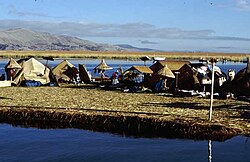

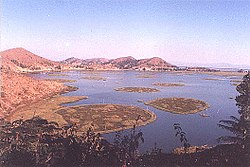


A floating island is a mass of floating aquatic plants, mud, and peat ranging in thickness from several centimeters to a few meters. Floating islands are found in many parts of the world. They exist less commonly as an artificial phenomenon. Floating islands are generally found on marshlands, lakes, and similar wetland locations, and can be many hectares in size.
Natural occurrences

Sometimes referred to as tussocks, floatons, or suds, natural floating islands are composed of vegetation growing on a buoyant mat of plant roots or other organic detritus. In aquatic regions of Northwestern Europe several hundred hectares or thousand acres of floating meadows (German Schwingrasen, Dutch trilveen) have been preserved, which are partly used as agricultural land, partly as nature reserves.
They typically occur when growths of cattails, bulrush, sedge, and reeds extend outward from the shoreline of a wetland area. As the water gets deeper the roots no longer reach the bottom, so they use the oxygen in their root mass for buoyancy, and the surrounding vegetation for support to retain their top-side-up orientation. The area beneath these floating mats is exceptionally rich in aquatic lifeforms. Eventually, storm events tear whole sections free from the shore, and the islands thus formed migrate around a lake with changing winds, eventually either reattaching to a new area of the shore or breaking up in heavy weather.
Some cenotes in northern Mexico have natural floating islands.[1]
In the Brazilian Amazon, floating islands form in lakes on the floodplains of white-water rivers and are known as Matupá and range in size from a few square meters to a few hectares.[2]
In Crow Wing County, Minnesota a floating bog over Template:Convert in size moved about the area resulting in docks and boat lifts being destroyed. As decaying mass decomposes it releases gases which keep the bog floating.[3]
Pumice rafts
Another type of natural floating island is the pumice raft, which is created by an explosive volcanic eruption, and can float on the ocean for months or even years before becoming fully saturated and sinking.[4] They may assist in the migration of plants and animals.[4]
Artificial islands

Floating artificial islands are generally made of bundled reeds, and the best known examples are those of the Uros people of Lake Titicaca, Peru, who build their villages upon what are in effect huge rafts of bundled totora reeds. The Uros originally created their islands to prevent attacks by their more aggressive neighbours, the Incas and Collas.
The Aztec capital, Tenochtitlan, was surrounded with chinampas, small artificial islands used for agriculture known as "floating gardens" (though not really floating). Floating gardens on a large scale have been demonstrated with aquaponics[5] systems in China growing rice, wheat and canna lily on islands, with some installations exceeding Template:Convert.[6]
Spiral Island was a more modern one-person effort to build an artificial floating island, on the Caribbean coast of Mexico. Modern artificial islands mimicking the floating reedbeds of the Uros are increasingly used by local governments and catchment managers to improve water quality at source, reducing pollutants in surface water bodies and providing biodiversity habitat. Examples include Gold Coast City Council[7] in Australia. Artificial floating reedbeds are commonly anchored to the shoreline or bottom of water body, to ensure the system does not float away in a storm event or create a hazard.
During World War II, the British Project Habakkuk proposed the construction of aircraft carriers made of ice-like Pykrete. Its size and speed made it more of an artificial iceberg or island than a ship.
Commercial development of floating islands has begun taking place. Floating habitat islands were installed with salicornia salt marsh plants at Sydney Olympic Park Authority in 2011[8] providing nesting sites for local and migratory birds including black swans, black-winged stilts, red-necked avocets, Pacific black ducks and chestnut teals, using the Aqua Biofilter product.[9] The world's largest vegetated floating islands Template:Convert in size were installed in 2004 using Aqua Biofilter™ product with Canna (plant) at Lake Tai, China using materials including a combination of polyurethane open cell filter foam, closed cell polyethylene flotation foam, bamboo and coconut fibre filter foam mix with wicking ability to supply water to plant roots.[10]
A commercially produced floating island was installed in the river otter enclosure at Zoo Montana in 2007.[11] In 2009 and the beginning of 2010, a few larger islands were launched to provide nesting habitat for Caspian tern colonies. The largest of the islands, at a record-setting Template:Convert, was launched into the water at Sheepy Lake. These islands are a collaboration between the United States Army Corps of Engineers, Oregon State University, and Floating Islands West, a Floating Island International license holder.[12]
A recent US Army Corps of Engineers project was built in The Hideout, Pennsylvania as part of a watershed management project. The floating island was created to mimic nature; help improve water quality, including reducing phosphorus levels; and buffer habitats against surges in nutrients and pollution.[13]
Buoyancy in artificial floating reedbeds is commonly provided by polyethylene or polyurethane foam, or polyethylene plastic containing air voids. Growth media include coconut fibre; mats made of polyester or recycled PET bottles; synthetic geotechnical mat; jute; soil; and sand. Template:Citation needed
Artificial floating islands are sometimes made by planting cattails and other plants on floating plastic rafts in order to reduce phosphorus levels in the water. [14] In Cleveland's Cuyahoga River floating rafts were made to restore fish populations. [15]
Locations
Africa
- Lake Victoria, Uganda
- Lake Kyoga, Uganda
- Lake Malawi, Africa[16]
- Lake Upemba, Democratic Republic of the Congo
- Lake Chad, Chad, Niger, Nigeria and Cameroon
- Hartbeespoort Dam, North West, South Africa
Asia

- Loktak Lake in Manipur state, India
- Prashar Lake at Mandi in Himachal Pradesh state, India
- Chamli gul, Takab, Iran
- Maldives Floating City, Maldives
- Inle Lake, Myanmar
- Çat Lake, Çelikhan, Adıyaman, Turkey
- Aksakal Lake, Solhan, Bingöl, Turkey
Australia
- Lagoon of Islands, Tasmania, Australia[17]
Europe
- Danube Delta, Romania
- Lake Visitor, Montenegro
- Marais Audomarois, France
- Vlasina Lake, Serbia
- Semeteš Lake, Serbia
- Sommen, Sweden
- Das schwimmende Land, Waakhausen, Germany
- Schwimmendes Moor, Jade, Germany
- Waterland, The Netherlands
- Lochan Saorach, Scotland
- Swiebodzinka, PolandTemplate:Citation needed
North America
- Lake Yarbo, Winter Garden, Florida
- Lake Buckeye, Winter Haven, Florida
- Lake Idyl, Winter Haven, Florida
- Lake Mary Jane, Orlando, Florida
- Umbagog Lake, Maine and New Hampshire, United States
- Mill Pond, Alton, New Hampshire
- Island Pond, Springfield, Massachusetts, United States
- Prairie Lake, Barron County, Wisconsin, United States[18]
- Bolton Lakes, Bolton and Vernon, Connecticut, United States[19][20]
- Lake Ontario, New York, United States and Ontario, Canada[20]
- Whitingham, Vermont Lake Sadawga
- Kettle Moraine, Wisconsin, United States[20]
- Duwamish River, Seattle, Washington, United States [21]
- El Zacaton, Tamaulipas, Mexico
- Shilshole Marina, Seattle, Washington, United States [22]
- Cranberry Island, Buckeye Lake , Ohio, United States
South America
- Lake Titicaca, Bolivia and Peru
- Template:Ill, Argentina[23][24]
See also
References
- ↑ Zacaton. A History, Kristovich, Ann. International Association of Nitrox and Technical Divers(2003-04-20). Retrieved 2023-05-19.
- ↑ The Floating Forest: Traditional Knowledge and Use of Matupá Vegetation Islands by Riverine Peoples of the Central Amazon. PLOS ONE({Template:Date).Template:Open access
- ↑ How Do You Solve a Problem Like a Giant Floating Bog?, Appleton, Andrea. Atlas Obscura(6 March 2018).
- ↑ 4.0 4.1 Giant pumice raft from underwater volcanic eruption makes its way to Great Barrier Reef, McKenna, Kate. abc.net.au. Australian Broadcasting Corporation(August 23, 2019). Retrieved August 24, 2019.
- ↑ Aquaponics floating biofilter grows rice on fish ponds. Tom Duncan. Retrieved 2014-01-20.
- ↑ Template:Cite magazine
- ↑ City of Gold Coast Floating Reedbeds. Gold Coast City Council. Retrieved 2014-01-20.
- ↑ Floating islands support waterbird populations. Sydney Olympic Park Authority(2012-08-15). Retrieved 2014-01-20.
- ↑ Floating habitat islands(17 July 2011). Retrieved 2014-01-20.
- ↑ World's Largest Aquaponics Project, in China's Third Largest Aquaculture Lake. Permaculture Research Institute(2014-10-14). Retrieved 2014-10-28.
- ↑ Zoo Montana installs a BioHaven in Otter enclosure(19 September 2007). Retrieved 2010-06-29.Template:Dead link
- ↑ Floating Island Constructed for Caspian Tern Nesting at Summer Lake Wildlife Refuge. Bird Research Northwest(1998-03-22). Retrieved 2010-06-29.
- ↑ Watershed management project. Wayne Independent(2012-10-16).
- ↑ Floating wetlands clear inspiration - The Spokesman-Review. www.spokesman.com.
- ↑ Greening the Cuyahoga River: Man-made floating plant islands the latest scheme in recovery efforts, Scott, Michael. cleveland.com(2011-09-03).
- ↑ Floating islands: a means of fish dispersal in Lake Malawi, Africa. Copeia({Template:Year).
- ↑ Lagoon of Islands, Corbett, Keith. Hobart District Group of The Australian Plants Society - Tasmania Inc.. Retrieved 2013-04-14.
- ↑ UPDATE: Floating island on the verge of breaking its tethers. WQOW TV(2011-07-30). Retrieved 2011-08-09.
- ↑ Bolton (Connecticut) Historical Society. www.boltoncthistory.org. Retrieved 2020-11-23.
- ↑ 20.0 20.1 20.2 And Sometimes, the Island Is Marooned on You (Published 2005). The New York Times(2005-11-06). Retrieved 2020-11-23.
- ↑ Duwamish Floating Wetlands – LIVING SHORELINES.
- ↑ Marine Floating Wetlands(19 January 2022).
- ↑ El Ojo: la isla circular que se mueve sola en el Delta del Paraná. Infobae. Retrieved 2017-07-23.
- ↑ ¿Una misteriosa isla del Paraná esconde una base alienígena? el video - Entre Ríos Ya. Entre Ríos Ya(2016-09-06). Retrieved 2017-07-23.
External links
- Inca Heartland: A site with numerous pictures of floating artificial islands on Lake Titicaca.
- Tourism Keeping Peruvian Islands Afloat article by Roderick Eime
- "Disagreement on whether to tether island that floats free in Massachusetts pond": San Francisco Chronicle
- Floating on an island