
About: the historical geographical region in the Eastern Mediterranean
For other uses, see Levantines (Latin Christians).
other uses
| Levant | |
|---|---|
|
[[File:Levant|250x250px|frameless|center]] | |
| Countries and regions | Narrow definition:
Template:Plain list Broad definition: Template:Plain list |
| Population | Narrow definition: 44,550,926Template:Efn |
| Demonym | Levantine |
| Languages | Arabic, Aramaic, Armenian, Circassian, Domari, Greek, Hebrew, Kurdish, Turkish |
| Time Zones | UTC+02:00 (EET) and UTC+03:00 (TRT/AST) |
.png)
The Levant (Template:IPAc-en) is an approximate historical geographical term referring to a large area in the Eastern Mediterranean region of West Asia. In its narrowest sense, which is in use today in archaeology and other cultural contexts, it is equivalent to Cyprus and a stretch of land bordering the Mediterranean Sea in western Asia:[1][2] i.e. the historical region of Syria ("Greater Syria"), which includes present-day Israel, Jordan, Lebanon, Syria, the Palestinian territories and most of Turkey southwest of the middle Euphrates. Its overwhelming characteristic is that it represents the land bridge between Africa and Eurasia.[2] In its widest historical sense, the Levant included all of the Eastern Mediterranean with its islands;[3] that is, it included all of the countries along the Eastern Mediterranean shores, extending from Greece to Cyrenaica in eastern Libya.[4][5][6]
In the 13th and 14th centuries, the term levante was used for Italian maritime commerce in the Eastern Mediterranean, including Greece, Anatolia, Syria-Palestine, and Egypt, that is, the lands east of Venice.[4] Eventually the term was restricted to the Muslim countries of Syria-Palestine and Egypt.[4] The term entered English in the late 15th century from French.[3] It derives from the Italian Template:Lang, meaning "rising", implying the rising of the Sun in the east,[4][5] and is broadly equivalent to the term al-Mashriq (Template:Lang-ar, Template:IPAc-ar),[7] meaning "the eastern place, where the Sun rises".Template:Sfn
In 1581, England set up the Levant Company to trade with the Ottoman Empire.[4] The name Levant States was used to refer to the French mandate over Syria and Lebanon after World War I.[4][5] This is probably the reason why the term Levant has come to be used more specifically to refer to modern Syria, Lebanon, Palestine, Israel, Jordan, and Cyprus.[4] Some scholars mistakenly believed that it derives from the name of Lebanon.[4] Today the term is often used in conjunction with prehistoric or ancient historical references. It has the same meaning as "Syria-Palestine" or Ash-Shaam (Template:Lang-ar, Template:IPA), the area that is bounded by the Taurus Mountains of Turkey in the north, the Mediterranean Sea in the west, the north Arabian Desert and Mesopotamia in the east, and Sinai in the south (which can be fully included or not).[8][2] Typically, it does not include Anatolia (also called Asia Minor), the Caucasus Mountains, or any part of the Arabian Peninsula proper. Cilicia (in Asia Minor) and the Sinai Peninsula (Asian Egypt) are sometimes included.
As a name for the contemporary region, several dictionaries consider Levant to be archaic today.[9][10][11] Both the noun Levant and the adjective Levantine are now commonly used to describe the ancient and modern culture area formerly called Syro-Palestinian or Biblical: archaeologists now speak of the Levant and of Levantine archaeology;[12][13][14] food scholars speak of Levantine cuisine;[1] and the Latin Christians of the Levant continue to be called Levantine Christians.[15]
The Levant has been described as the "crossroads of Western Asia, the Eastern Mediterranean, and Northeast Africa",[16] and in geological (tectonic) terms as the "northwest of the Arabian Plate".[17] The populations of the Levant[18][19] share not only the geographic position, but cuisine, some customs, and history. They are often referred to as Levantines.[20]
Etymology

The term Levant appears in English in 1497, and originally meant 'the East' or 'Mediterranean lands east of Italy'.[21] It is borrowed from the French Template:Lang 'rising', referring to the rising of the sun in the east,[21] or the point where the sun rises.[22] The phrase is ultimately from the Latin word Template:Lang, meaning 'lift, raise'. Similar etymologies are found in Greek Template:Lang Anatolē (cf. Anatolia 'the direction of sunrise'), in Germanic Morgenland (Template:Lit), in Italian (as in Riviera di Levante, the portion of the Liguria coast east of Genoa), in Hungarian Kelet ('east'), in Spanish and Catalan Levante and Llevant, ('the place of rising'), and in Hebrew Template:Lang mizraḥ ('east'). Most notably, "Orient" and its Latin source oriens meaning 'east', is literally "rising", deriving from Latin orior 'rise'.[23]
The notion of the Levant has undergone a dynamic process of historical evolution in usage, meaning, and understanding. While the term "Levantine" originally referred to the European residents of the eastern Mediterranean region, it later came to refer to regional "native" and "minority" groups.[24]
The term became current in English in the 16th century, along with the first English merchant adventurers in the region; English ships appeared in the Mediterranean in the 1570s, and the English merchant company signed its agreement ("capitulations") with the Ottoman Sultan in 1579.[25] The English Levant Company was founded in 1581 to trade with the Ottoman Empire, and in 1670 the French Compagnie du Levant was founded for the same purpose. At this time, the Far East was known as the "Upper Levant".[4]

In early 19th-century travel writing, the term sometimes incorporated certain Mediterranean provinces of the Ottoman Empire, as well as independent Greece (and especially the Greek islands). In 19th-century archaeology, it referred to overlapping cultures in this region during and after prehistoric times, intending to reference the place instead of any one culture. The French mandate of Syria and Lebanon (1920–1946) was called the Levant states.[4][5]
Geography and modern-day use of the term

Today, "Levant" is the term typically used by archaeologists and historians with reference to the history of the region. Scholars have adopted the term Levant to identify the region due to its being a "wider, yet relevant, cultural corpus" that does not have the "political overtones" of Syria-Palestine.Template:EfnTemplate:Efn The term is also used for modern events, peoples, states or parts of states in the same region,[26] namely Cyprus, Egypt, Iraq, Israel, Jordan, Lebanon, Palestine, Syria, and Turkey are sometimes considered Levant countries (compare with Near East, Middle East, Eastern Mediterranean and West Asia). Several researchers include the island of Cyprus in Levantine studies, including the Council for British Research in the Levant,[27] the UCLA Near Eastern Languages and Cultures department,[28] Journal of Levantine Studies[29] and the UCL Institute of Archaeology,[16] the last of which has dated the connection between Cyprus and mainland Levant to the early Iron Age. Archaeologists seeking a neutral orientation that is neither biblical nor national have used terms such as Levantine archaeology and archaeology of the Southern Levant.[30][31]
While the usage of the term "Levant" in academia has been restricted to the fields of archeology and literature, there is a recent attempt to reclaim the notion of the Levant as a category of analysis in political and social sciences. Two academic journals were launched in the early 2010s using the word: the Journal of Levantine Studies, published by the Van Leer Jerusalem Institute[32] and The Levantine Review, published by Boston College.[33]
The word Levant has been used in some translations of the term ash-Shām as used by the organization known as ISIL, ISIS, and other names, though there is disagreement as to whether this translation is accurate.[34]
In archaeology: a definition
In The Oxford Handbook of the Archaeology of the Levant: c. 8000–332 BCE (OHAL; 2013), the definition of the Levant for the specific purposes of the book is synonymous to that of the Arabic "bilad al-sham, 'the land of sham [Syria]'", translating in Western parlance to greater Syria.[8] OHAL defines the boundaries of the Levant as follows.[8][2]
- To the north: the Taurus Mountains[8] or the Plain of 'Amuq[2]
- To the east: the eastern deserts, i.e. (from north to south) the Euphrates and the Jebel el-Bishrī area for the northern Levant, followed by the Syrian Desert east of the eastern hinterland of the Anti-Lebanon range (whose southernmost part is Mount Hermon), and Transjordan's highlands and eastern desert (also discussed at Syrian Desert, also known as the Badia region).[2] In other words, Mesopotamia and the North Arabian Desert.[8]
- To the south: Wadi al-Arish in Sinai[2]
- To the west: the Mediterranean Sea[8]
- Subregions
A distinction is made between the main subregions of the Levant, the northern and the southern:[2]
- The Litani River marks the division between the Northern Levant and the Southern Levant.[2]
The island of Cyprus is also included as a third subregion in the archaeological region of the Levant:[2]
- Cyprus, geographically distinct from the Levant, is included due to its proximity and natural resources (copper in particular), which induced close cultural ties.[2]
History
Template:Further Template:See also
Demographics
Template:See also Template:Historical populations The largest religious group in the Levant are Muslims and the largest ethnic group are Arabs. Levantines predominantly speak Levantine Arabic, who derive their ancestry from the many ancient Semitic-speaking peoples who inhabited the ancient Near East during the Bronze and Iron Ages.[35] Others such as Bedouin Arabs inhabit the Syrian Desert and Naqab, and speak a dialect known as Bedouin Arabic that originated in Arabian Peninsula. Other minor ethnic groups in the Levant include Circassians, Chechens, Turks, Turkmens, Assyrians, Kurds, Nawars and Armenians.
Islam became the predominant religion in the region after the Muslim conquest of the Levant in the 7th century.[36][37] The majority of Levantine Muslims are Sunni with Alawite and Shia (Twelver and Nizari Ismaili) minorities. Alawites and Ismaili Shiites mainly inhabit Hatay and the Syrian Coastal Mountain Range, while Twelver Shiites are mainly concentrated in parts of Lebanon.
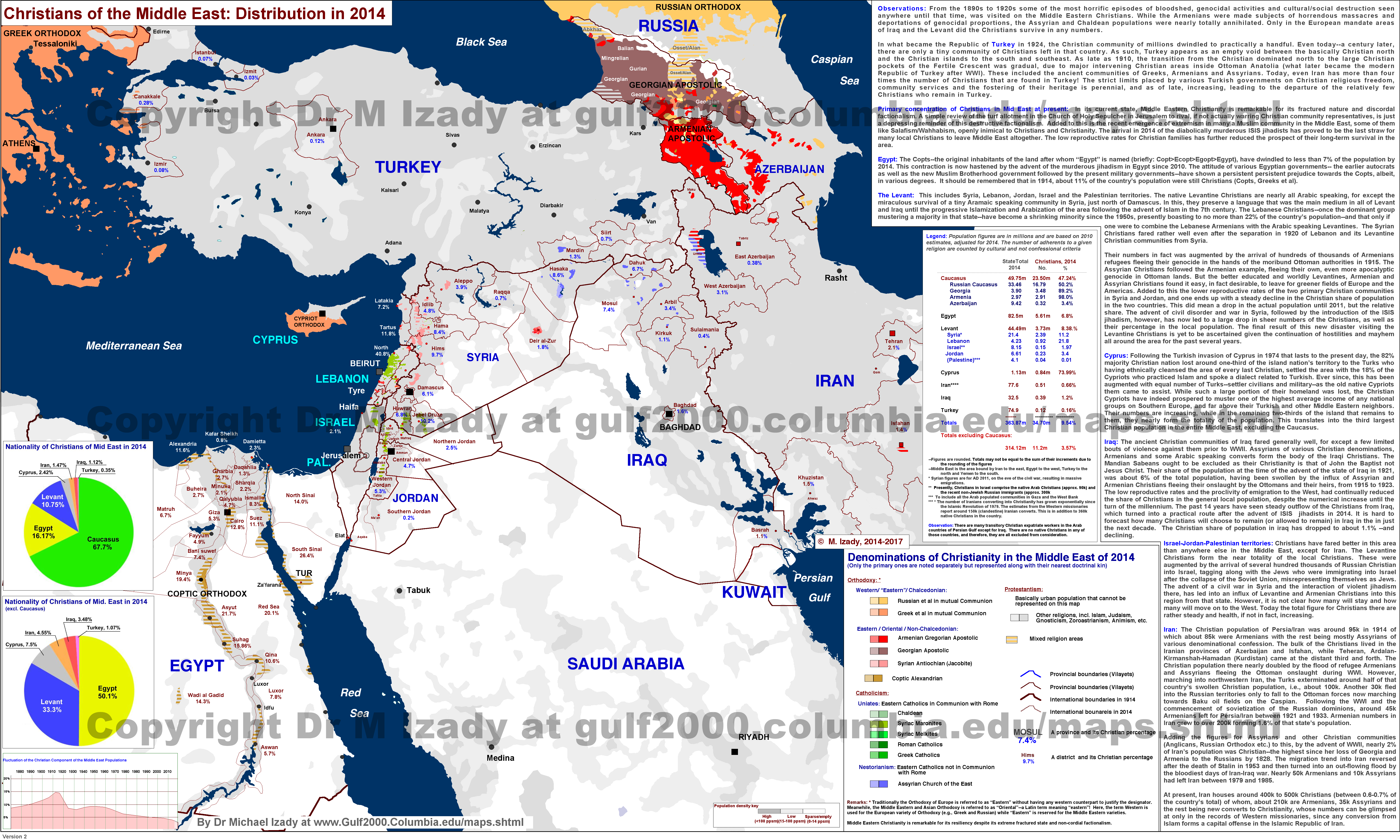
Levantine Christian groups are plenty and include Greek Orthodox (Antiochian Greek), Syriac Orthodox, Eastern Catholic (Syriac Catholic, Melkite and Maronite), Roman Catholic (Latin), Nestorian, and Protestant. Armenians mostly belong to the Armenian Apostolic Church. There are also Levantines or Franco-Levantines who adhere to Roman Catholicism. There are also Assyrians belonging to the Assyrian Church of the East and the Chaldean Catholic Church.[38]
Other religious groups in the Levant include Jews, Samaritans, Yazidis and Druze.[39]
In addition, this region has a number of sites that are of religious significance for Abrahamic religions, such as Masjid Al-Aqsa,[40] the Church of the Holy Sepulchre,[41] the Western Wall in Jerusalem, Sayyidah Zainab Mosque in Damascus and Antioch in Hatay.
Language

Most populations in the Levant speak Levantine Arabic (Template:Lang, Template:Transl), usually classified as the varieties North Levantine Arabic in Lebanon, Syria, and parts of Turkey, and South Levantine Arabic in Palestine and Jordan. Each of these encompasses a spectrum of regional or urban/rural variations. In addition to the varieties normally grouped together as "Levantine", a number of other varieties and dialects of Arabic are spoken in the Levant area, such as Levantine Bedawi Arabic and Mesopotamian Arabic.[42]
Among the languages of Israel, the official language is Hebrew; Arabic was until July 19, 2018, also an official language.[43] The Arab minority, in 2018 about 21% of the population of Israel,[43] speaks a dialect of Levantine Arabic essentially indistinguishable from the forms spoken in the Palestinian territories.
Of the languages of Cyprus, the two official languages are Turkish and Greek. The most used languages by population are Greek in the south followed by Turkish in the north. Two minority languages are recognized: Armenian, and Cypriot Maronite Arabic, a hybrid of mostly medieval Arabic vernaculars with strong influence from contact with Turkish and Greek, spoken by approximately 1,000 people.[44]
Some communities and populations speak Aramaic, Greek, Armenian, Circassian, French, Russian, or English.Template:Citation needed
See also
Overlapping regional designations
Subregional designations
Others
- French post offices in the Ottoman Empire ("Levant" stamps)
- History of the Levant
- Islamic State of Iraq and the Levant (Referred to in current events as ISIL or ISIS)
- Levantine Sea
- Levantines (Latin Christians), Catholic Europeans in the Levant
Other places in the east of a larger region
- Levante, Spain
- Riviera di Levante, Italy
Explanatory notes
- ↑ 1.0 1.1 Gasiorowski, Mark (2016). The Government and Politics of the Middle East and North Africa. p. 5: "... today the term Levantine can describe shared cultural products, such as Levantine cuisine or Levantine archaeology". Template:Isbn.
- ↑ 2.00 2.01 2.02 2.03 2.04 2.05 2.06 2.07 2.08 2.09 2.10 Steiner & Killebrew, p. 9 Template:Webarchive: "The general limits ..., as defined here, begin at the Plain of 'Amuq in the north and extend south until the Wâdī al-Arish, along the northern coast of Sinai. ... The western coastline and the eastern deserts set the boundaries for the Levant ... The Euphrates and the area around Jebel el-Bishrī mark the eastern boundary of the northern Levant, as does the Syrian Desert beyond the Anti-Lebanon range's eastern hinterland and Mount Hermon. This boundary continues south in the form of the highlands and eastern desert regions of Transjordan."
- ↑ 3.0 3.1 Template:Harvnb.
- ↑ 4.00 4.01 4.02 4.03 4.04 4.05 4.06 4.07 4.08 4.09 Cite error: Invalid
<ref>tag; no text was provided for refs namedOEAGR - ↑ 5.0 5.1 5.2 5.3 Cite error: Invalid
<ref>tag; no text was provided for refs namedEncarta - ↑ Pierre-Louis Gatier, E. Gubel, Philippe Marquis. The Levant History and Archaeology in the Eastern Mediterranean, Könemann, Page 7
- ↑ Template:Harvnb; Template:Harvnb;
- Amy Chua (2004), World on Fire: How Exporting Free Market Democracy Breeds Ethnic Hatred and Global Instability, p. 212;
- Mandyam Srinivasan, Theodore Stank, Philippe-Pierre Dornier, Kenneth Petersen (2014), Global Supply Chains: Evaluating Regions on an EPIC Framework – Economy, Politics, Infrastructure, and Competence: "EPIC" Structure – Economy, Politics, Infrastructure, and Competence, p. 3;
- Ayubi, Nazih N. (1996), Over-stating the Arab State: Politics and Society in the Middle East p. 108;
- David Thomas, Alexander Mallett (2012), Christian–Muslim Relations: A Bibliographical History. Volume 4 (1200–1350), p. 145;
- Jeff Lesser (1999), Negotiating National Identity: Immigrants, Minorities, and the Struggle for Ethnicity in Brazil p. 45
- ↑ 8.0 8.1 8.2 8.3 8.4 8.5 Steiner & Killebrew, p. 2 Template:Webarchive.
- ↑ LEVANT archaic The eastern part of the Mediterranean with the islands and neighbouring countries. New Oxford Dictionary of English, 2nd ed., revised, 2005.
- ↑ "LEVANT, THE". "A general term formerly given to the E shores of the Mediterranean Sea from W Greece to Egypt". The Penguin Encyclopedia, revised 2nd ed., 2004.
- ↑ LEVANT, (vieilli) Le Levant: les pays, les régions qui sont au levant (par rapport à la France) et spécialt. les régions de la Méditerrranée orientale. Le Nouveau Petit Robert de la langue française, (1993 revised ed.).
- ↑ Thomas Evan Levy, Historical Biblical Archaeology and the Future: The New Pragmatism, Routledge, 2016 Template:Isbn. Thomas E. Levy, "The New Pragmatism", p. 8: "after 1994, it is possible to see an increase in the use of the less geographically specific and more political [sic] neutral words 'Levant' or 'Levantine' in scholarly citations.... It is important to highlight the pedigree of the term 'Syro-Palestinian' and its gradual replacement by the term 'Levant' or 'Levantine' because the latter is a more culturally and politically neutral term that more accurately reflects the tapestry of countries and peoples of the region, without assuming directionality of cultural influence.". Aaron A. Burke, "The Archaeology of the Levant in North America: The Transformation of Biblical and Syro-Palestinian Archaeology" p. 82ff: "A number of factors account for the gradual emergence during the past two decades of what is now widely identified as Levantine archaeology in North America... a growing consensus regarding the appropriate terminology... archaeological field research in the Levant"
- ↑ William G. Dever, The Lives of Ordinary People in Ancient Israel: When Archaeology and the Bible Intersect, 2012, Template:Isbn, p. 249: "Today, however, the discipline is often called Palestinian, Syro-Palestinian, or Levantine archaeology."
- ↑ Steiner & Killebrew (2013). p. 1-2.
- ↑ Michel Elias Andraos, "Levantine Catholic Communities in the Diaspora at the Intersection of Many Identities and Worlds", in Michael L. Budde, Scattered and Gathered: Catholics in Diaspora, 2017 Template:Isbn p. 24: "The word 'Levantine' in the title is used on purpose instead of the 'Middle East' or the 'Near East'.... I use 'Levantine' more than the two other designations, because this is the term being used more often nowadays by Christian communities in the Middle East to describe their shared identity as al-maseeheyoun al-mashriqeyoun, Levantine Christians"
- ↑ 16.0 16.1 The Ancient Levant, UCL Institute of Archaeology, May 2008
- ↑ Egyptian Journal of Geology, Volume 42, Issue 1, p. 263, 1998
- ↑ Ancient Ashkelon – National Geographic Magazine. Ngm.nationalgeographic.com(2002-10-17). Retrieved 2011-10-17.
- ↑ The state of Israel: Internal influence driving change. BBC News(2011-11-06).
- ↑ Orfalea, Gregory (2006). The Arab Americans: A History. Olive Branch Press. Northampton, MA. Page 249.
- ↑ 21.0 21.1 Levant. Retrieved 2012-07-27.
- ↑ Oxford English Dictionary, 2nd edition
- ↑ Oxford Latin Course Part III{{#if:|, {{{last}}}}
- ↑ Journal of Levantine Studies. The Van Leer Jerusalem Institute. Retrieved 30 January 2014.
- ↑ Template:Harvnb.
- ↑ e.g., "The Levant Crisis: Syria, Iraq, and the Region", Australian National University [1] Template:Webarchive; Center for Strategic and International Studies, "Egypt and the Levant", 2017 [2] Template:Webarchive; Michael Kerr, Craig Larkin, eds., The Alawis of Syria, 2015 Template:Isbn
- ↑ Council for British Research in the Levant homepage. Cbrl.org.uk(2006-11-28). Retrieved 2010-07-05.
- ↑ Biblical and Levantine studies Template:Webarchive, UCLA
- ↑ About JLS. Journal of Levantine Studies.
- ↑ Dever, William G. "Syro-Palestinian and Biblical Archaeology", pp. 1244–1253.
- ↑ Sharon, Ilan "Biblical archaeology" in Encyclopedia of Archaeology Elsevier.
- ↑ Anat Lapidot-Firilla, "Editor's Note", Journal of Levantine Studies 1:1:5-12 (Summer 2011) full text Template:Webarchive
- ↑ Franck Salameh, "From the Editors", The Levantine Review 1:1:1-6 (Spring 2012), Template:Doi, full text Template:Webarchive
- ↑ Isis, Isil, IS or Daesh? One group, many names(2 December 2015). Retrieved 21 July 2018.
- ↑ A Genetic History of the Near East from an aDNA Time Course Sampling Eight Points in the Past 4,000 Years. American Journal of Human Genetics({Template:Year).
- ↑ The Great Arab Conquests: How the Spread of Islam Changed the World We Live In{{#if:Kennedy|, Kennedy}. Da Capo Press(2007). ISBN 978-0-306-81728-1
- ↑ A History of Islamic Societies{{#if:Lapidus|, Lapidus}. Cambridge University Press(13 October 2014). ISBN 978-0-521-51430-9
- ↑ Christian Population of Middle East in 2014. The Gulf/2000 Project, School of International and Public Affairs of Columbia University(2017). Retrieved 2018-08-31.
- ↑ Ethnic Groups of Africa and the Middle East: An Encyclopedia{{#if:|, {{{last}}}}. Abc-Clio(2011-10-31). ISBN 978-1-59884-362-0
- ↑ The Holy Land, Jerusalem and Al-Aqsa Mosque in the Qur'an, Sunnah and other Islamic Literary Source.
- ↑ Church of the Holy Sepulchre, Jerusalem. Sacred-destinations.com(2010-02-21). Retrieved 2012-07-07.
- ↑ Jordan and Syria. Ethnologue. Retrieved 2018-07-21.
- ↑ 43.0 43.1 Israeli Law Declares the Country the 'Nation-State of the Jewish People'. The New York Times(19 July 2018). Retrieved 2018-07-21.
- ↑ Encyclopedia of Arabic Language and Linguistics{{#if:Versteegh|, Versteegh}. Brill(2011). ISBN 978-90-04-14976-2
Citations
General and cited references
- [{{{url}}} The Mediterranean and the Mediterranean World in the Age of Phillip II].Template:Full citation needed
- [{{{url}}} Historical Biblical Archaeology and the Future: The New Pragmatism]. Equinox.
- [{{{url}}} Encarta]. Microsoft(2009).
- [{{{url}}} Ancient Greece and Rome]. Oxford University Press, Incorporated(31 December 2009).
- [{{{url}}} Towns in Ancient Israel and in the Southern Levant]. Peeters Publishers.
- [{{{url}}} The Semitic Languages: An International Handbook]. Walter de Gruyter.
- [{{{url}}} Oxford Dictionaries Online]. Oxford University Press.
- The Oxford Handbook of the Archaeology of the Levant: c. 8000–332 BCE{{#if:|, {{{last}}}}. OUP Oxford(2013). ISBN 978-0-19-921297-2
Further reading
- Julia Chatzipanagioti: Griechenland, Zypern, Balkan und Levante. Eine kommentierte Bibliographie der Reiseliteratur des 18. Jahrhunderts. 2 Vol. Eutin 2006. Template:ISBN.
- Levantine Heritage site. Includes many oral and scholarly histories, and genealogies for some Levantine Turkish families.
- Philip Mansel, Levant: Splendour and Catastrophe on the Mediterranean, London, John Murray, 11 November 2010, hardback, 480 pages, Template:ISBN, New Haven, Yale University Press, 24 May 2011, hardback, 470 pages, Template:ISBN.