
Template:Infobox religious building The Alamgir Mosque, also known as the Aurangzeb's Mosque (Template:Langx), is a mosque in Varanasi, Uttar Pradesh, India.Template:Sfn The site was originally an ancient Hindu temple known as Bindu Madhav Temple, originally dedicated to Vishnu. The temple was destroyed in 1673 by Muslim Mughal Emperor Aurangzeb who built the mosque on the ruins of the temple.[1][2][3] The mosque is located at a prominent site above the Panchaganga Ghat. The ghat has broad steps that go down to the Ganges.Template:Sfn
Overview
Aurangzeb conquered Varanasi in 1669 and constructed a mosque named Alamagir Mosque, in the name of his own honorary title "Alamgir", which he had adopted after becoming the emperor of the Mughal empire.[4]
The minarets could not withstand the test of time and in the 19th century, an English scholar James Prinsep had to restore them. In 1948 one of the minarets collapsed killing a few people around the time of the floods. Later the government pulled down the other minaret, for security reasons.Template:SfnTemplate:Sfn
The mosque is architecturally a blend of Indo-Islamic and Hindu architecture.Template:Sfn The mosque has high domes and minarets.Template:SfnTemplate:Sfn Two of its minarets were damaged; one minaret collapsed killing a few people and the other was officially brought down owing to stability concerns.Template:Sfn The Panchaganga Ghat where the mosque is situated is where five streams are said to join. In October lamps are lighted on top of a bamboo staff as a mark of guidance to the ancestors.Template:Sfn
Gallery
-
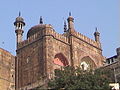 Exterior view
 -
 Interior view


See also
References
- ↑ Varanasi Guru | Book Heritage Walks & Boat Rides In Kashi(2018-01-30). Retrieved 2026-01-19.
- ↑ Controversy arises as BJP MLA Neelkanth Tiwari cleans Alamgir mosque in Varanasi. The Times of India(2025-04-08). Retrieved 2026-02-10.
- ↑ Another plea seeking 'puja' rights at Kashi Madhav temple filed. The Times of India(2022-06-01). Retrieved 2026-02-10.
- ↑ India Pictorial and Descriptive{{#if:|, {{{last}}}}. T. Nelson and Sons(1888)
Bibliography
- India – The North: Forts, Palaces, the Himalaya Dream Trip{{#if:|, {{{last}}}}. Footprint Travel Guides(27 September 2013). ISBN 978-1-907263-74-3
- India, a Travel Survival Kit{{#if:|, {{{last}}}}. Lonely Planet(1984). ISBN 978-0-908086-54-2
- Fodor's Exploring India{{#if:|, {{{last}}}}. Fodor's Travel Publications(2001). ISBN 978-0-679-00707-4
- Rediscovery of India, The: A New Subcontinent{{#if:Hussain|, Hussain}. Orient Blackswan(1 January 1999). ISBN 978-81-250-1595-6
- Pilgrimage Centres of India{{#if:Kumar|, Kumar}. Diamond Pocket Books (P) Ltd.(2003). ISBN 978-81-7182-185-3
- Innovation Sutra: The Secret of Good Business and a Good Life{{#if:Shetty|, Shetty}. Penguin Books Limited(1 May 2014). ISBN 978-93-5118-696-0
Further reading
- Architectural Heritage Revisited: A Holistic Engagement of its Tangible and Intangible Constituents{{#if:Vit-Suzan|, Vit-Suzan}. Ashgate Publishing, Ltd.(28 March 2014). ISBN 978-1-4724-2064-0