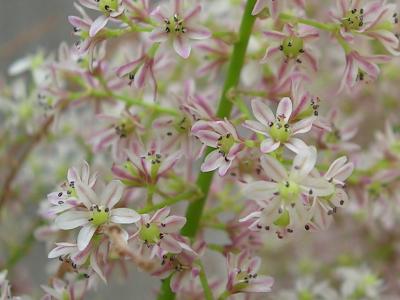
Asparagus racemosus (satavar, shatavari, or shatamull, shatawari) is a species of asparagus common throughout India and the Himalayas.Template:Citation needed and northern Australia.[1] It grows Template:Convert tall and prefers to take root in gravelly, rocky soils high up in piedmont plains, at Template:Convert elevation.[2] It was botanically described in 1799.[3] Because of its multiple uses, the demand for Asparagus racemosus is constantly on the rise. Due to destructive harvesting, combined with habitat destruction, and deforestation, the plant is now considered "endangered" in its natural habitat.Template:Citation needed
Description

Asparagus racemosus is a climber having stems up to 4 m long. Its roots are both fibrous and tuberous.[1]
Shatavari has small pine-needle-like phylloclades (photosynthetic branches) that are uniform and shiny green. In July, it produces minute, white flowers on short, spiky stems, and in September it fruits, producing blackish-purple, globular berries. It has an adventitious root system with tuberous roots that measure about one metre in length, tapering at both ends, with roughly a hundred on each plant.Template:Citation needed
Uses
Shatavari is used in Indian traditional medicine.[4][5][6] Despite its long history of use in Ayurveda, no high-quality clinical evidence exists to support using shatavari as a therapy for any disease.[7][4] Studies of its effects on lactation have shown mixed results.[7] Its safety has not been well-studied, with two small trials finding no adverse effects in mothers or their babies.[7] Constituents of shatavari include steroidal saponins, mucilage, and alkaloids.[7]
Australian aboriginal uses
The roots of Asparagus racemosa are boiled and give a liquid used as an external wash to treat colds and other sicknesses, by the aborigines of the Moyle River area in the Northern Territory.[8] (The Ngan'gi name for the plant is yerrwuwu.)[8]
Chemical constituents
Asparagamine A, a polycyclic alkaloid was isolated from the dried roots[9][10] and subsequently synthesized to allow for the construction of analogs.[11]
Steroidal saponins, shatavaroside A, shatavaroside B, filiasparoside C, shatavarins, immunoside, and schidigerasaponin D5 (or asparanin A) were isolated from the roots of Asparagus racemosus.[12][13]
Also known is the isoflavone 8-methoxy-5,6,4'-trihydroxyisoflavone 7-O-β-D-glucopyranoside.[14]
See also
- Shatavar Vatika Herbal Park, Hisar, Haryana—a herbal park in India for the research, preservation and production of Ayurveda products, including shatavari
References
- ↑ 1.0 1.1 Flora of Australia{{#if:H. T. Clifford, J. G. Conran|, H. T. Clifford, J. G. Conran}. Australian Biological Resources Study, Department of Agriculture, Water and the Environment(2020)
- ↑ LILIACEAE – Famine Foods. Purdue University(February 26, 1998).
- ↑ Cite error: Invalid
<ref>tag; no text was provided for refs namedgrin - ↑ 4.0 4.1 The Clinician's Handbook of Natural Medicine{{#if:|, {{{last}}}}. Churchill Livingstone(2015). ISBN 9780702055140
- ↑ Clinical Naturopathic Medicine{{#if:|, {{{last}}}}. Elsevier(2018). ISBN 9780729542425
- ↑ Asparagus racemosus—an update. Indian Journal of Medical Sciences({Template:Date).
- ↑ 7.0 7.1 7.2 7.3 Wild asparagus. LactMed. National Library of Medicine, US National Institutes of Health(16 August 2021).
- ↑ 8.0 8.1 Template:Cite Q
- ↑ The Ley Group: Combinatorial Chemistry and total synthesis of natural products Template:Webarchive
- ↑ ChemInform Abstract: Structure of Asparagamine A (I), a Novel Polycyclic Alkaloid from Asparagus racemosus. ChemInform({Template:Year).
- ↑ Total Synthesis Of The Antitumor Agent Asparagamine A retrieved 11-02-2011 Template:Webarchive
- ↑ Steroidal saponins from Asparagus racemosus. Chemical & Pharmaceutical Bulletin({Template:Year).
- ↑ Steroidal saponins from the roots of Asparagus racemosus. Phytochemistry({Template:Year).
- ↑ A new isoflavone from the roots of Asparagus racemosus. Fitoterapia({Template:Year).