
Template:Infobox protected area
Eaglenest or Eagle's Nest Wildlife Sanctuary is a protected area of India in the Himalayan foothills of West Kameng District, Arunachal Pradesh. It conjoins Sessa Orchid Sanctuary to the northeast and Pakhui Tiger Reserve across the Kameng river to the east. Altitude ranges are extreme: from Template:Convert to Template:Convert.[1] It is a part of the Kameng Elephant Reserve.
Eaglenest is notable as a prime birding site due to the extraordinary variety, numbers and accessibility of species.
Eaglenest derives its name from Red Eagle Division of the Indian army which was posted in the area in the 1950s.[2]
Geography and climate
Eaglenest and Sessa Orchid Sanctuary together occupy a rough east–west rectangle with Sessa occupying the northeast quadrant. Eaglenest is bounded to the north by Eaglenest Ridge and the reserved forests of the Bugun community (Lama Camp area). Eaglenest adjoins Tawang district to the north. The Bhalukpong–Bomdila highway (and Pakke immediately beyond) are its eastern boundary. There are no distinct geographical features delineating its western boundary along the Bhutan border and the southern boundary at about 27° N latitude.
Eaglenest and Sessa ridges rise to Template:Convert and Template:Convert respectively and are the first major barriers to the monsoon as it moves north from the plains of Assam. These ridges get over Template:Convert of rain on the southern slopes and about Template:Convert on the northern ones.[3]
The eastern half of Eaglenest and Sessa sanctuaries is drained by the Tippi Naala (Tippi river) which joins the Kameng river at Tippi village on the Bhalukpong–Bomdila highway. Several smaller streams including Buhiri Nadi and Dihung Nadi in the western half of the area flow down to join the Brahmaputra separately.[4][5]
Eaglenest Wildlife Sanctuary is part of the Kameng protected area complex (KPAC), the largest contiguous closed-canopy forest tract of Arunachal Pradesh, which includes Eaglenest, Pakke, Sessa, Nameri, and Sonai Rupai sanctuaries and associated reserved forest blocks. The complex covers 3500 km2 in area and ranges from Template:Convert to Template:Convert in altitude.

and Sessa Sanctuaries
Eaglenest has an unpaved road running from its base to Eaglenest pass at Template:Convert allowing good access to the entire altitudinal range, making it accessible to the military, scientists and ecotourists.[6]
Fauna

Birds

Eaglenest Wildlife Sanctuary is well known as a major birding area.[3] It is home to at least 454 species of birds including 3 cormorants, 5 herons, black stork, Oriental white (black-headed) ibis, 4 ducks, 20 hawks, eagles, kites, harriers and vultures, 3 falcons, 10 pheasants, junglefowl, quail, and peafowl, black-necked crane, 3 rails, 6 plovers, dotterels, and lapwings, 7 waders, ibisbill, stone-curlew (Eurasian thick-knee), small pratincole, 2 gulls, 14 pigeons, 3 parrots, 15 cukoos, 10 owls, 2 nightjars, 4 swifts, 2 trogons, 7 kingfishers, 2 bee-eaters, 2 rollers, hoopoes, 4 hornbills, 6 barbets, 14 woodpeckers, 2 broadbills, 2 pittas, 2 larks, 6 martins, 7 wagtails, 9 shrikes, 9 bulbuls, 4 fairy-bluebirds, 3 shrike, brown dipper, 3 accentors, 46 thrushes, 65 Old World flycatchers, 6 parrotbills, 31 warblers, 25 flycatchers, 10 tits, 5 nuthatches, 3 treecreepers, 5 flowerpeckers, 8 sunbirds, Indian white-eye, 3 bunting, 14 finches, 2 munia, 3 sparrows, 5 starlings, 2 orioles, 7 drongos, ashy woodswallow and 9 jays.[7] The sanctuary has the distinction of having three tragopan species, perhaps unique in India.[8]
Eaglenest is the site where Bugun liocichla was first discovered in 1995 and again observed and described in 2006 by Ramana Athreya.[9]

Herpetofauna

Eaglenest Wildlife Sanctuary is home to a wide variety of herpetofauna including at least 34 species of amphibians, 24 species of snakes and 7 species of lizards including 3 geckos, 3 agamids and 4 skinks. Abor Hills agama was rediscovered at Eaglenest after 125 years. Other rare species include the Darjeeling false-wolfsnake which was only known to science through five specimens, Anderson's mountain lizard, Günther's kukri snake, common slug snake, and keelback snakes which have not been definitively identified.
Mammals
Eaglenest Wildlife Sanctuary provides habitat to clouded leopard, marbled cat, Asian golden cat and leopard cat.[10] Other mammal species include the endangered capped langur, red panda, Asiatic black bear and the vulnerable, Arunachal macaque and gaur. It was here that a new taxon of primate was discovered in 1997 by noted primatologist of northeast India Dr Anwaruddin Choudhury,[11] but he thought it to be a new subspecies of Tibetan or Pere David's macaque.[12] It was described as a new species, i.e., Arunachal macaque in 2004.[13] The highest elevation, 11,000 ft that the wild Asian elephants reach anywhere is partly in this sanctuary.[14]
Butterflies

Eaglenest Wildlife Sanctuary is home to at least 165 species of butterflies including Bhutan glory, grey admiral, scarce red-forester, dusky labyrinth, tigerbrown, jungle-queen sp, white-edged bushbrown, and white owl.[15]
Flora

In Eaglenest Wildlife Sanctuary there is a camp named Sessni which in Nepali language means nettle. The place is filled with poisonous elephant nettles on either side of the road.[16]
Conservation

Eaglenest Wildlife Sanctuary is physically protected from timber and animal poaching only by its isolation and the poor quality of the one lane road leading inside it. It is administered by the Divisional Forest Officer, Shergaon Forest Division, Rupa (Millo Tasser, IFS). He is assisted by a Range Forest Office in Singchung and Beat Forest Offices in Ramalingam (close to Singchung) and Khellong. The absence of any settlement inside Eaglenest has minimized any problem of hunting.
The Critical Ecosystem Partnership Fund (CEPF), a consortium of major international and regional organizations, has identified the Eastern Himalayan region around Arunachal Pradesh (Nepal, Bhutan and all of Northeast India) as a critical global biodiversity rich area deserving of conservation focus. They identified the North Bank Landscape (i.e., north bank of Brahmaputra, extending up the Eaglenest slopes) and the Tawang region as worthy of particular focus.[17]
Eaglenest Wildlife Sanctuary is in the Conservation International Himalaya Biodiversity Hotspot area.[18]
BirdLife International has designated Eaglenest and Sessa sanctuaries as an Important Bird Area (IBA IN344), with Blyth's tragopan identified as a vulnerable species of the area.[19]
This area is extremely important for the continued well-being of the Asian elephant. Elephants regularly move up from the Assam plains to the Eaglenest ridge at 3250 m in summer, perhaps the highest altitude that elephants reach in India. Extensive clearing of forests through illegal encroachments in Assam adjacent to Eaglenest has exacerbated elephant-human conflict in the plains; it has also meant that elephants now have to stay longer in the Eaglenest area and may lead to depletion of their food resource by dominating the rate of regeneration.
References
- ↑ See Map 1 Template:Webarchive, Topo map
- ↑ Athreya Ramana (3/13/2005) Kaati Trust, Pune Eaglenest Wildlife Sanctuary Template:Webarchive
- ↑ 3.0 3.1 Choudhury A.U. (2003). Birds of Eaglenest Wildlife Sanctuary and Sessa Orchid Sanctuary, Arunachal Pradesh, India. Forktail 19:1-13
- ↑ Topographic map
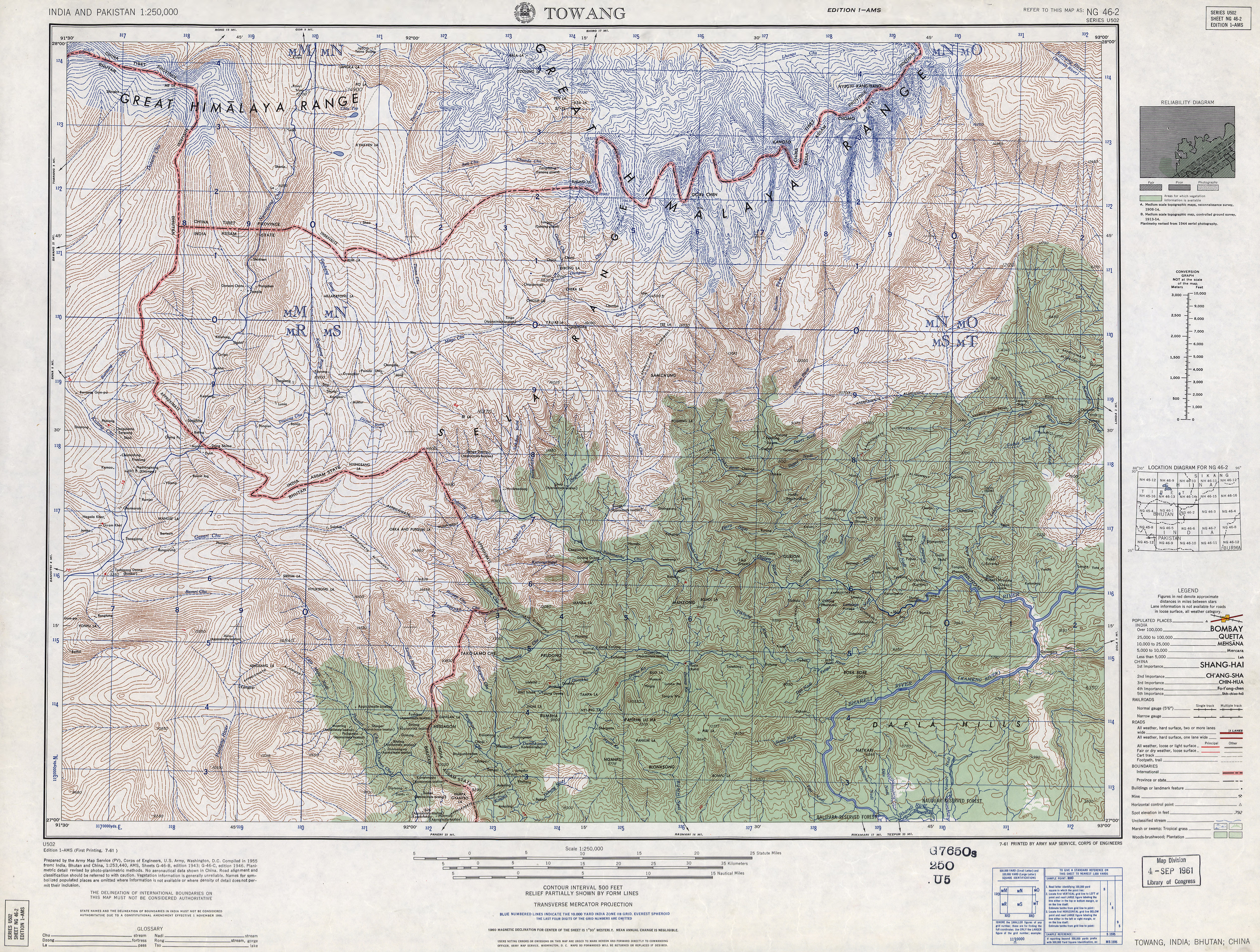
- ↑ Army Map Service, Corps of Engineers (1955) Series U502, Sheet NG-46-2, Towang, India; Bhutan; China, topographic map 1:250,000, retrieved 10/2/2007 Topographic map
- ↑ Official website of West Kameng District (6/21/2007) Geography Template:Webarchive
- ↑ Athreya Ramana (4/13/2005) Birds of W. Arunachal Pradesh, Checklist, Kaati Trust, Pune Eaglenest record (E) Template:Webarchive
- ↑ Choudhury, A.U. (2005). Distribution, status and conservation of galliformes in north-east India. Pp. 38-56 in: Fuller, R.A. & Browne, S.J. (eds) 2005. Galliformes 2004. Proceedings of the 3rd International Galliformes Symposium. World Pheasant Association, Fordingbridge, UK.
- ↑ Athreya, R. (9/8/2006) A new species of Liocichla (Aves: Timaliidae) from Eaglenest Wildlife Sanctuary, Arunachal Pradesh, India Indian Birds 2 (4): p82-94
- ↑ A tale of tails – an attempt to decipher small cat distributions by tail lengths. Small Wild Cat Conservation News({Template:Year).
- ↑ The mystery macaques of Arunachal Pradesh. Rhino Foundation Newsletter({Template:Year).
- ↑ https://www.britannica.com/animal/Pere-Davids-macaque
- ↑ Macaca munzala: a new species from western Arunachal Pradesh, northeastern India. International Journal of Primatology({Template:Year).
- ↑ Choudhury, A.U. (1999). Status and Conservation of the Asian elephant Elephas maximus in north-eastern India. Mammal Review 29(3): 141-173.
- ↑ Athreya, R. (2006) Eaglenest Biodiversity Project − I (2003–2006): A report submitted to the Forest Department of the Government of Arunachal Pradesh, India, and the Rufford-Maurice-Laing Foundation (UK). Kaati Trust, Pune. Conservation resources for Eaglenest wildlife sanctuary.
- ↑ In search of the Bugun Liocichla and other parables from Eaglenest.
- ↑ Critical Ecosystem Partnership Fund, Project database Eastern Himalayas Region Strategic Directions Template:Webarchive
- ↑ Conservation International (2007) Himalaya - conservation action and protected areas, retrieved 10/1/2007 Himalaya - conservation action and protected areas Template:Webarchive
- ↑ BirdLife International (2006) BirdLife IBA Factsheet, retrieved 10/1/2007 IN344 Eaglenest and Sessa Sanctuaries

Further reading
- Bugun Liocichla Liocichla bugunorum - Male
- Ramana Athreya's trip report in 1996 describing the new species
- The Eaglenest Biodiversity project
- The Bugun Liocichla, Discovery of new Bird Species in India: BNHSTemplate:Dead link
External sources
Template:Commons category
Butterflies from Eaglenest-Sessa-Pakke 72 photographs
Pictures from Eaglenest Wildlife Sanctuary - Wildlife Photographs