
About: the British East India Company
The East India Company (EIC)Template:Efn was an English, and later British, joint-stock company founded in 1600 and dissolved in 1874.[1] It was formed to trade in the Indian Ocean region, initially with the East Indies (the Indian subcontinent and Southeast Asia), and later with East Asia. The company seized control of large parts of the Indian subcontinent and colonised parts of Southeast Asia and Hong Kong. At its peak, the company was the largest corporation in the world by various measures. The EIC had its own armed forces in the form of the company's three Presidency armies, totalling about 260,000 soldiers, twice the size of the British army at the time.[2] The operations of the company had a profound effect on the global balance of trade, almost single-handedly[3] reversing the trend of eastward drain of Western bullion, seen since Roman times.[4]
Originally chartered as the "Governor and Company of Merchants of London Trading into the East-Indies",[5][6] the company rose to account for half of the world's trade during the mid-1700s and early 1800s,[7] particularly in basic commodities including cotton, silk, indigo dye, sugar, salt, spices, saltpetre, tea, and opium. The company also ruled the beginnings of the British Empire in India.[7][8]
The company eventually came to rule large areas of India, exercising military power and assuming administrative functions. Company rule in India effectively began in 1757 after the Battle of Plassey and lasted until 1858. Following the Indian Rebellion of 1857, the Government of India Act 1858 led to the British Crown assuming direct control of India in the form of the new British Raj.
The company subsequently experienced recurring problems with its finances, despite frequent government intervention. It was dissolved in 1874 under the terms of the East India Stock Dividend Redemption Act enacted one year earlier, as the Government of India Act had by then rendered it vestigial, powerless, and obsolete. The official government machinery of the British Raj had assumed its governmental functions and absorbed its armies.
Origins
Template:FurtherTemplate:Colonial India

In 1577, Francis Drake set out on an expedition from England to plunder Spanish settlements in South America in search of gold and silver. Sailing in the Golden Hind he achieved this, and then sailed across the Pacific Ocean in 1579, known then only to the Spanish and Portuguese. Drake eventually sailed into the East Indies and came across the Moluccas, also known as the Spice Islands, and met Sultan Babullah. In exchange for linen, gold and silver, a large haul of exotic spices including cloves and nutmeg were obtained – the English initially not realising their huge value.[9] Drake returned to England in 1580 and became a hero; his circumnavigation raised an enormous amount of money for England's coffers, and investors received a return of some 5,000 percent. Thus started an important element in the eastern design during the late sixteenth century.[10]
Soon after the defeat of the Spanish Armada in 1588, the captured Spanish and Portuguese ships and cargoes enabled English voyagers to travel the globe in search of riches.[11] London merchants presented a petition to Queen Elizabeth I for permission to sail to the Indian Ocean.[12] The aim was to deliver a decisive blow to the Spanish and Portuguese monopoly of far-eastern trade.[13] Elizabeth granted her permission and on 10 April 1591, James Lancaster in the Template:Ship with two other ships, financed by the Levant Company[14] sailed from Torbay around the Cape of Good Hope to the Arabian Sea, becoming the first successful English expedition to India[14] via the Cape.[3]Template:Rp Having sailed around Cape Comorin to the Malay Peninsula, they preyed on Spanish and Portuguese ships there before returning to England in 1594.[12]
The biggest prize that galvanised English trade was the seizure of a large Portuguese carrack, the Madre de Deus, by Sir Walter Raleigh and the Earl of Cumberland at the Battle of Flores on 13 August 1592.[15] When she was brought in to Dartmouth she was the largest vessel ever seen in England and she carried chests of jewels, pearls, gold, silver coins, ambergris, cloth, tapestries, pepper, cloves, cinnamon, nutmeg, benjamin (a highly aromatic balsamic resin used for perfumes and medicines), red dye, cochineal and ebony.Template:Sfn Equally valuable was the ship's rutter (mariner's handbook) containing vital information on the China, India, and Japan trade routes.[15]
In 1596, three more English ships sailed east but all were lost at sea.[12] A year later however saw the arrival of Ralph Fitch, an adventurer merchant who, with his companions, had made a remarkable fifteen-year overland journey to Mesopotamia, the Persian Gulf, the Indian Ocean, India and Southeast Asia.[16] Fitch was consulted on Indian affairs and gave even more valuable information to Lancaster.[17]
History
Formation
In 1599, a group of prominent merchants and explorers met to discuss a potential East Indies venture under a royal charter. Besides Fitch and Lancaster,[3]Template:Rp the group included Stephen Soame, then Lord Mayor of London; Thomas Smythe, a powerful London politician and administrator, whose father had established the Levant Company; Sir John Wolstenholme; Richard Hakluyt, writer and apologist for British colonization of the Americas; and several other sea-farers who had served with Drake and Raleigh.[3]Template:Rp
On 22 September, the group stated their intention "to venture in the pretended voyage to the East Indies (the which it may please the Lord to prosper)" and to themselves invest £30,133 (over £4,000,000 in today's money).[18][19] Two days later, the "Adventurers" reconvened and resolved to apply to the Queen for support of the project.[19] Although their first attempt had not been completely successful, they sought the Queen's unofficial approval to continue. They bought ships for the venture and increased their investment to £68,373.
They convened again a year later, on 31 December 1600, and this time they succeeded; the Queen, responded favourably to a petition by "George, Earl of Cumberland and 218 others,[20] including James Lancaster, Sir John Harte, Sir John Spencer (both of whom had been Lord Mayor of London), the adventurer Edward Michelborne, the nobleman William Cavendish and other Aldermen and citizens.[21] She granted her charter to their corporation named Governor and Company of Merchants of London trading into the East Indies.[12] For a period of fifteen years, the charter awarded the company a monopoly[22] on English trade with all countries east of the Cape of Good Hope and west of the Straits of Magellan.[23] Any traders there without a licence from the company were liable to forfeiture of their ships and cargo (half of which would go to the Crown and half to the company), as well as imprisonment at the "royal pleasure".[24]
The charter named Thomas Smythe as the first governor[21]Template:Rp of the company, and 24 directors (including James Lancaster)[21]Template:Rp or "committees", who made up a Court of Directors. They, in turn, reported to a Court of Proprietors, who appointed them. Ten committees reported to the Court of Directors. By tradition, business was initially transacted at the Nags Head Inn, opposite St Botolph's church in Bishopsgate, before moving to East India House in Leadenhall Street.[25]
Early voyages to the East Indies
Sir James Lancaster commanded the first East India Company voyage in 1601 aboard Template:Ship.[26] The following year, whilst sailing in the Malacca Straits, Lancaster took the rich 1,200 ton Portuguese carrack Sao Thome carrying pepper and spices. The booty enabled the voyagers to set up two "factories" – one at Bantam on Java and another in the Moluccas (Spice Islands) before leaving.[27] They returned to England in 1603 to learn of Elizabeth's death but Lancaster was knighted by the new king, James I on account of the voyage's success.[28] By this time, the war with Spain had ended but the company had profitably breached the Spanish-Portuguese duopoly; new horizons opened for the English.[13]
In March 1604, Sir Henry Middleton commanded the Company's second voyage. General William Keeling, a captain during the second voyage, led the third voyage aboard Red Dragon from 1607 to 1610 along with Hector under Captain William Hawkins and Consent under Captain David Middleton.[29]
Early in 1608, Alexander Sharpeigh was made captain of the company's Ascension, and general or commander of the fourth voyage. Thereafter two ships, Ascension and Union (captained by Richard Rowles), sailed from Woolwich on 14 March 1608.[29] This expedition would be lost.[30]
| Year | Vessels | Total Invested £ | Bullion sent £ | Goods sent £ | Ships & Provisions £ | Notes |
|---|---|---|---|---|---|---|
| 1603 | 3 | 60,450 | 11,160 | 1,142 | 48,140 | |
| 1606 | 3 | 58,500 | 17,600 | 7,280 | 28,620 | |
| 1607 | 2 | 38,000 | 15,000 | 3,400 | 14,600 | Vessels lost |
| 1608 | 1 | 13,700 | 6,000 | 1,700 | 6,000 | |
| 1609 | 3 | 82,000 | 28,500 | 21,300 | 32,000 | |
| 1610 | 4 | 71,581 | 19,200 | 10,081 | 42,500 | |
| 1611 | 4 | 76,355 | 17,675 | 10,000 | 48,700 | |
| 1612 | 1 | 7,200 | 1,250 | 650 | 5,300 | |
| 1613 | 8 | 272,544 | 18,810 | 12,446 | ||
| 1614 | 8 | 13,942 | 23,000 | |||
| 1615 | 6 | 26,660 | 26,065 | |||
| 1616 | 7 | 52,087 | 16,506 |
Initially, the company struggled in the spice trade because of competition from the well-established Dutch East India Company. The English company opened a factory in Bantam on Java on its first voyage, and imports of pepper from Java remained an important part of the company's trade for twenty years. The Bantam factory closed in 1683.


English traders frequently fought their Dutch and Portuguese counterparts in the Indian Ocean. The company achieved a major victory over the Portuguese in the Battle of Swally in 1612, at Suvali in Surat. The company decided to explore the feasibility of a foothold in mainland India, with official sanction from both Britain and the Mughal Empire, and requested that the Crown launch a diplomatic mission.[31]
Foothold in India
Company ships docked at Surat in Gujarat in 1608.[32] The company's first Indian factory was established in 1611 at Masulipatnam on the Andhra Coast of the Bay of Bengal, and its second in 1615 at Surat.[33][32] The high profits reported by the company after landing in India initially prompted James I to grant subsidiary licences to other trading companies in England. However, in 1609, he renewed the East India Company's charter for an indefinite period, with the proviso that its privileges would be annulled if trade was unprofitable for three consecutive years.Template:Cn
In 1615, James I instructed Sir Thomas Roe to visit the Mughal Emperor Nur-ud-din Salim Jahangir (r. 1605–1627) to arrange for a commercial treaty that would give the company exclusive rights to reside and establish factories in Surat and other areas. In return, the company offered to provide the Emperor with goods and rarities from the European market. This mission was highly successful, and Jahangir sent a letter to James through Sir Thomas Roe:[31]
Expansion
Template:See also The company, which benefited from the imperial patronage, soon expanded its commercial trading operations. It eclipsed the Portuguese Estado da Índia, which had established bases in Goa, Chittagong, and Bombay – Portugal later ceded Bombay to England as part of the dowry of Catherine of Braganza on her marriage to King Charles II. The East India Company also launched a joint attack with the Dutch United East India Company (VOC) on Portuguese and Spanish ships off the coast of China that helped secure EIC ports in China,[34] independently attacking the Portuguese in the Persian Gulf Residencies primarily for political reasons.[35] The company established trading posts in Surat (1619) and Madras (1639).[36] By 1647, the company had 23 factories and settlements in India, and 90 employees.[37] The Crown turned Bombay over to the company in 1668, and the company established a presence in Calcutta in 1690.[36] The major factories became the walled forts of Fort William in Bengal, Fort St George in Madras, and Bombay Castle.Template:Cn
In 1634, the Mughal emperor Shah Jahan extended his hospitality to the English traders to the region of Bengal,[38] and in 1717 customs duties were completely waived for the English in Bengal. The company's mainstay businesses were by then cotton, silk, indigo dye, saltpetre, and tea. The Dutch were aggressive competitors and had meanwhile expanded their monopoly of the spice trade in the Straits of Malacca by ousting the Portuguese in 1640–1641. With reduced Portuguese and Spanish influence in the region, the EIC and VOC entered a period of intense competition, resulting in the Anglo-Dutch Wars of the 17th and 18th centuries.
Within the first two decades of the 17th century, the Dutch East India Company or Vereenigde Oostindische Compagnie, (VOC) was the wealthiest commercial operation in the world with 50,000 employees worldwide and a private fleet of 200 ships. It specialised in the spice trade and gave its shareholders 40% annual dividend.[39]
The British East India Company was fiercely competitive with the Dutch and French throughout the 17th and 18th centuries over spices from the Spice Islands. Some spices, at the time, could only be found on these islands, such as nutmeg and cloves; and they could bring profits as high as 400 percent from one voyage.[40]
The tension was so high between the Dutch and the British East Indies Trading Companies that it escalated into at least four Anglo-Dutch Wars:[40] 1652–1654, 1665–1667, 1672–1674 and 1780–1784.
Competition arose in 1635 when Charles I granted a trading licence to Sir William Courteen, which permitted the rival Courteen association to trade with the east at any location in which the EIC had no presence.[41]
In an act aimed at strengthening the power of the EIC, King Charles II granted the EIC (in a series of five acts around 1670) the rights to autonomous territorial acquisitions, to mint money, to command fortresses and troops and form alliances, to make war and peace, and to exercise both civil and criminal jurisdiction over the acquired areas.[42]
In 1689, a Mughal fleet commanded by Sidi Yaqub attacked Bombay. After a year of resistance the EIC surrendered in 1690, and the company sent envoys to Aurangzeb's camp to plead for a pardon. The company's envoys had to prostrate themselves before the emperor, pay a large indemnity, and promise better behaviour in the future. The emperor withdrew his troops, and the company subsequently re-established itself in Bombay and set up a new base in Calcutta.[43]
| Years | EIC | VOC | France | EdI | Denmark | Total | ||||
|---|---|---|---|---|---|---|---|---|---|---|
| Bengal | Madras | Bombay | Surat | EIC (total) | VOC (total) | |||||
| 1665–1669 | 7,041 | 37,078 | 95,558 | 139,677 | 126,572 | 266,249 | ||||
| 1670–1674 | 46,510 | 169,052 | 294,959 | 510,521 | 257,918 | 768,439 | ||||
| 1675–1679 | 66,764 | 193,303 | 309,480 | 569,547 | 127,459 | 697,006 | ||||
| 1680–1684 | 107,669 | 408,032 | 452,083 | 967,784 | 283,456 | 1,251,240 | ||||
| 1685–1689 | 169,595 | 244,065 | 200,766 | 614,426 | 316,167 | 930,593 | ||||
| 1690–1694 | 59,390 | 23,011 | 89,486 | 171,887 | 156,891 | 328,778 | ||||
| 1695–1699 | 130,910 | 107,909 | 148,704 | 387,523 | 364,613 | 752,136 | ||||
| 1700–1704 | 197,012 | 104,939 | 296,027 | 597,978 | 310,611 | 908,589 | ||||
| 1705–1709 | 70,594 | 99,038 | 34,382 | 204,014 | 294,886 | 498,900 | ||||
| 1710–1714 | 260,318 | 150,042 | 164,742 | 575,102 | 372,601 | 947,703 | ||||
| 1715–1719 | 251,585 | 20,049 | 582,108 | 534,188 | 435,923 | 970,111 | ||||
| 1720–1724 | 341,925 | 269,653 | 184,715 | 796,293 | 475,752 | 1,272,045 | ||||
| 1725–1729 | 558,850 | 142,500 | 119,962 | 821,312 | 399,477 | 1,220,789 | ||||
| 1730–1734 | 583,707 | 86,606 | 57,503 | 727,816 | 241,070 | 968,886 | ||||
| 1735–1739 | 580,458 | 137,233 | 66,981 | 784,672 | 315,543 | 1,100,215 | ||||
| 1740–1744 | 619,309 | 98,252 | 295,139 | 812,700 | 288,050 | 1,100,750 | ||||
| 1745–1749 | 479,593 | 144,553 | 60,042 | 684,188 | 262,261 | 946,449 | ||||
| 1750–1754 | 406,706 | 169,892 | 55,576 | 632,174 | 532,865 | 1,165,039 | ||||
| 1755–1759 | 307,776 | 106,646 | 55,770 | 470,192 | 321,251 | 791,443 | ||||
Slavery 1621–1834
The East India Company's archives suggest its involvement in the slave trade began in 1684, when a Captain Robert Knox was ordered to buy and transport 250 slaves from Madagascar to St. Helena.[45] The East India Company began using and transporting slaves in Asia and the Atlantic in the early 1620s, according to the Encyclopædia Britannica,[46] or in 1621, according to Richard Allen.[47] Eventually, the company ended the trade in 1834 after numerous legal threats from the British state and the Royal Navy in the form of the West Africa Squadron, which discovered various ships had contained evidence of the illegal trade.[48]
Japan

In 1613, during the rule of Tokugawa Hidetada of the Tokugawa shogunate, the British ship Template:Ship, under the command of Captain John Saris, was the first British ship to call on Japan. Saris was the chief factor of the EIC's trading post in Java, and with the assistance of William Adams, a British sailor who had arrived in Japan in 1600, he was able to gain permission from the ruler to establish a commercial house in Hirado on the Japanese island of Kyushu: Template:Blockquote
Unable to obtain Japanese raw silk for export to China, and with their trading area reduced to Hirado and Nagasaki from 1616 onwards, the company closed its factory in 1623.[49]
Anglo-Mughal War

The first of the Anglo-Indian Wars occurred in 1686 when the company conducted naval operations against Shaista Khan, the governor of Mughal Bengal. This led to the siege of Bombay and the subsequent intervention of the Mughal Emperor, Aurangzeb. Subsequently, the English company was defeated and fined.[50][51]
Mughal convoy piracy incident of 1695
Template:Main In September 1695, Captain Henry Every, an English pirate on board the Template:Ship, reached the Straits of Bab-el-Mandeb,Template:Citation needed where he teamed up with five other pirate captains to make an attack on the Indian fleet returning from the annual pilgrimage to Mecca. The Mughal convoy included the treasure-laden Ganj-i-Sawai, reported to be the greatest in the Mughal fleet and the largest ship operational in the Indian Ocean, and its escort, the Fateh Muhammed. They were spotted passing the straits en route to Surat. The pirates gave chase and caught up with the Fateh Muhammed some days later, and meeting little resistance, took some £40,000 of silver.[52]
Every continued in pursuit and managed to overhaul Ganj-i-Sawai, which resisted strongly before eventually striking. Ganj-i-Sawai carried enormous wealth and, according to contemporary East India Company sources, was carrying a relative of the Grand Mughal, though there is no evidence to suggest that it was his daughter and her retinue. The loot from the Ganj-i-Sawai had a total value between £325,000 and £600,000, including 500,000 gold and silver pieces, and has become known as the richest ship ever taken by pirates.[53]
When the news arrived in England it caused an outcry. To appease Aurangzeb, the East India Company promised to pay all financial reparations, while Parliament declared the pirates hostis humani generis ("the enemy of humanity").Template:Citation needed In mid-1696 the government issued a £500 bounty on Every's head and offered a free pardon to any informer who disclosed his whereabouts. The first worldwide manhunt in recorded history was underway.[54]
The plunder of Aurangzeb's treasure ship had serious consequences for the English East India Company. The furious Mughal Emperor Aurangzeb ordered Sidi Yaqub and Nawab Daud Khan to attack and close four of the company's factories in India and imprison their officers, who were almost lynched by a mob of angry Mughals, blaming them for their countryman's depredations, and threatened to put an end to all English trading in India. To appease Emperor Aurangzeb and particularly his Grand Vizier Asad Khan, Parliament exempted Every from all of the Acts of Grace (pardons) and amnesties it would subsequently issue to other pirates.[55]Template:Disputed inline
-
 English, Dutch and Danish factories at Mocha
 -
 An 18th-century depiction of Henry Every, with the Fancy shown engaging its prey in the background
 -
 British pirates that fought during the Child's War engaging the Ganj-i-Sawai
 -
 Depiction of Captain Every's encounter with the Mughal Emperor's granddaughter after his September 1695 capture of the Mughal trader Ganj-i-Sawai


.png)
Forming a complete monopoly
Trade monopoly

The prosperity that the officers of the company enjoyed allowed them to return to Britain and establish sprawling estates and businesses, and to obtain political power, such as seats in the House of Commons.[56] Ship captains sold their appointments to successors for up to £500. As recruits aimed to return to Britain wealthy by securing Indian money, their loyalties to their homeland increased.[56]
The company developed a lobby in the English parliament. Pressure from ambitious tradesmen and former company associates (pejoratively termed Interlopers by the company), who wanted to establish private trading firms in India, led to the passing of the deregulating act in 1694.[57]
This act allowed any English firm to trade with India, unless specifically prohibited by act of parliament, thereby annulling the charter that had been in force for almost 100 years. When the East India Company Act 1697 (9 Will. c. 44) was passed in 1697, a new "parallel" East India Company (officially titled the English Company Trading to the East Indies) was floated under a state-backed indemnity of £2 million.[58] The powerful stockholders of the old company quickly subscribed a sum of £315,000 in the new concern, and dominated the new body. The two companies wrestled with each other for some time, both in England and in India, for a dominant share of the trade.[57]
It quickly became evident that, in practice, the original company faced scarcely any measurable competition. The companies merged in 1708, by a tripartite indenture involving both companies and the state, with the charter and agreement for the new United Company of Merchants of England Trading to the East Indies being awarded by Sidney Godolphin, 1st Earl of Godolphin.[59] Under this arrangement, the merged company lent a sum of £3,200,000 to the Treasury, in return for exclusive privileges for the next three years, after which the situation was to be reviewed. The amalgamated company became the United Company of Merchants of England Trading to the East Indies.[57]
A constant battle between the company lobby and Parliament followed for decades. The company sought a permanent establishment, while Parliament would not willingly allow it greater autonomy and so relinquish the opportunity to exploit the company's profits. In 1712, another act renewed the status of the company, though the debts were repaid. By 1720, 15% of British imports were from India, almost all passing through the company, which reasserted the influence of the company lobby. The licence was prolonged until 1766 by yet another act in 1730. Template:Citation needed
At this time, Britain and France became bitter rivals. Frequent skirmishes between them took place for control of colonial possessions. In 1742, fearing the monetary consequences of a war, the British government agreed to extend the deadline for the licensed exclusive trade by the company in India until 1783, in return for a further loan of £1 million. Between 1756 and 1763, the Seven Years' War diverted the state's attention towards consolidation and defence of its territorial possessions in Europe and its colonies in North America.[60]
The war partly took place in the Indian theater, between the company troops and the French forces. In 1757, the Law Officers of the Crown delivered the Pratt–Yorke opinion distinguishing overseas territories acquired by right of conquest from those acquired by private treaty. The opinion asserted that, while the Crown of Great Britain enjoyed sovereignty over both, only the property of the former was vested in the Crown.[60]
With the advent of the Industrial Revolution, Britain surged ahead of its European rivals. Demand for Indian commodities was boosted by the need to sustain troops and the economy during the war, and by the increased availability of raw materials and efficient methods of production. As home to the revolution, Britain experienced higher standards of living. Its ever-growing cycle of prosperity, demand and production had a profound influence on overseas trade. The company became the single largest player in the British global market. In 1801 Henry Dundas reported to the House of Commons that
Saltpetre trade
Sir John Banks, a businessman from Kent who negotiated an agreement between the king and the company, began his career in a syndicate arranging contracts for victualling the navy, an interest he kept up for most of his life. He knew that Samuel Pepys and John Evelyn had amassed a substantial fortune from the Levant and Indian trades.
He became a director and later, as governor of the East India Company in 1672, he arranged a contract which included a loan of £20,000 and £30,000 worth of saltpetre—also known as potassium nitrate, a primary ingredient in gunpowder—for the King "at the price it shall sell by the candle"—that is by auction—where bidding could continue as long as an inch-long candle remained alight.[61]
Outstanding debts were also agreed and the company permitted to export 250 tons of saltpetre. Again in 1673, Banks successfully negotiated another contract for 700 tons of saltpetre at £37,000 between the king and the company. So high was the demand from armed forces that the authorities sometimes turned a blind eye on the untaxed sales. One governor of the company was even reported as saying in 1864 that he would rather have the saltpetre made than the tax on salt.[62] Template:Clear
Basis for the monopoly
Colonial monopoly
The Seven Years' War (1756–1763) resulted in the defeat of the French forces, limited French imperial ambitions, and stunted the influence of the Industrial Revolution in French territories. Robert Clive, the Governor-General, led the company to a victory against Joseph François Dupleix, the commander of the French forces in India, and recaptured Fort St George from the French. The company took this respite to seize Manila in 1762.[63]Template:Better source needed
By the Treaty of Paris, France regained the five establishments captured by the British during the war (Pondichéry, Mahe, Karaikal, Yanam and Chandernagar) but was prevented from erecting fortifications and keeping troops in Bengal (art. XI). Elsewhere in India, the French were to remain a military threat, particularly during the War of American Independence, and up to the capture of Pondichéry in 1793 at the outset of the French Revolutionary Wars without any military presence. Although these small outposts remained French possessions for the next two hundred years, French ambitions on Indian territories were effectively laid to rest, thus eliminating a major source of economic competition for the company.Template:Cn
The Great Bengal famine of 1770, which was exacerbated by the actions of the East India Company, led to massive shortfalls in expected land values for the company. The Company bore heavy losses and its stock price fell significantly. In May 1772 the EIC stock price rose significantly. In June Alexander Fordyce lost £300,000 shorting EIC stock, leaving his partners liable for an estimated £243,000 in debts.[64] As this information became public, 20–30 banks across Europe collapsed during the British credit crisis of 1772-1773.[65][66] In India alone, the company had bill debts of £1.2 million. It seems that EIC directors James Cockburn and George Colebrooke were "bulling" the Amsterdam market during 1772.[67] The root of this crisis in relation to the East India Company came from the prediction by Isaac de Pinto that ‘peace conditions plus an abundance of money would push East Indian shares to ‘exorbitant heights.’[68]
On 14 January 1773 the directors of the EIC asked for a government loan and unlimited access to the tea market in the American colonies, both of which were granted.[69] In August 1773 the Bank of England assisted the EIC with a loan.[70]
The East India Company had also been granted competitive advantages over colonial American tea importers to sell tea from its colonies in Asia in American colonies. This led to the Boston Tea Party of 1773 in which protesters boarded British ships and threw the tea overboard. When protesters successfully prevented the unloading of tea in three other colonies and in Boston, Governor Thomas Hutchinson of the Province of Massachusetts Bay refused to allow the tea to be returned to Britain. This was one of the incidents which led to the American Revolution and independence of the American colonies.[71]
The company's trade monopoly with India was abolished in the Charter Act of 1813. The monopoly with China was ended in 1833, ending the trading activities of the company and rendering its activities purely administrative.
Disestablishment
In the aftermath of the Indian Rebellion of 1857 and under the provisions of the Government of India Act 1858, the British Government nationalised the company. The British government took over its Indian possessions, its administrative powers and machinery, and its armed forces.Template:Cn
The company had already divested itself of its commercial trading assets in India in favour of the UK government in 1833, with the latter assuming the debts and obligations of the company, which were to be serviced and paid from tax revenue raised in India. In return, the shareholders voted to accept an annual dividend of 10.5%, guaranteed for forty years, likewise to be funded from India, with a final pay-off to redeem outstanding shares. The debt obligations continued beyond dissolution, and were only extinguished by the UK government during the Second World War.[72]
The company remained in existence in vestigial form, continuing to manage the tea trade on behalf of the British Government (and the supply of Saint Helena) until the East India Stock Dividend Redemption Act 1873 came into effect, on 1 January 1874. This Act provided for the formal dissolution of the company on 1 June 1874, after a final dividend payment and the commutation or redemption of its stock.[73] The Times commented on 8 April 1873:[1] Template:Blockquote
Establishments in Britain
The company's headquarters in London, from which much of India was governed, was East India House in Leadenhall Street. After occupying premises in Philpot Lane from 1600 to 1621; in Crosby House, Bishopsgate from 1621 to 1638; and in Leadenhall Street from 1638 to 1648, the company moved into Craven House, an Elizabethan mansion in Leadenhall Street. The building had become known as East India House by 1661. It was completely rebuilt and enlarged in 1726–1729 and further significantly remodelled and expanded in 1796–1800. It was finally vacated in 1860 and demolished in 1861–1862.[74] The site is now occupied by the Lloyd's building.Template:Cn
In 1607, the company decided to build its own ships and leased a yard on the River Thames at Deptford. By 1614, the yard having become too small, an alternative site was acquired at Blackwall: the new yard was fully operational by 1617. It was sold in 1656, although for some years East India Company ships continued to be built and repaired there under the new owners.[75]
In 1803 an Act of Parliament, promoted by the East India Company, established the East India Dock Company, with the aim of establishing a new set of docks (the East India Docks) primarily for the use of ships trading with India. The existing Brunswick Dock, part of the Blackwall Yard site, became the Export Dock; while a new Import Dock was built to the north. In 1838 the East India Dock Company merged with the West India Dock Company. The docks were taken over by the Port of London Authority in 1909, and closed in 1967.[76]
The East India College was founded in 1806 as a training establishment for "writers" (i.e. clerks) in the company's service. It was initially located in Hertford Castle, but moved in 1809 to purpose-built premises at Hertford Heath, Hertfordshire. In 1858 the college closed; but in 1862 the buildings reopened as a public school, now Haileybury and Imperial Service College.[77][78]
The East India Company Military Seminary was founded in 1809 at Addiscombe, near Croydon, Surrey, to train young officers for service in the company's armies in India. It was based in Addiscombe Place, an early 18th-century mansion. The government took it over in 1858, and renamed it the Royal Indian Military College. In 1861 it was closed, and the site was subsequently redeveloped.[79][80]
In 1818, the company entered into an agreement by which those of its servants who were certified insane in India might be cared for at Pembroke House, Hackney, London, a private lunatic asylum run by Dr George Rees until 1838, and thereafter by Dr William Williams. The arrangement outlasted the company itself, continuing until 1870, when the India Office opened its own asylum, the Royal India Asylum, at Hanwell, Middlesex.[81][82]
The East India Club in London was formed in 1849 for officers of the company. The Club still exists today as a private gentlemen's club with its club house situated at 16 St James's Square, London.[83][84]
Symbols
Flags
- Historical depictions
-
 Downman (1685)
 -
 Lens (1700)
 -
 National Geographic (1917)
 -
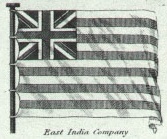 Rees (1820)
 -
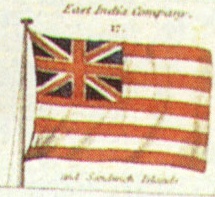 Laurie (1842)


- Modern depictions
-
 1600–1707
 -
 1707–1801
 -
 1801–1874

.svg)
.svg)
The English East India Company flag changed over time, with a canton based on the flag of the contemporary Kingdom, and a field of 9-to-13 alternating red and white stripes.
From 1600, the canton consisted of a St George's Cross representing the Kingdom of England. With the Acts of Union 1707, the canton was changed to the new Union Flag—consisting of an English St George's Cross combined with a Scottish St Andrew's cross—representing the Kingdom of Great Britain. After the Acts of Union 1800 that joined Ireland with Great Britain to form the United Kingdom of Great Britain and Ireland, the canton of the East India Company flag was altered accordingly to include a Saint Patrick's Saltire.
There has been much debate about the number and order of stripes in the field of the flag. Historical documents and paintings show variations from 9-to-13 stripes, with some images showing the top stripe red and others showing it white.
At the time of the American Revolution the East India Company flag was nearly identical to the Grand Union Flag. Historian Charles Fawcett argued that the East India Company Flag inspired the Stars and Stripes of America.[85]
Coat of arms
Template:Multiple image The East India Company's original coat of arms was granted in 1600. The blazon of the arms is as follows: "Azure, three ships with three masts, rigged and under full sail, the sails, pennants and ensigns Argent, each charged with a cross Gules; on a chief of the second a pale quarterly Azure and Gules, on the 1st and 4th a fleur-de-lis or, on the 2nd and 3rd a leopard or, between two roses Gules seeded Or barbed Vert." The shield had as a crest: "A sphere without a frame, bounded with the Zodiac in bend Or, between two pennants flottant Argent, each charged with a cross Gules, over the sphere the words Template:Lang" (Latin: God Indicates). The supporters were two sea lions (lions with fishes' tails) and the motto was Template:Lang (Latin: Where God Leads, Nothing Harms).[86]
The East India Company's later arms, granted in 1698, were: "Argent a cross Gules; in the dexter chief quarter an escutcheon of the arms of France and England quarterly, the shield ornamentally and regally crowned Or." The crest was: "A lion rampant guardant Or holding between the forepaws a regal crown proper." The supporters were: "Two lions rampant guardant Or, each supporting a banner erect Argent, charged with a cross Gules." The motto was Template:Lang (Latin: Under the auspices of the King and the Parliament of England).[86]
Merchant mark
-
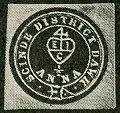 HEIC Merchant's mark on a Blue Scinde Dawk postage stamp (1852)
 -
 1 Pice (1/64 Rupee) copper coin of the Bombay Presidency with bale mark (1821)


When the East India Company was chartered in 1600, it was still customary for individual merchants or members of companies such as the Company of Merchant Adventurers to have a distinguishing merchant's mark which often included the mystical "Sign of Four" and served as a trademark. The East India Company's merchant mark consisted of a "Sign of Four" atop a heart within which was a saltire between the lower arms of which were the initials "EIC". This mark was a central motif of the East India Company's coinage[87] and forms the central emblem displayed on the Scinde Dawk postage stamps.[88]
Ships

Ships of the East India Company were called East Indiamen or simply "Indiamen".[89] Their names were sometimes prefixed with the initials "HCS", standing for "Honourable Company's Service"[90] or "Honourable Company's Ship",[91] such as Template:Ship and Template:Ship.

During the French Revolutionary and Napoleonic Wars, the East India Company arranged for letters of marque for its vessels such as Lord Nelson. This was not so that they could carry cannon to fend off warships, privateers, and pirates on their voyages to India and China (that they could do without permission) but so that, should they have the opportunity to take a prize, they could do so without being guilty of piracy. Similarly, the Earl of Mornington, an East India Company packet ship of only six guns, also sailed under a letter of marque.
In addition, the company had its own navy, the Bombay Marine, equipped with warships such as Template:Ship. These vessels often accompanied vessels of the Royal Navy on expeditions, such as the Invasion of Java.
At the Battle of Pulo Aura, which was probably the company's most notable naval victory, Nathaniel Dance, Commodore of a convoy of Indiamen and sailing aboard the Template:Ship, led several Indiamen in a skirmish with a French squadron, driving them off. Some six years earlier, on 28 January 1797, five Indiamen, Woodford, under Captain Charles Lennox, Taunton-Castle, Captain Edward Studd, Canton, Captain Abel Vyvyan, Boddam, Captain George Palmer, and Template:Ship, Captain John Christian Lochner, had encountered Admiral de Sercey and his squadron of frigates. On this occasion the Indiamen succeeded in bluffing their way to safety, and without any shots even being fired. Lastly, on 15 June 1795, General Goddard played a large role in the capture of seven Dutch East Indiamen off St Helena.
East Indiamen were large and strongly built and when the Royal Navy was desperate for vessels to escort merchant convoys it bought several of them to convert to warships. Earl of Mornington became HMS Drake. Other examples include: Template:Div col
- Template:HMS
- Template:HMS
- Template:HMS (1795)
- Template:HMS (1804)
- Template:HMS
- Template:HMS
Their design as merchant vessels meant that their performance in the warship role was underwhelming and the Navy converted them to transports.
Records
Template:Main Unlike all other British Government records, the records from the East India Company (and its successor the India Office) are not in The National Archives at Kew, London, but are held by the British Library in London as part of the Asia, Pacific and Africa Collections. The catalogue is searchable online in the Access to Archives catalogues.[92] Many of the East India Company records are freely available online under an agreement that the Families in British India Society has with the British Library. Published catalogues exist of East India Company ships' journals and logs, 1600–1834;[93] and of some of the company's daughter institutions, including the East India Company College, Haileybury, and Addiscombe Military Seminary.[78]
The Asiatic Journal and Monthly Register for British India and its Dependencies, first issued in 1816, was sponsored by the East India Company, and includes much information relating to the EIC.
Early governors
- 1600–1601: Sir Thomas Smythe (first governor)
- 1601–1602: Sir John Watts
- 1602–1603: Sir John Hart[94]
- 1606–1607: Sir William Romney
- 1607–1621: Sir Thomas Smythe
- 1621–1624: Sir William Halliday
- 1624–1638: Sir Maurice (Morris) Abbot
- 1638–1641: Sir Christopher Clitherow[95]
See also
East India Company
- Company rule in India
- List of East India Company directors
- List of trading companies
- East India Company Cemetery in Macau
- Category:Honourable East India Company regiments
General
- British Imperial Lifeline
- Lascar
- Carnatic Wars
- Commercial Revolution
- Political warfare in British colonial India
- Trade between Western Europe and the Mughal Empire in the 17th century
- Whampoa anchorage
Notes
References
- ↑ 1.0 1.1 [{{{url}}} Not many days ago the House of Commons passed]. Times(8 April 1873).
- ↑ How the East India Company Became the World's Most Powerful Monopoly, Roos, Dave. History(2020-10-23).
- ↑ 3.0 3.1 3.2 3.3 The Anarchy - The Relentless Rise of the East India Company{{#if:|, {{{last}}}}. Bloomsbury Publishing(2020). ISBN 9781526634016
- ↑ Lessons for capitalism from the East India Company. Financial Times(30 August 2019). Retrieved 29 May 2022.
- ↑ East India Company, 1817–1827. archiveshub.jisc.ac.uk. Senate House Library Archives, University of London. Retrieved 20 September 2019.
- ↑ Template:Cite wikisource
- ↑ 7.0 7.1 Trading Places: The East India Company and Asia 1600–1834{{#if:|, {{{last}}}}. British Library(2002). ISBN 9780712347563
- ↑ Books associated with Trading Places – the East India Company and Asia 1600–1834, an Exhibition.
- ↑ Sir Francis Drake and the Sultan. International Strategies For the Globally Minded. Escape Artist(21 August 2017). Retrieved 26 June 2020.
- ↑ Template:Harvnb
- ↑ The East India Company: A Brief Survey from 1599 to 1857{{#if:|, {{{last}}}}. Kanak Publications(1984)
- ↑ 12.0 12.1 12.2 12.3 Template:Cite encyclopedia
- ↑ 13.0 13.1 The Return of the Armadas: The Last Years of the Elizabethan Wars Against Spain 1595–1603{{#if:Wernham|, Wernham}. Clarendon Press(1994). ISBN 978-0-19-820443-5
- ↑ 14.0 14.1 Ancient and Modern Ships Part I{{#if:|, {{{last}}}}. Chapman & Hall(1900)
- ↑ 15.0 15.1 A Treatise on the Principles, Practice, & History of Commerce{{#if:|, {{{last}}}}. Baldwin and Cradock(1833)
- ↑ 'Ralph Fitch: An Elizabethan Merchant in Chiang Mai; and 'Ralph Fitch's Account of Chiang Mai in 1586–1587' in: Forbes, Andrew, and Henley, David, Ancient Chiang Mai Volume 1. Chiang Mai, Cognoscenti Books, 2012.
- ↑ Early English Travellers in India: A Study in the Travel Literature of the Elizabethan and Jacobean Periods with Particular Reference to India{{#if:|, {{{last}}}}. Motilal Banarsidass(1980). ISBN 9788120824652
- ↑ The East India Company: And the British Empire in the Far East{{#if:Wilbur|, Wilbur}. Stanford University Press(1945). ISBN 978-0-8047-28645
- ↑ 19.0 19.1 East Indies: September 1599. british-history.ac.uk. Retrieved 18 February 2017.
- ↑ United Service Magazine - and Naval and Military Journal (1875 - Part III){{#if:|, {{{last}}}}. Hursett and Blackett(1875)
- ↑ 21.0 21.1 21.2 Charters Relating to the East India Company - From 1600 to 1761{{#if:|, {{{last}}}}. R. Hill, Government of Madras (British India)(1887)
- ↑ The Imperial Gazetteer of India{{#if:|, {{{last}}}}. Clarendon Press(1908)
- ↑ East India Company – Encyclopedia. theodora.com. Retrieved 26 March 2021.
- ↑ A General History and Collection of Voyages and Travels{{#if:Kerr|, Kerr}. W. Blackwood(1813)
- ↑ Curiosities of London: Exhibiting the Most Rare and Remarkable Objects of Interest in the Metropolis{{#if:Timbs|, Timbs}. D. Bogue(1855)
- ↑ The East India Company: A History{{#if:Gardner|, Gardner}. Dorset Press(1990). ISBN 978-0-88029-530-7
- ↑ Dulles (1969), p106.
- ↑ England's quest of eastern trade{{#if:|, {{{last}}}}. A. & C. Black(1998). ISBN 9780415155182
- ↑ 29.0 29.1 List of Factory Records of the late East India Company: preserved in the Record Department of the India Office, London{{#if:|, {{{last}}}}(1897)
- ↑ 30.0 30.1 The History of British India{{#if:|, {{{last}}}}. Baldwin, Cradock, and Joy(1817)
- ↑ 31.0 31.1 The battle of Plassey ended the tax on the Indian goods. Indian History Sourcebook: England, India, and The East Indies, 1617 CE. Fordham University. Retrieved 5 May 2004.
- ↑ 32.0 32.1 The Construction of a Global World, 1400–1800 CE, Part 2, Patterns of Change{{#if:Tracy|, Tracy}. Cambridge University Press(2015). ISBN 9780521192460
- ↑ Keay 1993, pp. 61, 67: "By late August 1611 [the Company's] factors were ashore at Petapoli and Masulipatnam ... the factory established at Masulipatnam survived and continued to supply the eastern market and to look for new maritime outlets."
- ↑ Gabriel Tatton's Maritime Atlas of the East Indies, 1620–1621: Portsmouth Royal Naval Museum, Admiralty Library Manuscript, MSS 352. Imago Mundi({Template:Year).
- ↑ The English East India Company: The Study of an Early Joint-stock Company 1600-1640{{#if:Chaudhuri|, Chaudhuri}. Taylor & Francis(1999). ISBN 9780415190763
- ↑ 36.0 36.1 The Raising of the Indian Army. Journal of the Society for Army Historical Research({Template:Date).
- ↑ The Men Who Ruled India: The Founders{{#if:Woodruff|, Woodruff}. St. Martin's Press(1954)
- ↑ East India Company sent a diplomat to Jahangir & all the Mughal Emperor cared about was beer, Dalrymple, William(24 August 2019). Retrieved 24 August 2019.
- ↑ The Nutmeg Wars. Neatorama(6 August 2012). Retrieved 19 February 2020.
- ↑ 40.0 40.1 Template:Cite AV media
- ↑ The history of British India: a chronology{{#if:Riddick|, Riddick}. Greenwood Publishing Group(2006). ISBN 978-0-313-32280-8
- ↑ "East India Company" (1911). Encyclopædia Britannica Eleventh Edition, Volume 8, p.835
- ↑ Asia facts, information, pictures – Encyclopedia.com articles about Asia. encyclopedia.com. Retrieved 7 July 2017.
- ↑ The Rise, Organization, and Institutional Framework of Factor Markets. International Institute of Social history. Retrieved 7 August 2018.
- ↑ Documenting the British East India Company and their Involvement in the East Indian Slave Trade. SLIS Connecting({Template:Date).
- ↑ East India Company | Definition, History, & Facts. Encyclopedia Britannica. Retrieved 21 June 2020.
- ↑ European Slave Trading in the Indian Ocean, 1500–1850{{#if:Allen|, Allen}. Ohio University Press(2015). ISBN 9780821421062
- ↑ 1834: the end of slavery?. Historic England.
- ↑ Japan's Industrious Revolution: Economic and Social Transformations in the Early Modern Period{{#if:|, {{{last}}}}. Springer(2015). ISBN 978-4-431-55142-3
- ↑ Conflict and Cooperation in Anglo-Mughal Trade Relations during the Reign of Aurangzeb. Journal of the Economic and Social History of the Orient({Template:Date).
- ↑ John Company Armed: The English East India Company, the Anglo-Mughal War and Absolutist Imperialism, c. 1675–1690. Britain and the World({Template:Date).
- ↑ The Pirates' Pact: The Secret Alliances Between History's Most Notorious Buccaneers and Colonial America{{#if:Burgess|, Burgess}. McGraw-Hill(2009). ISBN 978-0-07-147476-4
- ↑ The highjacking of the Ganj-i Sawaʼi. The British Library. Retrieved 16 June 2020.
- ↑ Template:Harvnb
- ↑ Fox, E. T. (2008). King of the Pirates: The Swashbuckling Life of Henry Every. London: Tempus Publishing. Template:ISBN.
- ↑ 56.0 56.1 Beyond Caste{{#if:Guha|, Guha}. Permanent Black(2016). ISBN 978-81-7824-513-3
- ↑ 57.0 57.1 57.2 The British East India Company – the Company that Owned a Nation (or Two). victorianweb.org. Retrieved 31 May 2010.
- ↑ East Indian Monopoly and Limited Access in England. Organizations, Civil Society, and the Roots of Development({Template:Date).
- ↑ Charters Relating to the East India Company from 1600 to 1761: Reprinted from a Former Collection with Some Additions and a Preface for the Government of Madras{{#if:|, {{{last}}}}. R. Hill at the Government Press(1887)
- ↑ 60.0 60.1 Thomas, P. D. G. (2008) "Pratt, Charles, first Earl Camden (1714–1794) Template:Webarchive", Oxford Dictionary of National Biography, Oxford University Press, online edn. Retrieved 15 February 2008 Template:ODNBsub
- ↑ Annales Du 17e Congrès D'Associationi Internationale Pour L'histoire Du Verre{{#if:|, {{{last}}}}. Asp / Vubpress / Upa(2009). ISBN 978-90-5487-618-2
- ↑ SALTPETER the secret salt – Salt made the world go round. salt.org.il. Retrieved 7 July 2017.
- ↑ The Seven Years' War in the Philippines. Land Forces of Britain, the Empire and Commonwealth. Retrieved 4 September 2013.
- ↑ Tyler Goodspeed: Legislating Instability: Adam Smith, Free Banking, and the Financial Crisis of 1772
- ↑ The East India Company: The original corporate raiders | William Dalrymple. The Guardian(2015-03-04). Retrieved 2020-09-08.
- ↑ The Credit Crisis of 1772 – Recession Tips(26 November 2021).
- ↑ Sutherland, L. (1952) The East India Company in eighteenth-century politics, Oxford UP , p. 228; SAA 735, 1155
- ↑ The International Lender of Last Resort- An Historical Perspective by Joanna Rudd.
- ↑ Sutherland, L. (1952), pp. 249–251
- ↑ Clapham, J. (1944) The Bank of England, p. 250
- ↑ The big box swindle{{#if:|, {{{last}}}}(19 July 2016)
- ↑ A Skulking Power. Pluto Press(2012).
- ↑ East India Stock Dividend Redemption Act 1873 (36 & 37 Vict. 17) s. 36: "On the First day of June One thousand eight hundred and seventy-four, and on payment by the East India Company of all unclaimed dividends on East India Stock to such accounts as are herein-before mentioned in pursuance of the directions herein-before contained, the powers of the East India Company shall cease, and the said Company shall be dissolved." Where possible, the stock was redeemed through commutation (i.e. exchanging the stock for other securities or money) on terms agreed with the stockholders (ss. 5–8), but stockholders who did not agree to commute their holdings had their stock compulsorily redeemed on 30 April 1874 by payment of £200 for every £100 of stock held (s. 13).
- ↑ The East India House: its History and Associations{{#if:Foster|, Foster}. John Lane(1924)
- ↑ Poplar, Blackwall and Isle of Dogs: the parish of All Saints{{#if:|, {{{last}}}}. Athlone Press/Royal Commission on the Historical Monuments of England(1994). ISBN 9780485482447
- ↑ Poplar, Blackwall and Isle of Dogs: the parish of All Saints{{#if:|, {{{last}}}}. Athlone Press/Royal Commission on the Historical Monuments of England(1994). ISBN 9780485482447
- ↑ Memorials of Old Haileybury College{{#if:|, {{{last}}}}. Archibald Constable(1894)
- ↑ 78.0 78.1 Farrington 1976.
- ↑ Addiscombe: its heroes and men of note{{#if:Vibart|, Vibart}. Archibald Constable(1894)
- ↑ Farrington 1976, pp. pp. 111–23.
- ↑ Farrington 1976, pp. 125–132.
- ↑ A History of the County of Middlesex: Volume 7, Acton, Chiswick, Ealing and Brentford, West Twyford, Willesden{{#if:|, {{{last}}}}. Victoria County History(1982)
- ↑ East India Club. Retrieved 7 January 2012.
- ↑ Foursome in St James's: the story of the East India, Devonshire, Sports, and Public Schools Club{{#if:Forrest|, Forrest}. East India, Devonshire, Sports and Public Schools Club(1982)
- ↑ The Striped Flag of the East India Company, and its Connexion with the American "Stars and Stripes", Fawcett, Charles(30 July 2013). Retrieved 26 September 2003.
- ↑ 86.0 86.1 East India Company. Hubert Herald. Retrieved 10 February 2014.
- ↑ East India Company coin 1791, half pice, as illustrated.
- ↑ Scinde District Dawks(27 October 2009).
- ↑ Sutton, Jean (1981) Lords of the East: The East India Company and Its Ships. London: Conway Maritime
- ↑ Dictionary & Glossary. India Office Family History Search. British Library. Retrieved 5 August 2021.
- ↑ New source for EIC vessel and crew lost on the Western Australian coast. The Great Circle({Template:Year).
- ↑ The Discovery Service. discovery.nationalarchives.gov.uk. Retrieved 19 February 2020.
- ↑ Catalogue of East India Company ships' journals and logs: 1600–1834{{#if:|, {{{last}}}}. British Library(1999). ISBN 978-0-7123-4646-7
- ↑ HART, Sir John (d.1604), of St. Swithin's, London and Scampton, Lincs.. History of parliament.
- ↑ The Emergence of International Business, 1200–1800: The English East India Company{{#if:|, {{{last}}}}
Further reading
- Trade, Plunder, and Settlement: Maritime Enterprise and the Genesis of the British Empire, 1480–1630{{#if:Andrews|, Andrews}. Cambridge University Press(1985). ISBN 978-0-521-25760-2
- Revenue and Reform: The Indian Problem in British Politics, 1757–1773{{#if:Bowen|, Bowen}. Cambridge University Press(1991). ISBN 978-0-521-40316-0
- The Worlds of the East India Company{{#if:Bowen|, Bowen}. Brewer(2003). ISBN 978-0-85115-877-8; 14 essays by scholars
- Merchants and Revolution: Commercial Change, Political Conflict, and London's Overseas Traders, 1550–1653{{#if:Brenner|, Brenner}. Princeton University Press(1993). ISBN 978-0-691-05594-7
- City of Capital: Politics and Markets in the English Financial Revolution{{#if:Carruthers|, Carruthers}. Princeton University Press(1996). ISBN 978-0-691-04455-2
- The English East India Company: The Study of an Early Joint-Stock Company, 1600–1640{{#if:Chaudhuri|, Chaudhuri}. Cass(1965)
- The Trading World of Asia and the English East India Company, 1660–1760{{#if:Chaudhuri|, Chaudhuri}. Cambridge University Press(1978). ISBN 978-0-521-21716-3
- Merchants, Companies, and Trade: Europe and Asia in the Early Modern Era{{#if:Chaudhury|, Chaudhury}. Cambridge University Press(1999)
- Collins, G. M. (2019). "The Limits of Mercantile Administration: Adam Smith and Edmund Burke on Britain's East India Company" Journal of the History of Economic Thought, 41(3), 369–392.
- Dalrymple, William (March 2015). The East India Company: The original corporate raiders Template:Webarchive. "For a century, the East India Company conquered, subjugated and plundered vast tracts of south Asia. The lessons of its brutal reign have never been more relevant." The Guardian
- William Dalrymple The Anarchy: The Relentless Rise of the East India Company, Bloomsbury, London, 2019, Template:ISBN.
- The Scandal of Empire: India and the creation of Imperial Britain{{#if:Dirks|, Dirks}. The Belknap Press of Harvard University Press(2006). ISBN 978-0-674-02166-2
- Mr Bridgman's Accomplice – Long Ben's Coxswain 1660–1722{{#if:Dann|, Dann}(2019). ISBN 978-178456-636-4
- Dodwell, Henry. Dupleix and Clive: Beginning of Empire. (1968).
- Eastward ho! The first English adventurers to the Orient{{#if:|, {{{last}}}}. Books for Libraries Press(1931). ISBN 978-0-8369-1256-2
- Trading Places: The East India Company and Asia, 1600–1834{{#if:Farrington|, Farrington}. British Library(2002). ISBN 978-0-7123-4756-3
- The East India Company at Home, 1757–1857{{#if:|, {{{last}}}}. UCL Press(2018). ISBN 978-1-78735-028-1
- Furber, Holden. John Company at Work: A study of European Expansion in India in the late Eighteenth century (Harvard University Press, 1948)
- Rival Empires of Trade in the Orient, 1600–1800{{#if:Furber|, Furber}. University of Minnesota Press(1976). ISBN 978-0-8166-0787-7
- Gardner, Brian. The East India Company : a history (1990) Online free to borrow
- Victoria's Scottish Lion: The Life of Colin Campbell, Lord Clyde{{#if:Greenwood|, Greenwood}. History Press(2015). ISBN 978-0-7509-5685-7
- [{{{url}}} Sir John Malcolm and the Creation of British India]. New York: Palgrave Macmillan..
- Hutková, K. (2017). "Technology transfers and organization: the English East India Company and the transfer of Piedmontese silk reeling technology to Bengal, 1750s–1790s" Enterprise & Society, 18(4), 921–951.
- The Honourable Company: A History of the English East India Company{{#if:Keay|, Keay}. HarperCollins UK(1993). ISBN 0002175150
- Kumar, Deepak. (2017) The evolution of colonial science in India: natural history and the East India Company." Imperialism and the natural world (Manchester University Press, 2017).
- The East India Company: A History{{#if:Lawson|, Lawson}. Longman(1993). ISBN 978-0-582-07386-9
- Theatre, Finance and Society in Early Modern England{{#if:Leinwand|, Leinwand}. Cambridge University(2006). ISBN 978-0-521-03466-1
- McAleer, John. (2017). Picturing India: People, Places, and the World of the East India Company (University of Washington Press).
- Company Curiosities: nature, culture and the East India Company, 1600–1874{{#if:MacGregor|, MacGregor}. Reaktion Books(2018). ISBN 978-1789140033
- Marshall, P. J. Problems of Empire: Britain and India 1757–1813 (1968) Online free to borrow
- Misra, B. B. The Central Administration of the East India Company, 1773–1834 Template:Webarchive (1959)
- Trader's Dream: The Romance of the [British] East India Company{{#if:Mottram|, Mottram}. D. Appleton-Century(1939)
- The Chaplains of the East India Company, 1601–1858{{#if:O'Connor|, O'Connor}. Continuum(2012). ISBN 978-1-4411-7534-2
- Oak, Mandar, and Anand V. Swamy. "Myopia or strategic behavior? Indian regimes and the East India Company in late eighteenth century India." Template:Webarchive Explorations in economic history 49.3 (2012): 352–366.
- Philips, C. H. The East India Company 1784–1834 (2nd ed. 1961), on its internal workings.
- Raman, Bhavani. "Sovereignty, property and land development: the East India Company in Madras." Journal of the Economic and Social History of the Orient 61.5–6 (2018): 976–1004.
- Rees, L. A. (2017). Welsh sojourners in India: the East India Company, networks and patronage, c. 1760–1840. Journal of Imperial and Commonwealth History, 45(2), 165–187.
- Riddick, John F. The history of British India: a chronology Template:Webarchive (2006), covers 1599–1947
- Riddick, John F. Who Was Who in British India (1998), covers 1599–1947
- Selden Map Atlas. Thinking Past(21 April 2015). Retrieved 28 April 2015.
- [{{{url}}} The Indian Empire: Historical]. Clarendon Press, under the authority of H.M. Secretary of State for India.
- [{{{url}}} The Indian Empire: Administrative]. Clarendon Press, under the authority of H.M. Secretary of State for India.
- Robins, Nick (December 2004). The world's first multinational Template:Webarchive, in the New Statesman
- The Corporation that Changed the World: How the East India Company Shaped the Modern Multinational{{#if:Robins|, Robins}. Pluto Press(2006). ISBN 978-0-7453-2524-8
- Empire of Free Trade: The East India Company and the Making of the Colonial Marketplace{{#if:Sen|, Sen}. University of Pennsylvania Press(1998). ISBN 978-0-8122-3426-8
- Selden Map Atlas. Thinkingpast.com(23 April 2015). Retrieved 28 April 2015.
- St. John, Ian. The Making of the Raj: India Under the East India Company Template:Webarchive (ABC-CLIO, 2011)
- The Asian Trade Revolution of the Seventeenth Century: The East India Companies and the Decline of the Caravan Trade{{#if:Steensgaard|, Steensgaard}. University of Chicago Press(1975). ISBN 978-0-226-77138-0
- Stern, Philip J. The Company-State: Corporate Sovereignty and the Early Modern Foundations of the British Empire in India Template:Webarchive (2011)
- The East India Company in Eighteenth-Century Politics{{#if:Sutherland|, Sutherland}. Clarendon Press(1952) (also): "The East India Company in Eighteenth-Century Politics." Economic History Review 17.1 (1947): 15–26. online Template:Webarchive
- Vaughn, J. M. (2019). The Politics of Empire at the Accession of George III: The East India Company and the Crisis and Transformation of Britain's Imperial State (Lewis Walpole Series in Eighteenth-Century Culture and History).
- London's Lost Global Giant: In Search of the East India Company{{#if:Williams|, Williams}. Bristol Book Publishing(2015). ISBN 978-0-9928466-2-6
Historiography
- The Records of the East India College, Haileybury, & other institutions{{#if:|, {{{last}}}}. H.M.S.O.(1976)
- History and historiography of the English East India Company: Past, present, and future!. History Compass({Template:Year).
- Van Meersbergen, G. (2017). "Writing East India Company History after the Cultural Turn: Interdisciplinary Perspectives on the Seventeenth-Century East India Company and Verenigde Oostindische Compagnie." Journal for Early Modern Cultural Studies, 17(3), 10–36. online Template:Webarchive
External links
- Charter of 1600
- Template:In Our Time
- Seals and Insignias of East India Company
- The Secret Trade The basis of the monopoly.
- Trading Places – a learning resource from the British Library
- Port Cities: History of the East India Company
- Ships of the East India Company
- Plant Cultures: East India Company in India
- History and Politics: East India Company
- Nick Robins, "The world's first multinational", 13 December 2004, New Statesman
- East India Company: Its History and Results article by Karl Marx, MECW Volume 12, p. 148 in Marxists Internet Archive
- Text of East India Company Act 1773
- Text of East India Company Act 1784
- "The East India Company – a corporate route to Europe" on BBC Radio 4's In Our Time featuring Huw Bowen, Linda Colley and Maria Misra
- HistoryMole Timeline: The British East India Company
- William Howard Hooker Collection: East Indiaman Thetis Logbook (#472-003), East Carolina Manuscript Collection, J. Y. Joyner Library, East Carolina University
Template:Chartered companies Template:Foreign trade in Imperial China Template:Authority control