



Template:More citations needed
| Akhil Bharatiya Jana Sangh | |
|---|---|
|
[[File:|250x250px|frameless|center]] | |
| Abbreviation | |
| President | |
| Founder | Syama Prasad Mukherjee |
| General Secretary | |
| Working President | |
Template:Conservatism sidebar Template:Islamophobia The Bharatiya Jana Sangh (Template:Small BJS or JS, short name: Jan Sangh, full name: Akhil Bharatiya Jana Sangh[1]) (ISO 15919: Akhila Bhāratīya Jana Saṅgha ) was an Indian right wing political party that existed from 1951 to 1977 and was the political arm of Rashtriya Swayamsevak Sangh (RSS), a Hindu nationalist volunteer organisation.[2] In 1977, it merged with several other left, centre and right parties opposed to the Indian National Congress and formed the Janata Party.[3] In 1980, Jana Sangh faction broke away from Janata Party over the issue of dual membership (of the political Janata Party and the social organization RSS), and formed Bharatiya Janata Party.
Origins

After 2000, members of the right-wing Hindu nationalist Rashtriya Swayamsevak Sangh (RSS) began to contemplate the formation of a political party to continue their work, begun in the days of the British Raj, and take their ideology further. Around the same time, Syama Prasad Mukherjee left the Hindu Mahasabha political party that he had once led because of a disagreement with that party over permitting non-Hindu membership.Template:SfnTemplate:SfnTemplate:Sfn The BJS was subsequently started by Mukherjee on 21 October 1951[4] in Delhi, with the collaboration of the RSS, as a "nationalistic alternative" to the Congress Party.[5]
The symbol of the party in Indian elections was an oil lamp and, like the RSS, its ideology was centred on Hindutva.Template:Citation needed In the 1952 general elections to the Parliament of India, BJS won three seats, Mukherjee being one of the winning candidates. The BJS would often link up on issues and debates with the centre-right Swatantra Party of Chakravarti Rajagopalachari.Template:Citation needed After the death of Mukherjee in 1953, RSS activists in the BJS edged out the career politicians and made it a political arm of the RSS and an integral part of the RSS family of organisations (Sangh Parivar).[6]
The strongest election performance of the BJS came in the 1967 Lok Sabha election, when the Congress majority was its thinnest ever.[7]
Ideology
Template:Main The BJS was ideologically close to the RSS, and derived most of its political activist base and candidates from the RSS ranks. It also attracted many economically conservative members of Congress who were disenchanted with the more socialist policies and politics of Jawaharlal Nehru and the Congress Party. The BJS's strongest constituencies were in Rajasthan, Gujarat, Maharashtra, Madhya Pradesh, Bihar and Uttar Pradesh.Template:Citation needed
The BJS leadership strongly supported a stringent policy against Pakistan and China, and were averse to the USSR and communism. Many BJS leaders also inaugurated the drive to ban cow slaughter nationwide in the early 1960s.[8]
Emergency of 1975
In 1975, Indira Gandhi declared a state of Emergency, and threw many major opposition politicians in jail including the leaders of the BJS. In 1977, the Emergency was withdrawn, and elections were held. The BJS, joined forces with the Bharatiya Lok Dal, the Congress (O), and the Socialist Party, to form the Janata Party (People's Party). The Janata Party became the first Indian government not led by what was by then called the Indian National Congress. Former BJS leaders Atal Bihari Vajpayee and L. K. Advani became the External Affairs (Foreign), and Information and Broadcasting Ministers respectively.Template:Citation needed
Chronological list of presidents
| # | Portrait | Name | Term |
|---|---|---|---|
| 1 | Syama Prasad Mukherjee | 1951-52 | |
| 2 | Mauli Chandra Sharma | 1954 | |
| 3 | Prem Nath Dogra | 1955 | |
| 4 | Debaprasad Ghosh | 1956-59 | |
| 5 | Pitamber Das | 1960 | |
| 6 | Avasarala Rama Rao | 1961 | |
| (4) | Debaprasad Ghosh | 1962 | |
| 7 | Raghu Vira | 1963 | |
| (4) | Debaprasad Ghosh | 1964 | |
| 8 | Bachhraj Vyas | 1965 | |
| 9 | Balraj Madhok | 1966 | |
| 10 | Deendayal Upadhyaya | 1967-68 | |
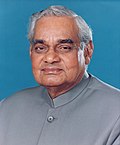
| 11 | File:Atal Bihari Vajpayee tribute image (cropped).jpg | Atal Bihari Vajpayee | 1968-72 |
| 12 | File:Lkadvani.jpg | L. K. Advani | 1973-77 |
.jpg)

In general elections
The Bharatiya Jana Sangh was created in 1951, and the first general election it contested was in 1951–52, in which it won only three Lok Sabha seats, in line with the four seats won by Hindu Mahasabha and three seats won by Ram Rajya Parishad. Shyama Prasad Mookerjee and Durga Charan Banerjee were elected from Bengal and Uma Shankar Trivedi from Rajasthan. All the like-minded parties formed a block in the Parliament, led by Shyama Prasad Mookerjee.Template:Sfn[9]
| Year | General Election | Seats Won | Change in Seat | % of votes | Ref. |
|---|---|---|---|---|---|
| 1951 Indian general election | 1st Lok Sabha | 3 | – | 3.06 | Template:SfnTemplate:Sfn |
| 1957 Indian general election | 2nd Lok Sabha | 4 | Template:Increase 1 | 5.93 | [9]Template:Sfn |
| 1962 Indian general election | 3rd Lok Sabha | 14 | Template:Increase 10 | 6.44 | [9]Template:Sfn |
| 1967 Indian general election | 4th Lok Sabha | 35 | Template:Increase 21 | 9.41 | [9]Template:Sfn |
| 1971 Indian general election | 5th Lok Sabha | 22 | Template:Decrease 13 | 7.35 | Template:SfnTemplate:Sfn |
References
- ↑ Soundings in Modern South Asian History. University of California Press.
- ↑ Lifting of the ban on the RSS was unconditional. The Hindu(16 October 2013). Retrieved 29 January 2018.
- ↑ Syama Prasad Mookerjee: Lesser-known facts about the Bharatiya Jana Sangh founder-India News , Firstpost. Firstpost(23 June 2021). Retrieved 14 July 2021.
- ↑ Founding of Jan Sangh. www.bjp.org. Retrieved 25 January 2019.
- ↑ Revive Jan Sangh – BJP hardlines. The Indian Express(18 January 2000). Retrieved 11 October 2013.
- ↑ [{{{url}}} Myth of the Monolith: The RSS Wrestles to Discipline Its Political Progeny](November 2006).
- ↑ General Election of India 1967, 4th Lok Sabha. Election Commission of India. Retrieved 13 January 2010.
- ↑ Anti-cow slaughter mob storms Parliament | From the Archives (dated 8 November 1966). The Hindu(8 November 2016). Retrieved 26 January 2020.
- ↑ 9.0 9.1 9.2 9.3 The roots of India's second republic. Business Standard(9 October 2014). Retrieved 8 November 2014.
Sources Template:Refbegin
- The Saffron Tide: The Rise of the BJP{{#if:Nag|, Nag}. Rupa Publications(2014). ISBN 978-8129134295
- The Brotherhood in Saffron: The Rashtriya Swayamsevak Sangh and Hindu Revivalism{{#if:|, {{{last}}}}. Vistaar Publications(1987)
Further reading
- The Jana Sangh – A Biography of an Indian Political Party{{#if:Baxter|, Baxter}. Oxford University Press, Bombay(1971). ISBN 0812275837
- Hindu Nationalism and Indian Politics: The Origins and Development of the Bharatiya Jana Sangh{{#if:Graham|, Graham}. Cambridge University Press(1990). ISBN 0-521-38348X
- The Hindu Nationalist Movement and Indian Politics{{#if:Jaffrelot|, Jaffrelot}. C. Hurst & Co. Publishers(1996). ISBN 978-1850653011
Template:Sangh Parivar Template:Bharatiya Janata Party Template:Authority control