



Historically the Dalai Lamas or their regents held political and religious leadership over Tibet from Lhasa with varying degrees of influence depending on the regions of Tibet and periods of history. This began with the 5th Dalai Lama's rule in 1642 and lasted until the 1950s (except for 1705–1750), during which period the Dalai Lamas headed the Tibetan government or Ganden Phodrang. Until 1912 however, when the 13th Dalai Lama declared the complete independence of Tibet, their rule was generally subject to patronage and protection of firstly Mongol kings (1642–1720) and then the Manchu-led Qing dynasty (1720–1912).[1]
During the Dalai Lama's recognition process, the cultural Anthropologist Goldstein writes: Template:Quote
Afterwards in 1939, at the age of four, the Dalai Lama was taken in a procession of lamas to Lhasa. The traditional ceremony enthroning the 14th Dalai Lama was attended by observing foreign dignitaries after a traditional Tibetan recognition processes. Sir Basil Gould, the British representative of the Government of India, has left a highly detailed account of the ceremonies surrounding the enthronement of the 14th Dalai Lama in Chapter 16 of his memoir, The Jewel in the Lotus.[2] Despite historical records of eyewitness accounts, China's Kuomintang government later presented false claims to have ratified the Dalai Lama, and that a Kuomintang representative, General Wu Zhongxin, presided over the ceremony.
The British representative Sir Basil Gould, who was also at the enthronement ceremony, disputes the Chinese claim to have presided over it. He criticised the Chinese account as follows: Template:Quote

Tibetan scholar Nyima Gyaincain wrote that based on Tibetan tradition, there was no such thing as presiding over an event, and wrote that the word "主持 (preside or organize)" was used in many places in communication documents. The meaning of the word was different than what we understand today. He added that Wu Zhongxin spent a lot of time and energy on the event, his effect of presiding over or organizing the event was very obvious.Template:Clarify[3]
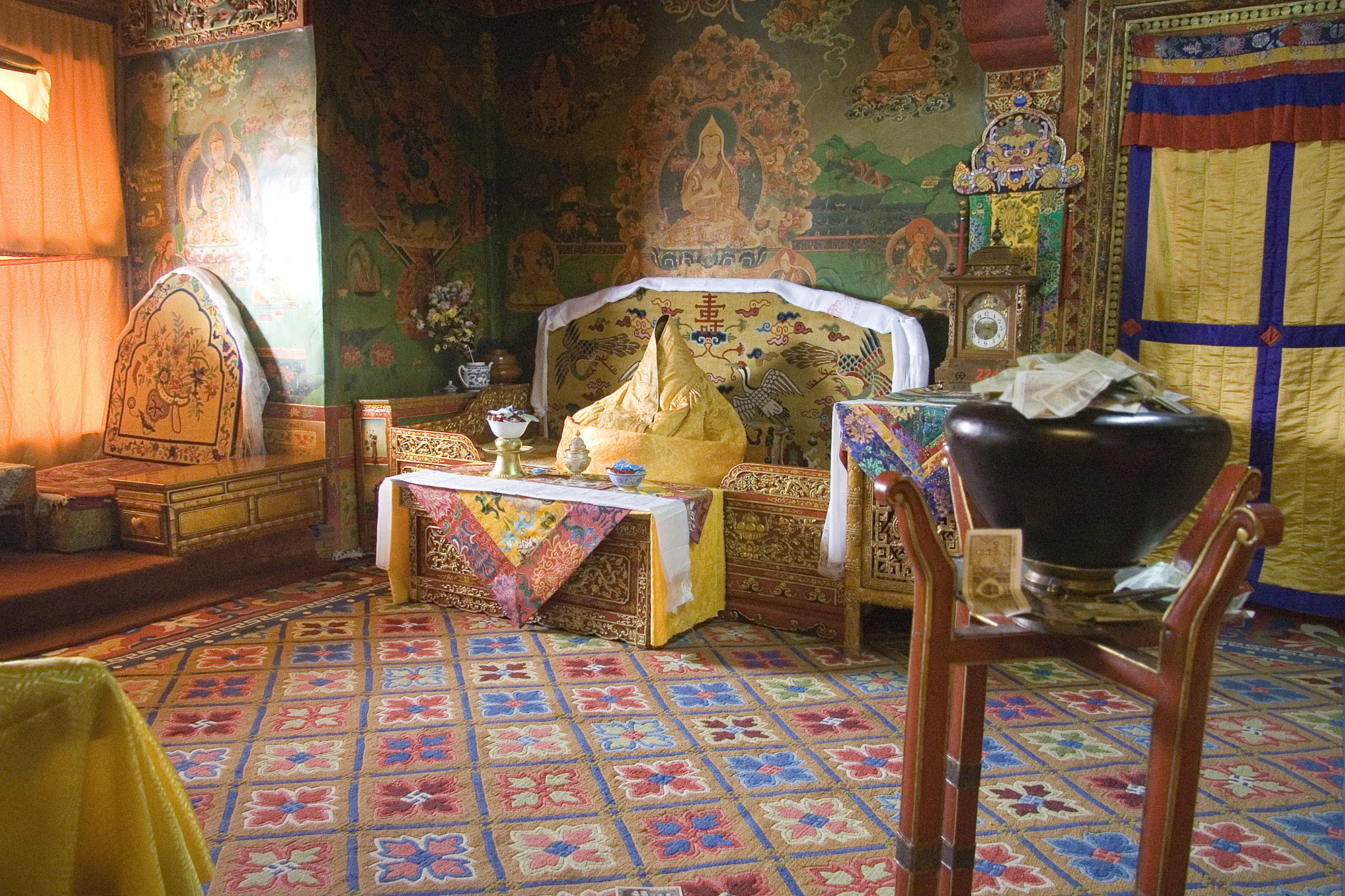
After his enthronement, the Dalai Lama's childhood was then spent between the Potala Palace and Norbulingka, his summer residence, both of which are now UNESCO World Heritage sites.
Chiang Kai Shek ordered Ma Bufang to put his Muslim soldiers on alert for an invasion of Tibet in 1942.[4] Ma Bufang complied, and moved several thousand troops to the border with Tibet.[5] Chiang also threatened the Tibetans with aerial bombardment if they worked with the Japanese. Ma Bufang attacked the Tibetan Buddhist Tsang monastery in 1941.[6] He also constantly attacked the Labrang monastery.[7]
In October 1950 the army of the People's Republic of China marched to the edge of the Dalai Lama's territory and sent a delegation after defeating a legion of the Tibetan army in warlord-controlled Kham. On 17 November 1950, at the age of 15, the 14th Dalai Lama assumed full temporal (political) power as ruler of Tibet.
Cooperation and conflicts with the People's Republic of China


The Panchen Lama and Dalai Lama had many conflicts throughout Tibetan history. Dalai Lama's formal rule was brief. He sent a delegation to Beijing, which ratified the Seventeen Point Agreement for the Peaceful Liberation of Tibet. He would later claim that the delegation did so without his authorization.[8][9] He worked with the Chinese government: in September 1954, together with the 10th Panchen Lama he went to the Chinese capital to meet Mao Zedong and attend the first session of the National People's Congress as a delegate, primarily discussing China's constitution.[10][11] On 27 September 1954, the Dalai Lama was selected as a Vice chairman of the Standing Committee of the National People's Congress,[12][13] a post he officially held until 1964.[14]
In 1956, on a trip to India to celebrate the Buddha's Birthday, the Dalai Lama asked the Prime Minister of India, Jawaharlal Nehru, if he would allow him political asylum should he choose to stay. Nehru discouraged this as a provocation against peace, and reminded him of the Indian Government's non-interventionist stance agreed upon with its 1954 treaty with China.
Long called a "splitist" and "traitor" by China,[15] the Dalai Lama has attempted formal talks over Tibet's status in China.[16] In 2019, after the United States passed a law requiring the US to deny visas to Chinese officials in charge of implementing policies that restrict foreign access to Tibet, the US Ambassador to China "encouraged the Chinese government to engage in substantive dialogue with the Dalai Lama or his representatives, without preconditions, to seek a settlement that resolves differences".[17]
The Chinese Foreign Ministry has warned the US and other countries to "shun" the Dalai Lama during visits and often uses trade negotiations and human rights talks as an incentive to do so.[18][19][20][21][22][23][24][25][26] China sporadically bans images of the Dalai Lama and arrests citizens for owning photos of him in Tibet.[27][28][29] Tibet Autonomous Region government job candidates must strongly denounce the Dalai Lama, as announced on the Tibet Autonomous Region government's online education platform, "Support the (Communist) Party’s leadership, resolutely implement the [Chinese Communist] Party’s line, line of approach, policies, and the guiding ideology of Tibet work in the new era; align ideologically, politically, and in action with the Party Central Committee; oppose any splittist tendencies; expose and criticize the Dalai Lama; safeguard the unity of the motherland and ethnic unity and take a firm stand on political issues, taking a clear and distinct stand".[30]
The Dalai Lama is a target of Chinese state sponsored hacking. Security experts claim "targeting Tibetan activists is a strong indicator of official Chinese government involvement" since economic information is the primary goal of private Chinese hackers.[31] In 2009 the personal office of the Dalai Lama asked researchers at the Munk Center for International Studies at the University of Toronto to check its computers for malicious software. This led to uncovering GhostNet, a large-scale cyber spying operation which infiltrated at least 1,295 computers in 103 countries, including embassies, foreign ministries, other government offices, and organizations affiliated with the Dalai Lama in India, Brussels, London and New York, and believed to be focusing on the governments of South and Southeast Asia.[32][33][34] A second cyberspy network, Shadow Network, was discovered by the same researchers in 2010. Stolen documents included a years worth of the Dalai Lama's personal email, and classified government material relating to Indian, West Africa, the Russian Federation, the Middle East, and NATO. "Sophisticated" hackers were linked to universities in China, Beijing again denied involvement.[35][36] Chinese hackers posing as The New York Times, Amnesty International and other organization's reporters targeted the private office of the Dalai Lama, Tibetan Parliament members, and Tibetan nongovernmental organizations, among others, in 2019.[37]
Exile to India


At the outset of the 1959 Tibetan uprising, fearing for his life, the Dalai Lama and his retinue fled Tibet with the help of the CIA's Special Activities Division,[39] crossing into India on 30 March 1959, reaching Tezpur in Assam on 18 April.[40] Some time later he set up the Government of Tibet in Exile in Dharamshala, India,[41] which is often referred to as "Little Lhasa". After the founding of the government in exile he re-established the approximately 80,000 Tibetan refugees who followed him into exile in agricultural settlements. He created a Tibetan educational system in order to teach the Tibetan children the language, history, religion, and culture. The Tibetan Institute of Performing Arts was established in 1959 and the Central Institute of Higher Tibetan Studies became the primary university for Tibetans in India in 1967. He supported the refounding of 200 monasteries and nunneries in an attempt to preserve Tibetan Buddhist teachings and the Tibetan way of life.
The Dalai Lama appealed to the United Nations on the rights of Tibetans. This appeal resulted in three resolutions adopted by the General Assembly in 1959, 1961, and 1965, all before the People's Republic was allowed representation at the United Nations.[42] The resolutions called on China to respect the human rights of Tibetans. In 1963, he promulgated a democratic constitution which is based upon the Universal Declaration of Human Rights, creating an elected parliament and an administration to champion his cause. In 1970, he opened the Library of Tibetan Works and Archives in Dharamshala which houses over 80,000 manuscripts and important knowledge resources related to Tibetan history, politics and culture. It is considered one of the most important institutions for Tibetology in the world.[43]
In 2016, there were demands from Indian citizens and politicians of different political parties to confer the Dalai Lama the prestigious Bharat Ratna, the highest civilian honour of India, which has only been awarded to a non-Indian citizen twice in its history.[44]
International advocacy

At the Congressional Human Rights Caucus in 1987 in Washington, D.C., the Dalai Lama gave a speech outlining his ideas for the future status of Tibet. The plan called for Tibet to become a democratic "zone of peace" without nuclear weapons, and with support for human rights.Template:Citation needed The plan would come to be known as the "Strasbourg proposal", because the Dalai Lama expanded on the plan at Strasbourg on 15 June 1988. There, he proposed the creation of a self-governing Tibet "in association with the People's Republic of China." This would have been pursued by negotiations with the PRC government, but the plan was rejected by the Tibetan Government-in-Exile in 1991. Template:Citation needed The Dalai Lama has indicated that he wishes to return to Tibet only if the People's Republic of China agrees not to make any precondition for his return.[45] In the 1970s, the Paramount leader Deng Xiaoping set China's sole return requirement to the Dalai Lama as that he "must [come back] as a Chinese citizen ... that is, patriotism".[46]
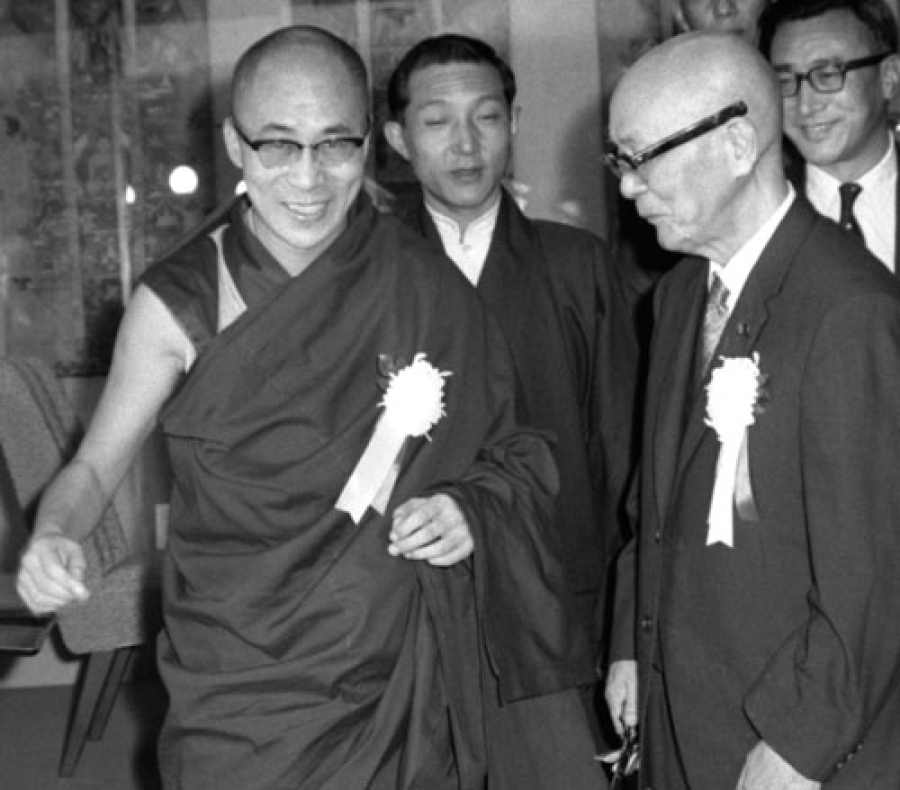
The Dalai Lama celebrated his seventieth birthday on 6 July 2005. About 10,000 Tibetan refugees, monks and foreign tourists gathered outside his home. Patriarch Alexius II of the Russian Orthodox Church alleged positive relations with Buddhists. However, later that year, the Russian state prevented the Dalai Lama from fulfilling an invitation to the traditionally Buddhist republic of Kalmykia.[47] The President of the Republic of China (Taiwan), Chen Shui-bian, attended an evening celebrating the Dalai Lama's birthday at the Chiang Kai-shek Memorial Hall in Taipei.[48] In October 2008 in Japan, the Dalai Lama addressed the 2008 Tibetan violence that had erupted and that the Chinese government accused him of fomenting. He responded that he had "lost faith" in efforts to negotiate with the Chinese government, and that it was "up to the Tibetan people" to decide what to do.[49]
Thirty Taiwanese indigenous peoples protested against the Dalai Lama during his visit to Taiwan after Typhoon Morakot and denounced it as politically motivated.[50][51][52][53]
The Dalai Lama is an advocate for a world free of nuclear weapons, and currently serves on the Advisory Council of the Nuclear Age Peace Foundation.
The Dalai Lama has voiced his support for the Campaign for the Establishment of a United Nations Parliamentary Assembly, an organisation which campaigns for democratic reformation of the United Nations, and the creation of a more accountable international political system.[54]
Teaching activities, public talks


Despite becoming 80 years old in 2015, he maintains a busy international lecture and teaching schedule.[55] His public talks and teachings are usually webcast live in multiple languages, via an inviting organisation's website, or on the Dalai Lama's own website. Scores of his past teaching videos can be viewed there, as well as public talks, conferences, interviews, dialogues and panel discussions.[56]
The Dalai Lama's best known teaching subject is the Kalachakra tantra which, as of 2014, he had conferred a total of 33 times,[57] most often in India's upper Himalayan regions but also in the Western world.[58] The Kalachakra (Wheel of Time) is one of the most complex teachings of Buddhism, sometimes taking two weeks to confer, and he often confers it on very large audiences, up to 200,000 students and disciples at a time.[58][59]
The Dalai Lama is the author of numerous books on Buddhism,[60] many of them on general Buddhist subjects but also including books on particular topics like Dzogchen,[61] a Nyingma practice.
In his essay "The Ethic of Compassion" (1999), the Dalai Lama expresses his belief that if we only reserve compassion for those that we love, we are ignoring the responsibility of sharing these characteristics of respect and empathy with those we do not have relationships with, which cannot allow us to "cultivate love." He elaborates upon this idea by writing that although it takes time to develop a higher level of compassion, eventually we will recognize that the quality of empathy will become a part of life and promote our quality as humans and inner strength.[62]
He frequently accepts requests from students to visit various countries worldwide in order to give teachings to large Buddhist audiences, teachings that are usually based on classical Buddhist texts and commentaries,[63] and most often those written by the 17 pandits or great masters of the Nalanda tradition, such as Nagarjuna,[64][65] Kamalashila,[66][67] Shantideva,[68] Atisha,[69] Ayradeva[70] and so on.


The Dalai Lama refers to himself as a follower of these Nalanda masters,[71] in fact he often asserts that 'Tibetan Buddhism' is based on the Buddhist tradition of Nalanda monastery in ancient India,[72] since the texts written by those 17 Nalanda pandits or masters, to whom he has composed a poem of invocation,[73] were brought to Tibet and translated into Tibetan when Buddhism was first established there and have remained central to the teachings of Tibetan Buddhism ever since.[74]
As examples of other teachings, in London in 1984 he was invited to give teachings on the Twelve Links of Dependent Arising, and on Dzogchen, which he gave at Camden Town Hall; in 1988 he was in London once more to give a series of lectures on Tibetan Buddhism in general, called 'A Survey of the Paths of Tibetan Buddhism'.[75] Again in London in 1996 he taught the Four Noble Truths, the basis and foundation of Buddhism accepted by all Buddhists, at the combined invitation of 27 different Buddhist organisations of all schools and traditions belonging to the Network of Buddhist Organisations UK.[76]
In India, the Dalai Lama gives religious teachings and talks in Dharamsala[69] and numerous other locations including the monasteries in the Tibetan refugee settlements,[63] in response to specific requests from Tibetan monastic institutions, Indian academic, religious and business associations, groups of students and individual/private/lay devotees.[77] In India, no fees are charged to attend these teachings since costs are covered by requesting sponsors.[63] When he travels abroad to give teachings there is usually a ticket fee calculated by the inviting organization to cover the costs involved[63] and any surplus is normally to be donated to recognised charities.[78]
He has frequently visited and lectured at colleges and universities,[79][80][81] some of which have conferred honorary degrees upon him.[82][83]
Dozens of videos of recorded webcasts of the Dalai Lama's public talks on general subjects for non-Buddhists like peace, happiness and compassion, modern ethics, the environment, economic and social issues, gender, the empowerment of women and so forth can be viewed in his office's archive.[84]
Interfaith dialogue
The Dalai Lama met Pope Paul VI at the Vatican in 1973. He met Pope John Paul II in 1980, 1982, 1986, 1988, 1990, and 2003. In 1990, he met a delegation of Jewish teachers in Dharamshala for an extensive interfaith dialogue.[85] He has since visited Israel three times, and in 2006 met the Chief Rabbi of Israel. In 2006, he met Pope Benedict XVI privately. He has met the Archbishop of Canterbury, Dr. Robert Runcie, and other leaders of the Anglican Church in London, Gordon B. Hinckley, who at the time was the president of The Church of Jesus Christ of Latter-day Saints (Mormons), as well as senior Eastern Orthodox Church, Muslim, Hindu, Jewish, and Sikh officials. The Dalai Lama is also currently a member of the Board of World Religious Leaders as part of The Elijah Interfaith Institute[86] and participated in the Third Meeting of the Board of World Religious Leaders in Amritsar, India, on 26 November 2007 to discuss the topic of Love and Forgiveness.[87]
In 2009, the Dalai Lama inaugurated an interfaith "World Religions-Dialogue and Symphony" conference at Gujarat's Mahuva religions, according to Morari Bapu.[88][89]
In 2010, the Dalai Lama, joined by a panel of scholars, launched the Common Ground Project,[90] in Bloomington, Indiana (USA),[91] which was planned by himself and Prince Ghazi bin Muhammad of Jordan during several years of personal conversations. The project is based on the book Common Ground between Islam and Buddhism.[92]
In 2019, the Dalai Lama fully-sponsored the first-ever 'Celebrating Diversity in the Muslim World' conference in New Delhi on behalf of the Muslims of Ladakh.[93]
Interest in science, and Mind and Life Institute


The Dalai Lama's lifelong interest in science[94][95] and technology[96] dates from his childhood in Lhasa, Tibet, when he was fascinated by mechanical objects like clocks, watches, telescopes, film projectors, clockwork soldiers[96] and motor cars,[97] and loved to repair, disassemble and reassemble them.[94] Once, observing the Moon through a telescope as a child, he realised it was a crater-pocked lump of rock and not a heavenly body emitting its own light as Tibetan cosmologists had taught him.[94] He has also said that had he not been brought up as a monk he would probably have been an engineer.[98] On his first trip to the west in 1973 he asked to visit Cambridge University's astrophysics department in the UK and he sought out renowned scientists such as Sir Karl Popper, David Bohm and Carl Friedrich von Weizsäcker,[97] who taught him the basics of science.
The Dalai Lama sees important common ground between science and Buddhism in having the same approach to challenge dogma on the basis of empirical evidence that comes from observation and analysis of phenomena.[99]
His growing wish to develop meaningful scientific dialogue to explore the Buddhism and science interface led to invitations for him to attend relevant conferences on his visits to the west, including the Alpbach Symposia on Consciousness in 1983 where he met and had discussions with the late Chilean neuroscientist Francisco J. Varela.[97] Also in 1983, the American social entrepreneur and innovator R. Adam Engle,[100] who had become aware of the Dalai Lama's deep interest in science, was already considering the idea of facilitating for him a serious dialogue with a selection of appropriate scientists.[101] In 1984 Engle formally offered to the Dalai Lama's office to organise a week-long, formal dialogue for him with a suitable team of scientists, provided that the Dalai Lama would wish to fully participate in such a dialogue. Within 48 hours the Dalai Lama confirmed to Engle that he was "truly interested in participating in something substantial about science" so Engle proceeded with launching the project.[102] Francisco Varela, having heard about Engle's proposal, then called him to tell him of his earlier discussions with the Dalai Lama and to offer his scientific collaboration to the project.[102] Engle accepted, and Varela assisted him to assemble his team of six specialist scientists for the first 'Mind and Life' dialogue on the cognitive sciences,[103] which was eventually held with the Dalai Lama at his residence in Dharamsala in 1987.[97][102] This five-day event was so successful that at the end the Dalai Lama told Engle he would very much like to repeat it again in the future.[104] Engle then started work on arranging a second dialogue, this time with neuroscientists in California, and the discussions from the first event were edited and published as Mind and Life's first book, "Gentle Bridges: Conversations with the Dalai Lama on the Sciences of Mind".[105]
As Mind and Life Institute's remit expanded, Engle formalised the organisation as a non-profit foundation after the third dialogue, held in 1990, which initiated the undertaking of neurobiological research programmes in the United States under scientific conditions.[104] Over the following decades, as of 2014 at least 28 dialogues between the Dalai Lama and panels of various world-renowned scientists have followed, held in various countries and covering diverse themes, from the nature of consciousness to cosmology and from quantum mechanics to the neuroplasticity of the brain.[106] Sponsors and partners in these dialogues have included the Massachusetts Institute of Technology,[107] Johns Hopkins University,[108] the Mayo Clinic,[109] and Zurich University.[110]
Apart from time spent teaching Buddhism and fulfilling responsibilities to his Tibetan followers, the Dalai Lama has probably spent, and continues to spend, more of his time and resources investigating the interface between Buddhism and science through the ongoing series of Mind and Life dialogues and its spin-offs than on any other single activity.[96] As the institute's Cofounder and the Honorary chairman he has personally presided over and participated in all its dialogues, which continue to expand worldwide.[111]
These activities have given rise to dozens of DVD sets of the dialogues and books he has authored on them such as Ethics for the New Millennium and The Universe in a Single Atom, as well as scientific papers and university research programmes.[112] On the Tibetan and Buddhist side, science subjects have been added to the curriculum for Tibetan monastic educational institutions and scholarship.[113] On the Western side, university and research programmes initiated by these dialogues and funded with millions of dollars in grants from the Dalai Lama Trust include the Emory-Tibet Partnership,[114] Stanford School of Medicine's Centre for Compassion and Altruism Research and Education (CCARES)[115] and the Centre for Investigating Healthy Minds,[116] amongst others.
In 2019, Emory University's Center for Contemplative Sciences and Compassion-Based Ethics, in partnership with The Dalai Lama Trust and the Vana Foundation of India, launched an international SEE Learning (Social, Emotional and Ethical Learning) program in New Delhi, India, a school curriculum for all classes from kindergarten to Std XII that builds on psychologist Daniel Goleman's work on emotional intelligence in the early 1990s. SEE learning focuses on developing critical thinking, ethical reasoning and compassion and stresses on commonalities rather than on the differences.[117][118][119][120]
In particular, the Mind and Life Education Humanities & Social Sciences initiatives have been instrumental in developing the emerging field of Contemplative Science, by researching, for example, the effects of contemplative practice on the human brain, behaviour and biology.[112]
In his 2005 book The Universe in a Single Atom and elsewhere, and to mark his commitment to scientific truth and its ultimate ascendancy over religious belief, unusually for a major religious leader the Dalai Lama advises his Buddhist followers: "If scientific analysis were conclusively to demonstrate certain claims in Buddhism to be false, then we must accept the findings of science and abandon those claims."[121] He has also cited examples of archaic Buddhist ideas he has abandoned himself on this basis.[94][122]
These activities have even had an impact in the Chinese capital. In 2013 an 'academic dialogue' with a Chinese scientist, a Tibetan 'living Buddha' and a Professor of Religion took place in Beijing. Entitled "High-end dialogue: ancient Buddhism and modern science" it addressed the same considerations that interest the Dalai Lama, described as 'discussing about the similarities between Buddhism and modern science'.[123]
Notes
References
- ↑ Tibetan Nation: A History of Tibetan Nationalism and Sino-Tibetan Relations{{#if:|, {{{last}}}}. HarperCollins(1997). ISBN 0-8133-3155-2
- ↑ Gould, B.J., The Jewel In The Lotus London: Chatto and Windus, 1957
- ↑ 中国西藏的历史地位{{#if:|, {{{last}}}}. 五洲传播出版社(1997). ISBN 978-7-80113-303-8
- ↑ War or Stratagem? Reassessing China's Military Advance towards Tibet, 1942–1943. The China Quarterly({Template:Year).
- ↑ China in the anti-Japanese War, 1937–1945: politics, culture and society{{#if:|, {{{last}}}}. Peter Lang(2001). ISBN 978-0-8204-4556-4
- ↑ Inner Asia, Volume 4, Issues 1–2{{#if:|, {{{last}}}}. The White Horse Press for the Mongolia and Inner Asia Studies Unit at the University of Cambridge(2002)
- ↑ Labrang: a Tibetan Buddhist monastery at the crossroads of four civilizations{{#if:|, {{{last}}}}. Snow Lion Publications(1999). ISBN 978-1-55939-090-3
- ↑ Gyatso, Tenzin, Dalai Lama XIV, interview, 25 July 1981.
- ↑ Goldstein, Melvyn C., A History of Modern Tibet, 1913–1951, University of California Press, 1989, pp. 812–813.
- ↑ Goldstein, M.C., A History of Modern Tibet, Volume 2 – The Calm before the Storm: 1951–1955, p. 493.
- ↑ Ngapoi recalls the founding of the TAR, Ngapoi Ngawang Jigme, China View, 30 August 2005.
- ↑ Goldstein, M.C., A History of Modern Tibet, Volume 2 – The Calm before the Storm: 1951–1955, p. 496.
- ↑ Chairman Mao: Long Live Dalai Lama!. Voyage.typepad.com(21 January 2007). Retrieved 2 May 2010.
- ↑ Official: Dalai Lama's U.S. award not to affect Tibet's stability. 17th National Congress of the Communist Party of China(16 October 2007). Retrieved 28 August 2010.
- ↑ Dalai Lama Finds China's Threats A Subject for Humor and Anxiety. The New York Times(6 March 1996). Retrieved 22 October 2019.
- ↑ Dalai Lama Delays Plan for Formal Talks With China. The Washington Post(11 November 1998). Retrieved 22 October 2019.
- ↑ U.S. ambassador urges China to talk to the Dalai Lama(25 May 2019). Retrieved 28 January 2020.
- ↑ Nobel laureates cancel Cape Town summit after Dalai Lama denied visa. Los Angeles Times(2 October 2014). Retrieved 22 October 2019.
- ↑ China says no excuses for foreign officials meeting Dalai Lama. Reuters(21 October 2017). Retrieved 22 October 2019.
- ↑ How David Cameron lost, and then won, China. Financial Times(12 March 2015). Retrieved 22 October 2019.
- ↑ Has Britain Sold Out to Beijing?(23 October 2015). Retrieved 22 October 2019.
- ↑ Dalai Lama faces cold shoulder as India looks to improve China ties(29 March 2018). Retrieved 22 October 2019.
- ↑ Dalai Lama is at the centre of a new great game in Himalayas between India, China & Tibet(22 October 2019). Retrieved 22 October 2019.
- ↑ China Cancels Human Rights Talks With Germany(15 October 2007). Retrieved 22 October 2019.
- ↑ Obama and Dalai Lama Meet Over China's Objection. The New York Times(15 June 2016). Retrieved 22 October 2019.
- ↑ Pope Declines to Meet With Dalai Lama. The New York Times(12 December 2014). Retrieved 22 October 2019.
- ↑ China's ban on displaying Dalai Lama pictures is lifted(27 June 2013). Retrieved 22 October 2019.
- ↑ Tibetans Beaten, Detained in Kardze Over Dalai Lama Photos(29 July 2019). Retrieved 22 October 2019.
- ↑ "Severe punishments" for Dalai Lama photos(3 February 2016). Retrieved 22 October 2019.
- ↑ Tibetan graduates need to 'expose and criticise Dalai Lama' for Chinese government jobs. Hindustan Times(19 October 2019). Retrieved 22 October 2019.
- ↑ Case Based in China Puts a Face on Persistent Hacking. The New York Times(29 March 2012). Retrieved 23 October 2019.
- ↑ Vast Spy System Loots Computers in 103 Countries. The New York Times(28 March 2009). Retrieved 22 October 2019.
- ↑ Tracking Cyberspies Through the Web Wilderness. The New York Times(11 May 2009). Retrieved 22 October 2019.
- ↑ Major cyber spy network uncovered. BBC News(29 March 2009). Retrieved 22 October 2019.
- ↑ Cyber-spies based in China target Indian government and Dalai Lama. The Guardian(6 April 2010). Retrieved 23 October 2019.
- ↑ Researchers Trace Data Theft to Intruders in China. The New York Times(5 April 2010). Retrieved 23 October 2019.
- ↑ China Sharpens Hacking to Hound Its Minorities, Far and Wide. The New York Times(25 October 2019). Retrieved 22 October 2019.
- ↑ Dalai Lama opens exhibit of Tibetan art at Ueno. Stars and Stripes(1967-09-28).
- ↑ The CIA's Secret War in Tibet, Kenneth Conboy, James Morrison, The University Press of Kansas, 2002.
- ↑ Richardson (1984), p. 210.
- ↑ "Witness: Reporting on the Dalai Lama's escape to India." Peter Jackson. Reuters. 27 February 2009.Witness: Reporting on the Dalai Lama's escape to India| Reuters
- ↑ Events of 1971. Year in Review. Retrieved 28 August 2010.
- ↑ Library of Tibetan Works and Archives. Government of Tibet in Exile. Retrieved 23 September 2008.
- ↑ Bharat Ratna demanded for Dalai Lama.
- ↑ Interview with The Guardian, 5 September 2003
- ↑ Origin of the title of "Dalai Lama" and its related background(1 March 2009). Retrieved 28 August 2010.
- ↑ Fagan, Geraldine. "Russia: How Many Missionaries Now Denied Visas'." Forum 18 News Service. Vol. 7. 2005.
- ↑ China keeps up attacks on Dalai Lama. CNN.
- ↑ Dalai Lama admits Tibet failure(3 November 2008). Retrieved 28 August 2010.
- ↑ Protesters accuse Dalai Lama of staging 'political show' in Taiwan. asiaone news(31 August 2009).
- ↑ Dalai Lama visits Taiwan typhoon victims. The Sydney Morning Herald(31 August 2009).
- ↑ Dalai Lama visits Taiwan typhoon victims amid Chinese anger. Terra Daily(31 August 2009).
- ↑ Dalai Lama Visits Taiwan. The Wall Street Journal(2 September 2009).
- ↑ Overview. Campaign for a UN Parliamentary Assembly. Retrieved 21 September 2017.
- ↑ Schedule. Office of the Dalai Lama. Retrieved 19 May 2015.
- ↑ Browse webcasts – Teachings. Office of the Dalai Lama. Retrieved 19 May 2015.
- ↑ His Holiness Dalai Lama leading the 33rd Kalachakra World Peace Prayer in Ladakh.. Demotix(21 July 2014).
- ↑ 58.0 58.1 Kalachakra Initiations by His Holiness the Dalai Lama. Office of Dalai Lama. Retrieved 19 May 2015.
- ↑ Dalai Lama Delivers Kalachakra Buddhist Teaching To Thousands of Devotees(7 July 2014).
- ↑ Books (on Buddhism) by the Dalai Lama. Various. Retrieved 3 May 2015.
- ↑ Dzogchen: The Heart Essence of the Great Perfection. Shambala Publications. Retrieved 3 May 2015.
- ↑ The Ethic of Compassion.{{#if:|, {{{last}}}}. Riverhead Books(1999)
- ↑ 63.0 63.1 63.2 63.3 Schedule. Office of Dalai Lama. Retrieved 3 May 2015.
- ↑ His Holiness the Dalai Lama in Brisbane(5 January 2015).
- ↑ Nagarjuna. Encyclopædia Britannica(24 April 2014).
- ↑ When Indian Pandit Kamalashila defeated China's Hashang in Tibet. Sherpa World. Retrieved 3 May 2015.
- ↑ Dalai Lama teaching Kamalashila text in Australia, 2008. Dalai Lama in Australia(11 June 2008).
- ↑ Compassion in Emptiness: Dalai Lama Teaches Shantideva. Oscilloscope(7 May 2011).
- ↑ 69.0 69.1 Disciples from over 60 countries attend the Dalai Lama's teachings. Phayul.com(1 October 2012).
- ↑ The Dalai Lama's Boston teachings. Shambala Publications(17 October 2012).
- ↑ The Seventeen Pandits of Nalanda Monastery. FPMT(July 2012). Retrieved 19 May 2015.
- ↑ About the Seventeen Paṇḍitas of Nālandā. Bodhimarga. Retrieved 19 May 2015.
- ↑ An invocation of the seventeen great sagely adepts of glorious Nalanda. Bhikshuni Thubten Chodron(15 December 2001).
- ↑ Tibetan language must to keep Nalanda tradition alive: Dalai Lama. Hindustan Times(7 March 2015).
- ↑ A Survey of the Paths of Tibetan Buddhism. Lama Yeshe Wisdom Archive. Retrieved 18 May 2015.
- ↑ His Holiness the Dalai Lama will visit the UK from July 15–22 1996. World Tibet Network News(7 July 1996).
- ↑ Teachings. Office of Dalai Lama. Retrieved 3 May 2015.
- ↑ ONLINE DONATION FACILITY IS AVAILABLE. Dalai Lama in Australia. Retrieved 3 May 2015.
- ↑ His Holiness the 14th Dalai Lama to give public talk at Princeton University. Princeton University(9 September 2014).
- ↑ Dalai Lama Visits Colgate. The Office of His Holiness the Dalai Lama. Retrieved 23 April 2008.
- ↑ Lehigh University: His Holiness the Dalai Lama. .lehigh.edu. Retrieved 2 May 2010.
- ↑ The Dalai Lama. umn.edu. Retrieved 9 May 2012.
- ↑ His Holiness the 14th Dalai Lama visits Macalester, speaks to over 3,500. The Mac Weekly(7 March 2014). Retrieved 9 March 2014.
- ↑ Public talks. Office of the Dalai Lama. Retrieved 19 May 2015.
- ↑ Kamenetz, Rodger (1994)The Jew in the Lotus Harper Collins: 1994.
- ↑ The Elijah Interfaith Institute – Buddhist Members of the Board of World Religious Leaders. Elijah-interfaith.org(24 December 2006). Retrieved 17 July 2013.
- ↑ Third Meeting of the Board of World Religious Leaders. Elijah-interfaith.org(7 April 2013). Retrieved 17 July 2013.
- ↑ Dalai Lama inaugurates 6-day world religions meet at Mahua. The Indian Express(7 January 2009). Retrieved 2 May 2010.
- ↑ Dalai Lama to inaugurate inter-faith conference. Tibet.ca. Retrieved 2 May 2010.
- ↑ Islam and Buddhism. Islambuddhism.com(12 May 2010). Retrieved 17 July 2013.
- ↑ Dalai Lama, Muslim Leaders Seek Peace in Bloomington. Islambuddhism.com(31 May 2010). Retrieved 17 July 2013.
- ↑ Common Ground Between Islam and Buddhism{{#if:|, {{{last}}}}. Fons Vitae(2010). ISBN 978-1-891785-62-7
- ↑ His Holiness the Dalai Lama ushers religious harmony amongst Muslim communities at 'Celebrating Diversity in the Muslim World' Conference. Retrieved 2021-06-25.
- ↑ 94.0 94.1 94.2 94.3 Our Faith in Science. The New York Times(12 November 2005).
- ↑ Carl Sagan and the Dalai Lama found deep connections in 1991–92 meetings, says Sagan's widow. Cormell University, Cornell Chronicle(3 October 2007).
- ↑ 96.0 96.1 96.2 Dalai Lama enlightens and enraptures contemplative scientists in Boston(3 November 2014).
- ↑ 97.0 97.1 97.2 97.3 The Dalai Lama and Western Science. Mind and Life Institute. Retrieved 6 May 2015.
- ↑ 10 Things You Didn't Know About the Dalai Lama, Kyle, Bobbie L.. The U.S. News & World Report(28 March 2008).
- ↑ Meditation and the Brain. technologyreview.com. MIT Technology Review(1 February 2004).
- ↑ The Evolution of the Mind and Life Dialogues. Buddhist Geeks. Retrieved 9 May 2015.
- ↑ Train Your Mind, Change Your Brain{{#if:|, {{{last}}}}. Random House(2007). ISBN 978-0-345-47989-1
- ↑ 102.0 102.1 102.2 Train Your Mind, Change Your Brain{{#if:|, {{{last}}}}. Random House(2007). ISBN 978-0-345-47989-1
- ↑ Mission. Mind and Life Institute. Retrieved 6 May 2015.
- ↑ 104.0 104.1 The Evolution of the Mind and Life Dialogues. Buddhist Geeks. Retrieved 9 May 2015.
- ↑ Gentle Bridges: Conversations with the Dalai Lama on the Sciences of Mind. Shambala. Retrieved 6 May 2015.
- ↑ Past Dialogues. Mind and Life Institute. Retrieved 6 May 2015.
- ↑ The Dalai Lama Centre for Ethics and Transformative Values. Massachusetts Institute of Technology. Retrieved 7 May 2015.
- ↑ The Science and Clinical Applications of Meditation. Mind and Life XIII(2005).
- ↑ His Holiness the Dalai Lama to Give Special Presentation at Mayo Clinic. Mayo Clinic(20 April 2012).
- ↑ Science at the Crossroads. Office of Dalai Lama(12 November 2005).
- ↑ Dialogues with the Dalai Lama. Mind and Life Institute. Retrieved 6 May 2015.
- ↑ 112.0 112.1 A 25 Years History of Accomplishment. Mind and Life Institute(2012). Retrieved 6 May 2015.
- ↑ The Dalai Lama and Western Science. Mind and Life Institute. Retrieved 6 May 2015.
- ↑ Emory-Tibet Science Initiative receives $1 million grant from Dalai Lama Trust. Emory University(2014).
- ↑ His Holiness the XIVth Dalai Lama, Tenzin Gyatso Founding Patron, CCARE. Stanford University School of Medicine. Retrieved 7 May 2015.
- ↑ Our History. University of Wisconsin-Madison. Retrieved 7 May 2015.
- ↑ Emory University launches global Social, Emotional and Ethical Learning program. news.emory.edu(2 April 2019). Retrieved 12 June 2019.
- ↑ SEE learning and why we need compassionate classrooms, Mohan, Shriya. @businessline. Retrieved 12 June 2019.
- ↑ Home – SEE Learning. seelearning.emory.edu. Retrieved 12 June 2019.
- ↑ Dalai Lama to launch Emory University's SEE Learning program in New Delhi. The Economic Times(4 April 2019). Retrieved 12 June 2019.
- ↑ The Universe in a Single Atom{{#if:|, {{{last}}}}. Random House(2005). ISBN 978-0-375-72845-7
- ↑ Dalai Lama enlightens and enraptures contemplative scientists in Boston(3 November 2014).
- ↑ High-end dialogue: ancient Buddhism and modern science. China Tibet Online(18 December 2013).