
Template:Infobox country Template:TNhistory Ma'bar Sultanate (Template:Lang-fa), unofficially known as the Madurai Sultanate, was a short lived kingdom based in the city of Madurai in Tamil Nadu, India that was dominated by Urdu-speaking Muslims.[1] The sultanate was proclaimed in 1335 in Madurai led by Jalaluddin Ahsan Khan, a native of Kaithal in North India,[2] declared his independence from the Delhi Sultanate. Ahsan Khan and his descendants ruled Madurai and surrounding territories until 1378 when the last sultan, Ala-ud-Din Sikandar Shah fell in battle against the forces of the Vijayanagara Kingdom. During this short span of 43 years, the Sultanate had 8 different rulers.
Origins

The founder Jalaluddin Ahsan Khan was a Sayyid native of Kaithal, Haryana, of the same descent of the Muslim historian Ziauddin Barani.[3][4][5]
In 1325, Fakhruddin Jauna Khan acceded to the throne in Delhi as Muhammad bin Tughluq. His plans for invading Persia and Khorasan bankrupted his treasury and led to the issuing of token currency. This led to counterfeiting and further worsened the sultanate's finances. He was unable to pay his huge army and the soldiers stationed in distant provinces revolted. The first province to rebel was Bengal and Ma'bar soon followed. The Governor of Ma'bar, Jalaluddin Ahsan Khan declared independence and set up the Madurai Sultanate.Template:Sfnp The exact year of founding of the Madurai Sultanate is not clear. Numismatic evidence points to 1335 CE as the founding year.Template:Sfnp The Persian historian Firishta however places the year of Ma'bar's revolt as 1340 CE.Template:Sfnp
This short lived Muslim dynasty at Madurai came into existence following the decline of the Second Pandyan empire, and ruled Madurai, Trichinopoly and parts of South Arcot, for the next 43 years, first as feudatories of the Delhi Sultanate and later as independent monarchies lasting until 1378.[6] The Madurai Sultanate was destroyed by the rise of Vijayanagara, later followed by the Madurai Nayaks.
A rich merchant from the Ma'bar Sultanate, Abu Ali (P'aehali) 孛哈里 (or 布哈爾 Buhaer), was associated closely with the Ma'bar royal family. After falling out with them, he moved to Yuan dynasty China and received a Korean woman as his wife and a job from the Mongol Emperor; the woman was formerly 桑哥 Sangha's wife and her father was 蔡仁揆 채송년 Ch'ae In'gyu during the reign of 忠烈 Chungnyeol of Goryeo, recorded in the Dongguk Tonggam, Goryeosa and 留夢炎 Liu Mengyan's 中俺集 Zhong'anji.[7][8] 桑哥 Sangha was a Tibetan.[9]<--!>
Jalal-ud-Din Ahsan Khan
Jalaluddin Ahsan Khan declared independence from Delhi Sultanate around 1335 CE. His daughter was married to the historian Ibn Battuta and his son Ibrahim was the purse bearer of Muhammad bin Tughluq.Template:Sfnp When Tughluq heard of Jalaluddin's rebellion he had Ibrahim killed in retaliation. Jalaluddin is variously referred to as "Syed", "Hasan" or "Hussun" by the historians Firishta and Ziauddin Barani. Tughluq tried to conquer the Tamil region, known in Muslim chronicles as Ma'bar back in 1337 CE. But he fell ill at Bidar on the way to Ma'bar and had to return to Deogiri. His army was defeated by Jalaluddin.Template:Sfnp Jalaluddin was killed by one of his nobles in 1340 CE.Template:Sfnp
Ala-ud-Din Udauji and Qutb-ud-Din Firuz

After Jalaluddin's murder, Ala-ud-Din Udauji Shah took power in 1340 CE. He was succeeded by his son in law Qutb-ud-Din Firuz Shah, who in turn was assassinated within forty days of taking power. Qutbuddin's killer Ghiyas-ud-din Dhamagani took over as Sultan in 1340.
Ghiyas-ud-Din Muhammad Damghani
Ghiyasuddin was defeated by the Hoysala king Veera Ballala III at first, but later managed to capture and kill Ballala in 1343 CE during the siege of Kannanur Koppam. Ghiyasuddin captured Balalla, robbed him of his wealth, had him killed and his stuffed body displayed on the walls of Madurai.Template:Sfnp Ghiyasuddin died in 1344 CE from the after effects of an aphrodisiac.Template:Sfnp
Ibn Battuta's chronicles
During his reign, Ibn Battuta, the Muslim Moroccan explorer known for his extensive travels through Africa and Asia, visited his court while on his way to China. He married Jalaluddin Ahsan Khan's daughter. His travel notes mention Ghiyas-ud-Din Muhammad Damghani's atrocious behaviour towards the local population. His army under his personal orders had the habit of frequently rounding up the local villagers, indiscriminately impaling them on sharpened wooden spikes and leaving them to die.[10] These accounts of were published in a travelogue that has come to be known as The Rihla (lit. "Journey"). This History is also displayed in Ibn Battuta Mall Dubai[11]
Nasir-ud-Din Mahmud Damghan Shah
Ghiyasuddin was succeeded by his nephew Nasir-ud-Din Mahmud Damghan Shah, reportedly a soldier who originated from Delhi. He fled Hindustan and joined his uncle in Madurai.[12] He upon ascension quickly started dismissing and killing many of the officers and nobles and various political enemies who were likely to disturb his possession of the throne.[10] He too fell into decline and was killed in a short time.
Rule
From contemporary historical accounts, the rulers of Madurai Sultanate come across as tyrants and persecutors of Hindus. Both Ibn Batutta's and Gangadevi's accounts contain graphic descriptions of atrocities committed by the Sultans on the Hindu population.
Ibn Batuta describes Ghiyasuddin Dhamgani's actions as:
Gangadevi's Madhura Vijayam declares the Muslim rule to be the pain to the three worlds:
On the condition of Madurai under the Muslim rule, Gangadevi writes: Template:Quote
Ibn Batuta describes a plague afflicting Madurai: Template:Quote
Gangadevi agrees with the Ibn Battuta on the prevalence of unnatural death: Template:Quote
Decline
Between 1344 and 1357 CE, the Madurai Sultanate went into a decline due to infighting and the rise of Vijayanagar in the North. This is inferred by the lack of any coinage issued during this period. However coins from 1358 to 1378 bearing the names of three Madurai Sultans – Shams-ud-Din Adil Shah, Fakhr-ud-Din Mubarak Shah and Ala-ud-Din Sikandar Shah – have been found. This indicates an interruption of the Indian Muslim power during 1344–57 CE and a brief revival during 1357–78 CE.Template:Sfnp
Fall
The Vijayanagara Empire under Bukka Raya I made a series of efforts to conquer South India. There were a series of Vijayanagaran invasions in the middle of the fourteenth century which succeeded in initially restricting and finally ending the Madurai Sultanate's rule over South India. Historian John Bowman says that Bukka Raya annexed Madurai to his Karnata empire's south in 1360 CE. Vijayanagar's armies were led by Bukka's son, Kumara Kampana. Kampana first subdued the Sambuvaraya dynasty in present-day Kanchipuram district, then a vassal of Delhi Sultanate who refused to aid the Madurai conquest and then conquered Madurai. Bowman states that the Ma'bar Sultanate was conquered by Kumara Kampana in 1370 CE.[13] Kampana's invasion has been chronicled in the Sanskrit epic poem Madura Vijayam ("The Conquest of Madurai") or Vira Kamparaya Charithram ("History of Kampana"), written by Kampana's wife Gangadevi. Kampana's victory is symbolised by the restoration of the Srirangam temple to its old glory in 1371 CE. Vijayanagara formally declared Madurai to be its possession during Harihara II's rule in 1378 CE.Template:Sfnp
Shahs of Madurai
| Titular Name | Personal Name | Reign | |
|---|---|---|---|
| Independence from Tughlaq dynasty of Delhi Sultanate. | |||
| Jalal-ud-din Shah Template:Nastaliq |
Ahsan Khan | 1335–1339 CE | |
| Ala-ud-din Shah Template:Nastaliq |
Ala-ud-din Udauji Shah | 1339 CE | |
| Qutb-ud-din Shah Template:Nastaliq |
Firuz Khan | 1339–1340 CE | |
| Ghiyath-ud-din Shah Template:Nastaliq |
Muhammad Damghani | 1340–1344 CE | |
| Nasir-ud-din Shah Template:Nastaliq |
Mahmud Damghani | 1344–1345 CE | |
| Shams-ud-din Shah Template:Nastaliq |
Adil Khan | 1356–1358 CE | |
| Fakhr-ud-din Shah Template:Nastaliq |
Mubarak Khan | 1358–1368 CE | |
| Ala-ud-din Shah II Template:Nastaliq |
Sikander Khan | 1368–1378 CE | |
| Conquered by Vijayanagara Empire. | |||
Gallery
-
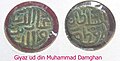 copper coin of Muhammad Damghani
 -
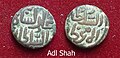 A copper coin of Adl Shah
 -
 Coin of Fakhr-ud-Din Mubarak Shah, Sultan of Madurai Sultanate, 1358–1368 CE.
 -
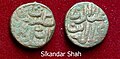 A copper coin of Sikandar Shah the last ruler


Notes
- ↑ 'How Best Do We Survive?' A Modern Political History of the Tamil Muslims{{#if:|, {{{last}}}}(2012). ISBN 9781136198335
- ↑ Essays on Medieval India{{#if:|, {{{last}}}}(2003). ISBN 9788171416837
- ↑ Essays on Medieval India{{#if:|, {{{last}}}}(2003). ISBN 9788171416837
- ↑ Jalal al-Din Ahsan.
- ↑ Kusumāñjali:New Interpretation of Indian Art & Culture : Sh. C. Sivaramamurti Commemoration Volume · Volume 2{{#if:|, {{{last}}}}(1987)
- ↑ Template:Harvnb
- ↑ The East Asian Mediterranean: Maritime Crossroads of Culture, Commerce and Human Migration{{#if:|, {{{last}}}}. Otto Harrassowitz Verlag(2008). ISBN 978-3-447-05809-4
- ↑ Sen, Tansen (2006) “The Yuan Khanate and India: Cross-cultural Diplomacy in the Thirteenth and Fourteenth Centuries”. Asia Major 19 (1/2). Academia Sinica: 317. https://www.jstor.org/stable/41649921?seq=17.
- ↑ http://www.sino-platonic.org/complete/spp110_wuzong_emperor.pdf p. 15.
- ↑ 10.0 10.1 Jerry Bently, The Adventures of Ibn Battuta: A Muslim Traveler of the 14th Century by Ross E. Dunn (University of California Press, 1986),245.
- ↑ Largest Themed Shopping Mall in Dubai.
- ↑ A Comprehensive History of India: The Delhi Sultanat, A.D. 1206-1526, edited by Mohammad Habib and Khaliq Ahmad Nizami{{#if:|, {{{last}}}}(1970)
- ↑ Columbia Chronologies of Asian History and Culture{{#if:Bowman|, Bowman}. Columbia University Press(2000-09-05). ISBN 978-0-231-50004-3
Bibliography
Template:Commons category Template:Wikiquote
- South India and her Muhammadan Invaders. Humphrey Milford, Oxford University Press.
- Voyages d'Ibn Batoutah. La Societé Asiatique, L'Imprimerie Nationale.
- [{{{url}}} The Delhi Sultanate]. Mumbai: Bharatiya Vidya Bhavan.
- A History of South India: From Prehistoric Times to the Fall of Vijayanagar. Oxford University Press, Amen House, London.
- Madhura Vijaya (or Virakamparaya Charita): An Historical Kavya. Sridhara Power Press(1924).
- The travels of Ibn Batuta :translated from the abridged Arabic manuscript copies, preserved in the Public Library of Cambridge. With notes, illustrative of the history, geography, botany, antiquities, &c. occurring throughout the work. Oriental Translation Committee.
- Studying Early India: Archaeology, Texts and Historical Issues. Anthem Press.