
Template:Redirect Template:Pp-pc
Template:Population taxobox The Asiatic lion is a lion that belongs to the subspecies Panthera leo leo. The surviving population of these lions is restricted to the Indian state of Gujarat. It is classified as endangered in the IUCN Red List, is included on CITES Appendix I, and is legally protected in India.
Phylogeographic analysis reveal that the Asiatic lion is genetically closely related to the North and West African lions. The adult males measure up to Template:Cvt in shoulder height and weigh about Template:Cvt, making them slightly smaller than large African lions but similar to Central African populations. The Asiatic lion has a ruddy-tawny to sandy grey fur, a distinctive longitudinal skin fold along its belly, and a larger tail tuft. The males are distinguishable from the females by the presence of manes, though they are shorter and sparser than the African counterparts. It also differs from the African lion in skull structure, having a stronger sagittal crest, shorter post-orbital area, and often divided infraorbital foramina.
The first scientific description of the Asiatic lion published in 1826 was based on a specimen from Persia. Until the 19th century, it ranged from Saudi Arabia, eastern Turkey, Iran, Mesopotamia and southern Pakistan to Central India. Since the turn of the 20th century, its range has been restricted to the Gir National Park and its surrounding areas in Western India. The Indian population, which numbered only 411 individuals in 2010, has steadily increased since then. In 2015, the lion population was estimated at 523 individuals, which increased to 650 in 2017 and 674 by 2023. Template:As of, there was an estimated 891 lions in the wild.[1] Since the mid-1990s, due to increase in the Asiatic lion population, about a third resided outside the protected area, and the conflict between local residents and the lions have increased.
Male Asiatic lions are often solitary or form small coalitions of up to three, while females live in larger prides with the cubs. Males and females usually only associate briefly during mating. In the Gir National Park, they are mainly nocturnal and defend territories, whose size varies. They prefer dense vegetation or shaded riverine habitats in dry periods. They prefer large prey and commonly hunt chital, sambar, nilgai, and other livestock, and may also scavenge or prey on species such as wild boar and mugger crocodiles near water sources.
Taxonomy
Felis leo persicus was the scientific name proposed by Johann N. Meyer in 1826 who described an Asiatic lion skin from Persia.[2] In the 19th century, several zoologists described lion zoological specimen from other parts of Asia that used to be considered synonyms of P. l. persica:[3]
- Felis leo bengalensis proposed by Edward Turner Bennett in 1829 was a lion kept in the menagerie of the Tower of London. Bennett's essay contains a drawing titled 'Bengal lion'.[4]
- Felis leo goojratensis proposed by Walter Smee in 1833 was based on two skins of maneless lions from Gujarat that Smee exhibited in a meeting of the Zoological Society of London.[5]
- Leo asiaticus proposed by Sir William Jardine, 7th Baronet in 1834 was a lion from India.[6]
- Felis leo indicus proposed by Henri Marie Ducrotay de Blainville in 1843 was based on an Asiatic lion skull.[7]
In 2017, the Asiatic lion was subsumed to P. l. leo due to close morphological and molecular genetic similarities with Barbary lion specimens.[8][9] However, several scientists continue using P. l. persica for the Asiatic lion.[10][11][12][13][14][15] A standardised haplogroup phylogeny supports that the Asiatic lion is not a distinct subspecies, and that it represents a haplogroup of the northern P. l. leo.[16]
Evolution
Template:Main Lions first left Africa at least 700,000 years ago, giving rise to the Eurasian Panthera fossilis which later evolved into Panthera spelaea (commonly known as the cave lion), which became extinct around 14,000 years ago. Genetic analysis of P. spelaea indicates that it represented a distinct species from the modern lion that diverged from them around 500,000 years ago and unrelated to modern Asian lions.[17] Pleistocene fossils assigned as belonging or probably belonging to the modern lion have been reported from several sites in the Middle East, such as Shishan Marsh in the Azraq Basin, Jordan, dating to around 250,000 years ago,[18] and Wezmeh Cave in the Zagros Mountains of western Iran, dating to around 70–10,000 years ago,[19] with other reports from Pleistocene deposits in Nadaouiyeh Ain Askar and Douara Cave, Syria.[18] In 1976, fossil lion remains were reported from Pleistocene deposits in West Bengal.[20] A fossil carnassial excavated from Batadomba Cave indicates that lions inhabited Sri Lanka during the Late Pleistocene. This population may have become extinct around 39,000 years ago, before the arrival of humans in Sri Lanka.[21]
Phylogeography

Results of a phylogeographic analysis based on mtDNA sequences of lions from across the global range, including now extinct populations like Barbary lions, indicates that sub-Saharan African lions are phylogenetically basal to all modern lions. These findings support an African origin of modern lion evolution with a probable centre in East and Southern Africa. It is likely that lions migrated from there to West Africa, eastern North Africa and via the periphery of the Arabian Peninsula into Turkey, southern Europe and northern India during the last 20,000 years. The Sahara, Congolian rainforests and the Great Rift Valley are natural barriers to lion dispersal.[22]
Genetic markers of 357 samples from captive and wild lions from Africa and India were examined. Results indicate four lineages of lion populations: one in Central and North Africa to Asia, one in Kenya, one in Southern Africa, and one in Southern and East Africa; the first wave of lion expansion probably occurred about 118,000 years ago from East Africa into West Asia, and the second wave in the late Pleistocene or early Holocene periods from Southern Africa towards East Africa.[23] The Asiatic lion is genetically closer to North and West African lions than to the group comprising East and Southern African lions. The two groups probably diverged about 186,000–128,000 years ago. It is thought that the Asiatic lion remained connected to North and Central African lions until gene flow was interrupted due to extinction of lions in Western Eurasia and the Middle East during the Holocene.[24][25]
Asiatic lions are less genetically diverse than African lions, which may be the result of a founder effect in the recent history of the remnant population in the Gir forest.[26]
Characteristics

The Asiatic lion's fur ranges in colour from ruddy-tawny, heavily speckled with black, to sandy or buffish grey, sometimes with a silvery sheen in certain lighting. Males have only moderate mane growth at the top of the head, so that their ears are always visible. The mane is scanty on the cheeks and throat, where it is only Template:Cvt long. About half of Asiatic lions' skulls from the Gir forest have divided infraorbital foramina, whereas African lions have only one foramen on either side. The sagittal crest is more strongly developed, and the post-orbital area is shorter than in African lions. Skull length in adult males ranges from Template:Cvt, and in females, from Template:Cvt. It differs from the African lion by a larger tail tuft and less inflated auditory bullae.[3] The most striking morphological character of the Asiatic lion is a longitudinal fold of skin running along its belly.[27]
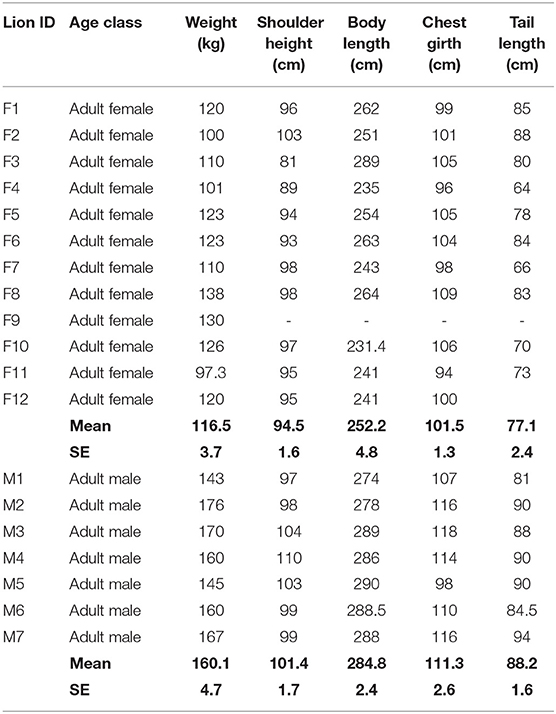
Males have a shoulder height of up to Template:Cvt, and females of Template:Cvt.[28] Two lions in Gir forest measured Template:Cvt from head to body with a Template:Cvt long tail of and total lengths of Template:Cvt. The Gir lion is similar in size to the Central African lion,[3] and smaller than large African lions.[29] An adult male Asiatic lion weighs Template:Cvt on average with the limit being Template:Cvt; a wild female weighs Template:Cvt.[30][31][32]
Manes

Colour and development of manes in male lions varies between regions, among populations and with age of lions.[33] In general, the Asiatic lion differs from the African lion by a less developed mane.[3] The manes of most lions in ancient Greece and Asia Minor were also less developed and did not extend to below the belly, sides or ulnas. Lions with such smaller manes were also known in the Syrian region, Arabian Peninsula and Egypt.[34][35]
Exceptionally sized lions
The confirmed record for the total length of a male Asiatic lion is Template:Cvt, including the tail.[36] Mughal emperor Jahangir allegedly speared a lion in the 1620s that measured Template:Cvt and weighed Template:Cvt.[37] In 1841, English traveller Austen Henry Layard, who accompanied hunters in Khuzestan, Iran, sighted a lion which "had done much damage in the plain of Ram Hormuz," before one of his companions killed it. He described it as being "unusually large and of very dark brown colour", with some parts of its body being almost black.[38] In 1935, a British admiral claimed to have sighted a maneless lion near Quetta in Pakistan. He wrote "It was a large lion, very stocky, light tawny in colour, and I may say that no one of us three had the slightest doubt of what we had seen until, on our arrival at Quetta, many officers expressed doubts as to its identity, or to the possibility of there being a lion in the district."[39]
Distribution and habitat

In Saurashtra's Gir forest, an area of Template:Cvt was declared as a sanctuary for Asiatic lion conservation in 1965. This sanctuary and the surrounding areas are the only habitats supporting the Asiatic lion.[40] After 1965, a national park was established covering an area of Template:Cvt where human activity is not allowed. In the surrounding sanctuary only Maldharis have the right to take their livestock for grazing.[41]
Lions inhabit remnant forest habitats in the two hill systems of Gir and Girnar that comprise Gujarat's largest tracts of tropical and subtropical dry broadleaf forests, thorny forest and savanna, and provide valuable habitat for a diverse flora and fauna. Five protected areas currently exist to protect the Asiatic lion: Gir National Park, Gir, Pania, Girnar, and Mitiyala Wildlife Sanctuaries. The first three protected areas form the Gir Conservation Area, a Template:Cvt large forest block that represents the core habitat of the lion population. The other two sanctuaries Mitiyala and Girnar protect satellite areas within dispersal distance of the Gir Conservation Area. An additional sanctuary is being established in the nearby Barda Wildlife Sanctuary to serve as an alternative home for lions.[40][42] The drier eastern part is vegetated with acacia thorn savanna and receives about Template:Cvt annual rainfall; rainfall in the west is higher at about Template:Cvt per year.[30]
The lion population recovered from the brink of extinction to 411 individuals by 2010. In that year, approximately 105 lions lived outside the Gir forest, representing a quarter of the entire lion population. Dispersing sub-adults established new territories outside their natal prides, and as a result the satellite lion population has been increasing since 1995.[40] By 2015, the total population had grown to an estimated 523 individuals, inhabiting an area of Template:Cvt in the Saurashtra region., comprising 109 adult males, 201 adult females and 213 cubs.[43][10][44] The Asiatic Lion Census conducted in 2017 revealed about 650 individuals.[45]
By 2020, at least six satellite populations had spread to eight districts in Gujarat and live in human-dominated areas outside the protected area network.[46] 104 lived near the coastline. Lions living along the coast, as well as those between the coastline and the Gir forest, have larger individual ranges.[47] By the time of the census, approximately 300–325 lions lived within the Gir preserve itself. The remainder of the population was instead spread across the adjoining Amreli, Bhavnagar, and Gir Somnath Districts, with populations recorded in the Girnar, Mitiyala, and Pania Wildlife Sanctuaries in addition to areas outside protected zones.[45][48] In 2024 and 2025, lions began swimming to Diu Island, separated from the mainland of Gujarat by a narrow channel. These individuals were relocated to Gujarat on request of the Diu administration over concerns of disruption to human life, although conservationists protested the removal as unnecessary.[48]
Former range
During the Holocene, from around 6,500 years ago and possibly as early as 8,000 years ago, modern lions colonised Southeast Europe (including modern Bulgaria and Greece in the Balkans), as well as parts of Central Europe like Hungary and Ukraine in Eastern Europe. Analysis of remains of these European lions suggests that they do not differ from those of modern Asiatic lions, and they should be assigned to this population.[49] Historical records suggest that lions became extinct in Europe during Classical antiquity,[50] though it has been suggested that they may have survived as late as the Middle Ages in Ukraine.[49]


The Asiatic lion used to occur in Arabia, the Levant, Mesopotamia and Baluchistan.[3] In South Caucasia, it was known since the Holocene and became extinct in the 10th century. Until the middle of the 19th century, it survived in regions adjoining Mesopotamia and Syria, and was still sighted in the upper reaches of the Euphrates River in the early 1870s.[34][52] By the late 19th century, it had become extinct in Saudi Arabia and Turkey.[53][54] The last known lion in Iraq was killed on the lower Tigris in 1918.[55]
Historical records in Iran indicate that it ranged from the Khuzestan Plain to Fars province at elevations below Template:Cvt in steppe vegetation and pistachio-almond woodlands.[56] It was widespread in the country, but in the 1870s, it was sighted only on the western slopes of the Zagros Mountains, and in the forest regions south of Shiraz.[34] It served as the national emblem and appeared on the country's flag. Some of the country's last lions were sighted in 1941 between Shiraz and Jahrom in Fars province, and in 1942, a lion was spotted about Template:Cvt northwest of Dezful.[57] In 1944, the corpse of a lioness was found on the banks of the Karun River in Iran's Khuzestan province.[58][59]
In India, the Asiatic lion occurred in Sind, Bahawalpur, Punjab, Gujarat, Rajasthan, Haryana, Bihar and eastward as far as Palamau and Rewa, Madhya Pradesh in the early 19th century.[60][38] It once ranged to Bangladesh in the east and up to Narmada River in the south.[38] Because of the lion's restricted distribution in India, Reginald Innes Pocock assumed that it arrived from Europe, entering southwestern Asia through Balochistan only recently, before humans started limiting its dispersal in the country. The advent and increasing availability of firearms led to its local extirpation over large areas.[3] Heavy hunting by British colonial officers and Indian rulers caused a steady and marked decline of lion numbers in the country.[41] Lions were exterminated in Palamau by 1814, in Baroda State, Hariana and Ahmedabad district in the 1830s, in Kot Diji and Damoh district in the 1840s. During the Indian Rebellion of 1857, a British officer shot 300 lions. The last lions of Gwalior and Rewah were shot in the 1860s. One lion was killed near Allahabad in 1866.[60] The last lion of Mount Abu in Rajasthan was spotted in 1872.[61] By the late 1870s, lions were extinct in Rajasthan.[38] By 1880, no lion survived in Guna, Deesa and Palanpur districts, and only about a dozen lions were left in Junagadh district. By the turn of the century, the Gir forest held the only Asiatic lion population in India, which was protected by the Nawab of Junagarh in his private hunting grounds.[3][38]
Ecology and behaviour

Male Asiatic lions are solitary, or associate with up to three males, forming a loose pride. Pairs of males rest, hunt and feed together, and display marking behaviour at the same sites. Females associate with up to twelve other females, forming a stronger pride together with their cubs. Female and male lions usually associate only for a few days when mating, but rarely live and feed together.[62][63]
Results of a radio telemetry study indicate that annual home ranges of male lions vary from Template:Cvt in dry and wet seasons. Home ranges of females are smaller, varying between Template:Cvt.[64] During hot and dry seasons, they favour densely vegetated and shady riverine habitats, where prey species also congregate.[65][66] Coalitions of males defend home ranges containing one or more female prides.[67] Together, they hold a territory for a longer time than single lions. Males in coalitions of three to four individuals exhibit a pronounced hierarchy with one male dominating the others.[68]
The lions in Gir National Park often spend the day resting and are more active at twilight and by night.[14][69] Studies on captive Asiatic lions also indicated that they spent nearly most of the day time lying down or inactive, with juveniles spending slightly lesser time on inactive behaviours. The activity increased towards the twilight hours, when the lions spend more time on feeding, and walking. They also sometimes engage in self and social grooming.[70] The lions also showed various levels of increased activity in response to perceived threat or other stimuli.[71]
Feeding ecology

In general, lions prefer large prey species within a weight range of Template:Cvt, irrespective of their availability.[72] In the Gir forest, the lions' prey includes chital (Axis axis), nilgai (Boselaphus tragocamelus), sambar (Rusa unicolor), and less frequently wild boar (Sus scrofa).[64] They most commonly kill chital, which weighs around Template:Cvt on average.[67] They prey on sambar deer when the latter descend from the hills during the summer. Outside the protected area where wild prey species do not occur, Domestic cattle (Bos taurus), and water buffalo (Bubalus bubalis) have historically formed a major component of the Asiatic lions' diet in the Gir region.[3] They also rarely prey on dromedary (Camelus dromedarius).[64] They regularly visit specific sites within the protected area to scavenge on dead livestock dumped by Maldhari livestock herders.[73] During dry, hot months, they have also been noticed to prey on mugger crocodiles (Crocodylus palustris) on the banks of Kamleshwar Dam.[59]Template:Rp
In 1974, the Indian forest department estimated the wild ungulate population of the Gir forest at 9,650 individuals. In the following decades, with the decline of the lion population, the population of the ungulates grew consistently to 31,490 in 1990 and 64,850 in 2010, including 52,490 chital, 4,440 wild boar, 4,000 sambar, 2,890 nilgai, 740 chinkara (Gazella bennetti), and 290 four-horned antelope (Tetracerus quadricornis). The populations of domestic buffalo and cattle declined from 24,250 individuals in the 1970s declined to 12,500 by the mid-1980s in the Gir Conservation Area, largely following the resettlement of people. Though, the population of livestock later increased to 23,440 animals by 2010, the Asiatic lions had shifted their predation patterns by then, and very few livestock kills occurred within the sanctuary. Most of these kills occur in peripheral villages instead, and predation records indicate that the lions killed on average 2,023 livestock annually between 2005 and 2009, and an additional 696 individuals in satellite areas in around the Gir forest.[40]

The lions generally kill most prey less than Template:Cvt away from water bodies. They usually charge towards the prey from close range and generally jump on the backs of large prey to bring them down.[64] They might also trip the legs of smaller prey, and later use their powerful jaws to snap the animal's neck or to strangle it to death.[74] They later drag the hunted carcasses into dense cover.[64]
The nocturnal behaviour of the lions shows a high temporal overlap with its prey such as nilgai, sambar, and wild boar.[14][69] Females share large carcasses among each other, but seldom with males.[62] Dominant males consume about 47% more from kills than their coalition partners. Aggression between partners increases when coalitions are large, but kills are small.[68] In the Gir forest, the lionesses often made kills at times when they were least likely to be encountered by males, to prevent the carcass being shared with or stolen by males. The level of kleptoparasitism was lower in Asiatic lions, compared to their African counterparts. The lions spend more time eating hunted prey, rather than scavenged carcasses.[69]
Reproduction

Asiatic lions mate foremost between October and November.[75] Mating lasts three to six days. During these days, they usually do not hunt, but only drink water. Gestation lasts about 110 days. Litters comprise one to four cubs.[76] The average interval between births is 24 months, unless cubs die due to infanticide by adult males or because of diseases and injuries. Cubs become independent at the age of about two years. Subadult males leave their natal pride latest at the age of three years and become nomads until they establish their own territory.[63] Dominant males mate more frequently than their coalition partners. During a study carried out between December 2012 and December 2016, three females were observed switching mating partners in favour of the dominant male.[68] Monitoring of more than 70 mating events showed that females mated with males of several rivaling prides that shared their home ranges, and that these males were tolerant toward the same cubs. Only new males that entered the female territories killed unfamiliar cubs. Young females mated foremost with males within their home ranges. Older females selected males at the periphery of their home ranges.[77]
Threats
.jpg)
The Asiatic lion currently exists as a single subpopulation, and is thus vulnerable to extinction from unpredictable events, such as an epidemic or large forest fire. There are indications of poaching incidents in recent years, as well as reports that organized poacher gangs have switched attention from local Bengal tigers to the Gujarat lions. There have also been a number of drowning incidents, after lions fell into wells.[78]
Prior to the resettlement of Maldharis, the Gir forest was heavily degraded and used by livestock, which competed with and restricted the population sizes of native ungulates. Various studies reveal tremendous habitat recovery and increases in wild ungulate populations following the resettlement of Maldharis since the 1970s.[40]
Nearly 25 lions in the vicinity of Gir forest were found dead in October 2018. Four of them had died because of canine distemper virus, the same virus that had also killed several lions in the Serengeti.[79][80]
Conflicts with humans
Since the mid-1990s, the Asiatic lion population has increased to an extent that by 2015, about a third resided outside the protected area. Hence, conflict between local residents and wildlife also increased. Local people protect their crops from nilgai, wild boar, and other herbivores by using electrical fences that are powered with high voltage. Some consider the presence of predators a benefit, as they keep the herbivore population in check. But some also fear the lions, and killed several in retaliation for attacks on livestock.[81]
In July 2012, a lion dragged a man from the veranda of his house and killed him about Template:Cvt from Gir National Park. This was the second attack by a lion in this area, six months after a 25-year-old man was attacked and killed in Dhodadar.[82]
Conservation
Panthera leo persica was included on CITES Appendix I,[83] and is fully protected in India,[39] where it is considered endangered.[84]
Reintroduction

India
Template:Main In the 1950s, biologists advised the Indian government to re-establish at least one wild population in the Asiatic lion's former range to ensure the population's reproductive health and to prevent it from being affected by an outbreak of an epidemic. In 1956, the Indian Board for Wildlife accepted a proposal by the Government of Uttar Pradesh to establish a new sanctuary for the envisaged reintroduction, Chandra Prabha Wildlife Sanctuary, covering Template:Cvt in eastern Uttar Pradesh, where climate, terrain and vegetation is similar to the conditions in the Gir forest. In 1957, one male and two female wild-caught Asiatic lions were set free in the sanctuary. This population comprised 11 animals in 1965, which all disappeared thereafter.[85]
The Asiatic Lion Reintroduction Project to find an alternative habitat for reintroducing Asiatic lions was pursued in the early 1990s. Biologists from the Wildlife Institute of India assessed several potential translocation sites for their suitability regarding existing prey population and habitat conditions. The Palpur-Kuno Wildlife Sanctuary in northern Madhya Pradesh was ranked as the most promising location, followed by Sita Mata Wildlife Sanctuary and Darrah National Park.[86] Until 2000, 1,100 families from 16 villages had been resettled from the Palpur-Kuno Wildlife Sanctuary, and another 500 families from eight villages were expected to be resettled. With this resettlement scheme the protected area was expanded by Template:Cvt.[85][87]
Gujarat state officials resisted the relocation, since it would make the Gir Sanctuary lose its status as the world's only home of the Asiatic lion. Gujarat raised a number of objections to the proposal, and thus the matter went before the Indian Supreme Court. In April 2013, the Indian Supreme Court ordered the Gujarat state to send some of their Gir lions to Madhya Pradesh to establish a second population there.[88] The Gujarat state government has resisted relocation of lions to other states.[89]
Iran
Template:See also In 1977, Iran attempted to restore its lion population by transporting Gir lions to Arzhan National Park, but the project met resistance from the local population, and thus it was not implemented.[52][57] However, this did not stop Iran from seeking to bring back the lion.[90][91] In February 2019, Tehran Zoological Garden obtained a male Asiatic lion from Bristol Zoo in the United Kingdom,[92] followed in June by a female from Dublin Zoo. There are hopes for them to successfully reproduce.[93]
In captivity
.jpg)

Until the late 1990s, captive Asiatic lions in Indian zoos were haphazardly interbred with African lions confiscated from circuses, leading to genetic pollution in the captive Asiatic lion stock. Once discovered, this led to the complete shutdown of the European and American endangered species breeding programs for Asiatic lions, as its founder animals were captive-bred Asiatic lions originally imported from India and were ascertained to be intraspecific hybrids of African and Asian lions. In North American zoos, several Indian-African lion crosses were inadvertently bred, and researchers noted that "the fecundity, reproductive success, and spermatozoal development improved dramatically."[94][95]
DNA fingerprinting studies of Asiatic lions have helped in identifying individuals with high genetic variability, which can be used for conservation breeding programs.[96]
In 2006, the Central Zoo Authority of India stopped breeding Indian-African cross lions stating that "hybrid lions have no conservation value and it is not worth to spend resources on them".[94][97] Now only pure native Asiatic lions are bred in India.
In 1972 the Sakkarbaug Zoo sold a pair of young pure-stock lions to the Fauna Preservation Society; which decided they would be accommodated at the Jersey Wildlife Trust where it was hoped to begin a captive breeding programme.[98]
The Asiatic lion International Studbook was initiated in 1977, followed in 1983 by the North American Species Survival Plan (SSP).[99] The North American population of captive Asiatic lions was composed of descendants of five founder lions, three of which were pure Asian and two were African or African-Asian hybrids. The lions kept in the framework of the SSP consisted of animals with high inbreeding coefficients.[27]
In the early 1990s, three European zoos imported pure Asiatic lions from India: London Zoo obtained two pairs; the Zürich Zoologischer Garten one pair; and the Korkeasaari Zoo in Helsinki one male and two females. In 1994, the European Endangered Species Programme (EEP) for Asiatic lions was initiated. The European Association of Zoos and Aquaria (EAZA) published the first European Studbook in 1999. By 2005, there were 80 Asiatic lions kept in the EEP – the only captive population outside of India.[99] As of 2009, more than 100 Asiatic lions were kept within the EEP. The SSP had not resumed; pure-bred Asiatic lions are needed to form a new founder population for breeding in American zoos.[100]
In culture
South and East Asia

Neolithic cave paintings of lions were found in Bhimbetka rock shelters in Central India, which are at least 30,000 years old.[101] The lion was a prominent symbol in various cultures and countries in South and East Asia.
- The Sanskrit word for 'lion' is Template:Lang Template:IAST.[102] Siṃha is one of the twelve months in the Hindu calendar.[103][104] It is one of the twelve rāśis, that corresponds to Leo of the Zodiac.[102]
- The Sanskrit name of Sri Lanka is 'Simhala' meaning 'Abode of lions' or 'Simhaladvipah' meaning 'Lion Island'.[105][106] The Emblem and Flag of Sri Lanka consists of a golden lion passant holding a sword.[107]
- Singapore derives its name from the Malay words Template:Lang 'lion' and Template:Lang 'city', which in turn is from the Sanskrit Template:Lang Template:IAST and Template:Lang Template:IAST, latter also meaning 'fortified town'.[102][108] The Coat of arms of Singapore consists of a lion dexter.[109][110]
- In early Buddhist architecture, the lion was considered auspicious, and hence it appeared as a symbol in various pillars and depiction of the Mauryan period (4th to 2nd century BCE).[111] The Lion Capital of Ashoka, erected by the Mauryan emperor Ashoka in Sarnath (Template:Circa), consists of four lions, and later formed the basis of the Emblem of India.[112][113]
- Bharat Mata, the national personification of India, is sometimes depicted accompanied by a lion.[114]
- In Hindu mythology, the half man, half lion avatar of Narasimha is the fourth of the ten incarnations of Vishnu.[115] The Hindu goddess Durga is depicted as riding a lion as her vahana (mount).[116]
- In the Hindu epic of Mahabharata, Bharata is mentioned to deprive lions of their prowess.[117]
- The lion is the symbol of Mahavira, the 24th and last Tirthankara in Jainism.[118][119]
- The lion plays a prominent role in the Panchatantra, a collection of Indian animal fables, that was translated into Persian, Greek, and Hebrew languages as The Fables of Pilpay between the 8th and 12th centuries.[120]
- In Meitei mythology and Sanamahism, Kanglā shā is a sacred guardian beast with a lion's body and a two-horned dragon's head.[121][122]
- The earliest known Chinese stone sculptures of lions date to the Han dynasty at the turn of the first millennium.[123] The lion dance is a traditional dance in Chinese culture that is strongly associated with Buddhism and known since at least the Han dynasty.[124]
- Simhamukha is a lion-faced protector and dakini in Tibetan Buddhism.[125]
- The lion is the third animal of the Burmese zodiac and the sixth animal of the Sinhalese zodiac.[126]
- Cambodia has a native martial art called Bokator (Template:Langx, pounding a lion).[127]
West Asia and Europe


Lions are depicted on vases dating to about 2600 BCE that were excavated near Lake Urmia in Iran.[128] The lion was an important symbol in Ancient Iraq and is depicted in a stone relief at Nineveh in the Mesopotamian Plain.[129][130]
- The lion makes appearances in the Bible, most notably as having fought Samson in the Book of Judges.[131]
- The Lion of Judah is a Jewish national and cultural symbol, traditionally regarded as the symbol of the tribe of Judah. It is mentioned in the blessing given by Jacob to his fourth son, Judah, in the Book of Genesis of the Hebrew Bible.[132]
- Having occurred in the Arab world, particularly the Arabian Peninsula,[34] the Asiatic lion has significance in Arab and Islamic culture. For example, Surah al-Muddaththir of the Quran criticizes people who were averse to the Islamic Prophet Muhammad's teachings, such as that the rich have an obligation to donate wealth to the poor, comparing their attitude to itself, with the response of prey to a qaswarah (Template:Langx, meaning "lion", "beast of prey", or "hunter").[133] Other Arabic words for 'lion' include asad (Template:Langx) and sabaʿ (Template:Langx),[134] and they can be used as names of places, or titles of people. An Arabic toponym for the Israeli City of Beersheba (Template:Langx) can mean "Spring of the Lion."[135] Ali ibn Abi Talib and Hamzah ibn Abdul-Muttalib, who were loyal kinsmen of Muhammad, were given titles like Asad Allah (Template:Langx).[136]
- The Lion of Babylon is an ancient Babylonian symbol, which represented the King of Babylon.[137] The lion of Babylon is a statue at the Ishtar Gate in Babylon.[52] The lion has an important association with the figure Gilgamesh, as demonstrated in his epic.[138] The lion featured in the coat of arms of Iraq in the early 20th century and the Iraqi national football team is nicknamed "Lions of Mesopotamia."[139]
- The symbol of the lion is closely tied to the Persian people. Achaemenid kings were known to carry the symbol of the lion on their thrones and garments. The name 'Shir' (also pronounced 'Sher') (Template:Langx) is a part of the names of many places in Iran and Central Asia, like those of city of Shiraz and the Sherabad River, and had been adopted into other languages, like Hindi.[3][34][52] The Shir-va-Khorshid (Template:Langx, "Lion and Sun") is one of the most prominent symbols of Iran, dating back to the Safavid dynasty, and was used on the flag of Iran until 1979.[140]
- The lion was an objective of hunting in the Caucasus, by both locals and foreigners. The locals were called 'Shirvanshakhs'.[34]
- The Nemean lion of pre-literate Greek myth is associated with the Labours of Hercules.[141]
- A Bronze Age statue of a lion from either Southern Italy or southern Spain from around 1000–1200 years BCE, the "Mari-Cha Lion", was exhibited at the Louvre Abu Dhabi.[142]
- Damnatio ad bestias was a form of Roman capital punishment where the condemned person was killed by wild animals, usually lions. Games held at the Colosseum included events where gladiators fought lions.[143]
See also
References
- ↑ India's Asiatic lion population rises by a third. RTÉ.ie(21 May 2025). Retrieved 1 June 2025.
- ↑ Template:Cite thesis
- ↑ 3.0 3.1 3.2 3.3 3.4 3.5 3.6 3.7 3.8 The Fauna of British India, including Ceylon and Burma{{#if:Pocock|, Pocock}. Taylor and Francis Ltd.(1939)
- ↑ The Tower Menagerie, Comprising the Natural History of the Animals Contained in That Establishment; With Anecdotes of Their Characters and History{{#if:Bennett|, Bennett}. Robert Jennings(1829)
- ↑ Felis leo, Linn., Var. goojratensis. Proceedings of the Zoological Society of London({Template:Year).
- ↑ Natural History of the Felinae. Series: Naturalist's library{{#if:Jardine|, Jardine}. H. G. Bohn(1834)
- ↑ Ostéographie, ou Description iconographique comparée du squelette et du système dentaire des mammifères récents et fossiles pour servir de base à la zoologie et à la géologie.{{#if:Blainville|, Blainville}. J.B. Ballière et fils(1843)
- ↑ A revised taxonomy of the Felidae: The final report of the Cat Classification Task Force of the IUCN Cat Specialist Group. Cat News({Template:Year).
- ↑ Divided infraorbital foramen in the lion (Panthera leo): its implications for colonisation history, population bottlenecks, and conservation of the Asian lion (P. l. persica). Contributions to Zoology({Template:Year).
- ↑ 10.0 10.1 Dispersion of the Asiatic lion Panthera leo persica and its survival in human-dominated landscape outside the Gir forest, Gujarat, India. Current Science({Template:Year).
- ↑ Estimation of the Status of Asiatic Lion (Panthera leo persica) Population in Gir Lion Landscape, Gujarat, India. Indian Forester({Template:Year).
- ↑ Chronological distribution of the tiger Panthera tigris and the Asiatic lion Panthera leo persica in their common range in Asia. Mammal Review({Template:Year).
- ↑ Using longitudinal data to evaluate the behavioural impact of a switch to carcass feeding on an Asiatic lion (Panthera leo persica). Journal of Zoo and Aquarium Research({Template:Year).
- ↑ 14.0 14.1 14.2 Spatio-temporal partitioning and coexistence between leopard (Panthera pardus fusca) and Asiatic lion (Panthera leo persica) in Gir protected area, Gujarat, India. PLOS ONE({Template:Year).
- ↑ Biogeographical distribution of Asiatic Lion (Panthera leo persica), Cheetah (Acinonyx jubatus venaticus) in ancient, medieval and modern Rajasthan: Study of plans to relocate them in Rajasthan. Indian Journal of Environmental Sciences({Template:Year).
- ↑ From Caves to the Savannah, the Mitogenome History of Modern Lions (Panthera leo) and Their Ancestors. International Journal of Molecular Sciences({Template:Year).
- ↑ The evolutionary history of extinct and living lions. Proceedings of the National Academy of Sciences of the United States of America({Template:Year).
- ↑ 18.0 18.1 Faunal remains from recent excavations at Shishan Marsh 1 (SM1), a Late Lower Paleolithic open-air site in the Azraq Basin, Jordan. Quaternary Research({Template:Date).
- ↑ Carnivores and their prey in the Wezmeh Cave (Kermanshah, Iran): a Late Pleistocene refuge in the Zagros. International Journal of Osteoarchaeology({Template:Date).
- ↑ Occurrence of fossil lion and spotted hyena from Pleistocene deposits of Susunia, Bankura District, West Bengal. Journal of the Geological Society of India({Template:Year).
- ↑ A second extinct big cat from the late Quaternary of Sri Lanka. The Raffles Bulletin of Zoology({Template:Year).
- ↑ The origin, current diversity and future conservation of the modern lion (Panthera leo). Proceedings of the Royal Society B({Template:Year).
- ↑ The evolutionary dynamics of the Lion Panthera leo revealed by host and viral population genomics. PLOS Genetics({Template:Year).
- ↑ Genetic diversity, evolutionary history and implications for conservation of the lion (Panthera leo) in West and Central Africa. Journal of Biogeography({Template:Year).
- ↑ Phylogeographic patterns in Africa and High Resolution Delineation of genetic clades in the Lion (Panthera leo). Scientific Reports({Template:Year).
- ↑ Biochemical genetic variation in geographic isolates of African and Asiatic lions. National Geographic Research({Template:Year).
- ↑ 27.0 27.1 Evidence for African origins of founders of the Asiatic lion Species Survival Plan. Zoo Biology({Template:Year).
- ↑ Natural History of the Mammalia of India and Ceylon{{#if:Sterndale|, Sterndale}. Thacker, Spink and Co.(1884)
- ↑ Comparative growth of wild male and female lions (Panthera leo). Journal of Zoology({Template:Year).
- ↑ 30.0 30.1 Mammals as predators: the proceedings of a symposium held by the Zoological Society of London and the Mammal Society, London. Volume 65 of Symposia of the Zoological Society of London{{#if:|, {{{last}}}}. Zoological Society of London(1993)
- ↑ Asiatic Lion: Ecology, Economics, and Politics of Conservation. Frontiers in Ecology and Evolution({Template:Date).
- ↑ Measurements, Asiatic Lion. Retrieved 1 June 2025.
- ↑ Panthera leo. Mammalian Species({Template:Year).
- ↑ 34.0 34.1 34.2 34.3 34.4 34.5 Mlekopitajuščie Sovetskogo Soiuza. Moskva: Vysšaia Škola{{#if:|, {{{last}}}}. Smithsonian Institution and the National Science Foundation(1992). ISBN 978-90-04-08876-4
- ↑ Lost populations and preserving genetic diversity in the lion Panthera leo: Implications for its ex situ conservation. Conservation Genetics({Template:Year).
- ↑ Template:Cite thesis
- ↑ Big Cats{{#if:Brakefield|, Brakefield}. Voyageur Press(1993). ISBN 978-1-61060-354-6
- ↑ 38.0 38.1 38.2 38.3 38.4 The past and present distribution of the lion in south eastern Asia. Journal of the Bombay Natural History Society({Template:Year).
- ↑ 39.0 39.1 Wild Cats: Status Survey and Conservation Action Plan{{#if:|, {{{last}}}}. IUCN/SSC Cat Specialist Group(1996). ISBN 978-2-8317-0045-8
- ↑ 40.0 40.1 40.2 40.3 40.4 A conservation success story in the otherwise dire megafauna extinction crisis: The Asiatic lion (Panthera leo persica) of Gir forest. Biological Conservation({Template:Year).
- ↑ 41.0 41.1 The Asiatic Lion and the Maldharis of Gir Forest. The Journal of Environment & Development({Template:Year).
- ↑ Asiatic Lion. Retrieved 1 June 2025.
- ↑ Human Animal Conflict in Agro-Pastoral Context: Issues & Policies{{#if:Venkataraman|, Venkataraman}. Indian Council of Agricultural Research(2016)
- ↑ The Asiatic Lion (Panthera leo persica): 50 years journey for conservation of an Endangered carnivore and its habitat in Gir Protected Area, Gujarat, India. Indian Forester({Template:Year).
- ↑ 45.0 45.1 Lion population roars to 650 in Gujarat forests. The Times of India(2017). Retrieved 9 August 2017.
- ↑ Building walls around open wells prevent Asiatic Lion Panthera leo persica (Mammalia: Carnivora: Felidae) mortality in the Gir Lion Landscape, Gujarat, India. Journal of Threatened Taxa({Template:Year).
- ↑ Why are India's lions increasingly swapping the jungle for the beach?. The Guardian(19 May 2023). Retrieved 26 May 2023.
- ↑ 48.0 48.1 Have Asiatic lions from Gujarat found a new home in Diu?. Hindustan Times(14 February 2025). Retrieved 15 February 2025.
- ↑ 49.0 49.1 The Quaternary lions of Ukraine and a trend of decreasing size in Panthera spelaea. Journal of Mammalian Evolution({Template:Date).
- ↑ Past and present distribution of the North African-Asian lion subgroup: a review. Mammal Review({Template:Year).
- ↑ Men with live lion, Sevruguin, A.. National Museum of Ethnology in Leiden, The Netherlands; Stephen Arpee Collection(1880). Retrieved 26 March 2018.
- ↑ 52.0 52.1 52.2 52.3 Lion and Gazelle: The Mammals and Birds of Iran{{#if:|, {{{last}}}}. Images Publishing(1999). ISBN 978-0-9513977-6-3
- ↑ Wildlife conservation and development in Saudi Arabia{{#if:Nader|, Nader}. National Commission for Wildlife Conservation and Development Publishing(1989)
- ↑ Hunting in Turkey{{#if:Üstay, A. H.|, Üstay, A. H.}. BBA(1990)
- ↑ The mammals of Iraq{{#if:Hatt|, Hatt}. Museum of Zoology, University of Michigan(1959)
- ↑ The lair of the lion in Iran. Cat News({Template:Year).
- ↑ 57.0 57.1 The complete fauna of Iran{{#if:Firouz|, Firouz}. I. B. Tauris(2005). ISBN 978-1-85043-946-2
- ↑ Simba: The Life of the Lion{{#if:Guggisberg|, Guggisberg}. Howard Timmins(1961)
- ↑ 59.0 59.1 Gir Forest and the saga of the Asiatic lion{{#if:Mitra|, Mitra}. Indus(2005). ISBN 978-81-7387-183-2
- ↑ 60.0 60.1 The Fauna of British India, including Ceylon and Burma. Mammalia{{#if:Blanford|, Blanford}. Taylor and Francis(1889)
- ↑ Faunal Heritage of Rajasthan, India: Conservation and Management of Vertebrates{{#if:|, {{{last}}}}. Springer Science & Business Media(2013). ISBN 978-3-319-01345-9
- ↑ 62.0 62.1 The Asiatic lion: a study of ecology and behaviour{{#if:Joslin|, Joslin}. Department of Forestry and Natural Resources(1973)
- ↑ 63.0 63.1 Reproductive strategy and behaviour of male Asiatic Lions{{#if:Meena V.|, Meena V.}. Wildlife Institute of India(2008)
- ↑ 64.0 64.1 64.2 64.3 64.4 Ecology of the Asiatic lion (Panthera leo persica){{#if:Chellam|, Chellam}. Wildlife Institute of India(1993)
- ↑ Asia's Envy, India's Pride. Srishti({Template:Year).
- ↑ Home range and habitat preference of female lions (Panthera leo persica) in Gir forests, India. Biodiversity and Conservation({Template:Year).
- ↑ 67.0 67.1 Great Cats{{#if:|, {{{last}}}}. Merehurst(1991)
- ↑ 68.0 68.1 68.2 Selfish partners: resource partitioning in male coalitions of Asiatic lions. Behavioral Ecology({Template:Year).
- ↑ 69.0 69.1 69.2 Activity of Asiatic lions in relation to activity of prey and kleptoparasitism. Animal Behaviour({Template:Date).
- ↑ Template:Cite thesis
- ↑ Effects of Nearby Construction Work on the Behavior of Asiatic Lions (Panthera leo persica). Journal of Zoological and Botanical Gardens({Template:Year).
- ↑ Prey preferences of the lion (Panthera leo). Journal of Zoology({Template:Year).
- ↑ Template:Cite report
- ↑ How do lions hunt. Retrieved 1 June 2025.
- ↑ Template:Cite report
- ↑ The Gir Lions. Vivekananda Kendra Patrika({Template:Year).
- ↑ Battle of the sexes: a multi-male mating strategy helps lionesses win the gender war of fitness. Behavioral Ecology({Template:Year).
- ↑ Cite error: Invalid
<ref>tag; no text was provided for refs namediucn - ↑ Did The Failure To Set Up A 'Second Home' For in Madhya Pradesh Cause Lion Deaths in Gir?. The Times of India(2018). Retrieved 5 October 2018.
- ↑ Asiatic lions in Gujarat's Gir forest dying of Canine Distemper Virus: ICMR. The Hindustan Times(2018). Retrieved 5 October 2018.
- ↑ Human Animal Conflict in Agro-Pastoral Context: Issues & Policies{{#if:Meena|, Meena}. Indian Council of Agricultural Research(2016)
- ↑ Man-eater lion kills 50-year-old in Amreli, preys on him. Daily News and Analysis(2012). Retrieved 28 March 2015.
- ↑ Appendices. Retrieved 7 May 2025.
- ↑ Red Data Book on Indian Animals. Part. 1: Vertebrata (Mammalia, Aves, Reptilia and Amphibia), The{{#if:Zoological Survey of India|, Zoological Survey of India}. White Lotus Press(1994)
- ↑ 85.0 85.1 Field Days: A Naturalist's Journey Through South and Southeast Asia{{#if:Johnsingh|, Johnsingh}. Universities Press(2006). ISBN 978-81-7371-552-5
- ↑ Walker, S. (1994). Executive summary of the Asiatic lion PHVA. First draft report. Zoo's Print: 2–22.
- ↑ Asia's Lions Live in One Last Place on Earth—And They're Thriving, Hugo, K.. National Geographic Society. Retrieved 10 August 2016.
- ↑ Supreme Court gives Madhya Pradesh lions' share from Gujarat's Gir. The Indian Express(2013). Template:Webarchive
- ↑ Despite SC order, no shifting of lions outside Gujarat in Centre's 25-year plan. Indian Express(2022). Retrieved 27 July 2022.
- ↑ Rajasthan to be home for cheetahs. The Times of India(2009). Retrieved 9 August 2009.
- ↑ Russia, Iran exchange tigers for leopards but some experts express doubts. Payvand News(2010). Retrieved 6 August 2011.
- ↑ Return To Motherland: Asiatic lion returns to Iran after 80 years. Tehran Times. Retrieved 14 October 2019.
- ↑ From Dublin to Tehran: Persian Lioness Joins Male Companion. Retrieved 14 October 2019.
- ↑ 94.0 94.1 Engineer in the Garden{{#if:Tudge|, Tudge}. Random House(2011). ISBN 978-1-4464-6698-8
- ↑ Conservation Genetics: Case Histories from Nature{{#if:|, {{{last}}}}. Springer Science & Business Media(1996). ISBN 978-0-412-05581-2
- ↑ Genetic variation in Asiatic lions and Indian tigers. Electrophoresis({Template:Year).
- ↑ Hybrid lions at Chhatbir Zoo in danger. The Times of India(18 September 2006). Retrieved 30 September 2014.
- ↑ Annual Report 1972: Durrell Wildlife Conservation Trust; pp 39–42 Template:Webarchive;
- ↑ 99.0 99.1 Asiatic Lion Studbooks: a short history. Zoos' Print Journal({Template:Year).
- ↑ The Asiatic lion captive breeding programme. asiatic-lion.org.
- ↑ Template:Cite conference
- ↑ 102.0 102.1 102.2 Revised and enlarged edition of Prin. V. S. Apte's The practical Sanskrit-English dictionary{{#if:Apte|, Apte}. Prasad Prakashan(1957–1959)
- ↑ The Illustrated Encyclopedia of Hinduism: A-M, N-Z (Vol 1 & 2){{#if:|, {{{last}}}}. The Rosen Publishing Group(2002). ISBN 978-0-8239-3179-8
- ↑ Calendrical Calculations{{#if:|, {{{last}}}}. Cambridge University Press(2008). ISBN 978-0-521-88540-9
- ↑ Hobson-Jobson Glossary of Colloquial Anglo-Indian Words and Phrases. University of Chicago(1 September 2001). Retrieved 15 August 2018.
- ↑ Chinese account of Ceylon. The Asiatic Journal and Monthly Register for British and Foreign India, China, and Australasia({Template:Date).
- ↑ Our national symbols(31 January 2010). Retrieved 28 October 2010.
- ↑ Revised and enlarged edition of Prin. V. S. Apte's The practical Sanskrit-English dictionary{{#if:Apte|, Apte}. Prasad Prakashan(1957–1959)
- ↑ Template:Cite interview
- ↑ State symbols. Access to Archives Online (a2o), National Archives of Singapore. Retrieved 4 November 2007.
- ↑ Old fights, new meanings: Lions and elephants in combat. Res: Anthropology and Aesthetics({Template:Year).
- ↑ The Art and Architecture of the Indian Subcontinent{{#if:Harle|, Harle}. Yale University Press(1994). ISBN 0-300-06217-6
- ↑ Archaeology of South Asia: From Indus to Asoka, c. 6500 BCE–200 CE{{#if:|, {{{last}}}}. Cambridge University Press(2015). ISBN 978-0-521-84697-4
- ↑ Visualizing space in Banaras: images, maps, and the practice of representation{{#if:|, {{{last}}}}. Otto Harrassowitz Verlag(2006). ISBN 978-3-447-05187-3
- ↑ Handbook of Hindu Mythology{{#if:Williams|, Williams}. Oxford University Press(2008). ISBN 978-0-19-533261-2
- ↑ The Encyclopedia of World Religions{{#if:|, {{{last}}}}. Infobase Publishing(2007). ISBN 978-1-4381-1038-7
- ↑ The Mahabharata{{#if:Ganguli|, Ganguli}. John Bruno Hare(1883–1896)
- ↑ The Mega Yearbook 2018 – Current Affairs & General Knowledge for Competitive Exams with 52 Monthly ebook Updates & eTests{{#if:Ansari|, Ansari}. Disha Publications(2017). ISBN 978-93-87421-22-6
- ↑ Indian Hist (Opt){{#if:Reddy|, Reddy}. Tata McGraw-Hill Education(2006). ISBN 978-0-07-063577-7
- ↑ The Anvari Suhaili; or the Lights of Canopus Being the Persian version of the Fables of Pilpay; or the Book Kalílah and Damnah rendered into Persian by Husain Vá'iz U'L-Káshifí{{#if:Eastwick|, Eastwick}. Stephen Austin, Bookseller to the East-India College(1854)
- ↑ The Eastern Gate: War and Peace in Nagaland, Manipur and India's Far East{{#if:Chakravarti|, Chakravarti}. Simon and Schuster(2022). ISBN 978-93-92099-26-7
- ↑ Proceedings of North East India History Association{{#if:Session|, Session}. University of Michigan(1990)
- ↑ Some Observations on Stone Winged Chimeras at Ancient Chinese Tomb Sites. Artibus Asiae({Template:Year).
- ↑ The Art of Lion Dance{{#if:Yap|, Yap}. Joey Yap Research Group(2017). ISBN 978-967-13038-7-0
- ↑ Tantrik Literature and Culture: Hermeneutics and Expositions{{#if:Loseries|, Loseries}. Buddhist World Press(2013). ISBN 978-93-80852-20-1
- ↑ The History and Doctrine of Budhism: Popularly Illustrated: with Notices of the Kappooism, Or Demon Worship, and of the Bali, Or Planetary Incantations, of Ceylon{{#if:|, {{{last}}}}. R. Ackermann(1829)
- ↑ Cambodia{{#if:|, {{{last}}}}. Lonely Planet(2010). ISBN 978-1-74179-457-1
- ↑ Iran{{#if:|, {{{last}}}}. Musées Royaux D'Art et D'Histoire(1993)
- ↑ The Seventy Wonders of the Ancient World{{#if:Scarre|, Scarre}. Thames & Hudson(1999). ISBN 978-0-500-05096-5
- ↑ An extinct Mesopotamian lion subspecies. Veterinary Heritage({Template:Year).
- ↑ Symbolism of the lion. Retrieved 1 June 2025.
- ↑ Genesis 49:9. Biblos. Retrieved 1 December 2014.
- ↑ Template:Cite quran
- ↑ The Book of the Lion{{#if:Pease|, Pease}. John Murray(1913)
- ↑ Mammals of the Holy Land{{#if:Qumsiyeh|, Qumsiyeh}. Texas Tech University Press(1996). ISBN 0-8967-2364-X
- ↑ The Companions of Badr{{#if:Muhammad ibn Saad|, Muhammad ibn Saad}. Ta-Ha Publishers(2013)
- ↑ Aramaic and figural stamp impressions on bricks of the sixth century B.C. from Babylon{{#if:|, {{{last}}}}. Otto Harrassowitz Verlag(2010)
- ↑ Myths from Mesopotamia: Creation, the Flood, Gilgamesh, and Others{{#if:|, {{{last}}}}. Oxford University Press(2000). ISBN 978-0-19-953836-2
- ↑ Iraq secure much-needed win over rivals Iran in friendly. Iraqi-Football.com(2017). Retrieved 28 November 2017.
- ↑ Template:Cite encyclopedia
- ↑ Mythographi Graeci{{#if:|, {{{last}}}}. Рипол Классик. ISBN 978-5-87455-463-7
- ↑ Template:Cite report
- ↑ Blood in the Arena: The Spectacle of Roman Power{{#if:Futrell|, Futrell}. University of Texas Press(2000). ISBN 978-0-292-72523-2
Template:Anchor Template:Anchor
Further reading
- A Narrative of a journey from Heraut to Khiva, Moscow and St. Petersburgh{{#if:Abbott|, Abbott}. James Madden(1856)
- Wire fences death traps for big cats. The Times of India.
- Endangered Animals of India and their conservation{{#if:Nair|, Nair}. National Book Trust(1999)
- Executive summary of the Asiatic lion PHVA. Zoo's Print({Template:Date).
- Chronological distribution of the tiger Panthera tigris and the Asiatic lion Panthera leo persica in their common range in Asia. Mammal Review({Template:Date).