


.png)
Template:Hinduism small Template:Indo-European topics
The historical Vedic religion (also known as Vedicism, Vedism or ancient HinduismTemplate:Efn), and subsequently Brahmanism (also spelled as Brahminism), constituted the religious ideas and practices among some of the Indo-Aryan peoples of northwest India (Punjab and the western Ganges plain) of ancient India during the Vedic period (1500–500 BCE).Template:Sfn[1]Template:SfnTemplate:Sfn These ideas and practices are found in the Vedic texts, and some Vedic rituals are still practiced today.Template:Sfn[2][3] It is one of the major traditions which shaped Hinduism, though present-day Hinduism is markedly different from the historical Vedic religion.Template:SfnTemplate:SfnTemplate:Refn
The Vedic religion developed in the northwestern region of the Indian subcontinent during the early Vedic period (1500–1100 BCE), but has roots in the Eurasian Steppe Sintashta culture (2200–1800 BCE), the subsequent Central Asian Andronovo culture (2000–900 BCE),Template:SfnTemplate:Efn and the Indus Valley Civilisation (2600–1900 BCE).Template:Sfn It was a composite of the religion of the Central Asian Indo-Aryans, itself "a syncretic mixture of old Central Asian and new Indo-European elements",Template:Sfn which borrowed "distinctive religious beliefs and practices"Template:Sfn from the Bactria–Margiana culture;Template:Sfn and the remnants of the Harappan culture of the Indus Valley.Template:Sfn
During the late Vedic period (1100–500 BCE) Brahmanism developed out of the Vedic religion, as an ideology of the Kuru-Panchala realm which expanded into a wider area after the demise of the Kuru-Pancala realm. Brahmanism was one of the major influences that shaped contemporary Hinduism, when it was synthesized with the non-Vedic Indo-Aryan religious heritage of the eastern Ganges plain (which also gave rise to Buddhism and Jainism), and with local religious traditions.[4]Template:SfnTemplate:SfnTemplate:SfnTemplate:Efn
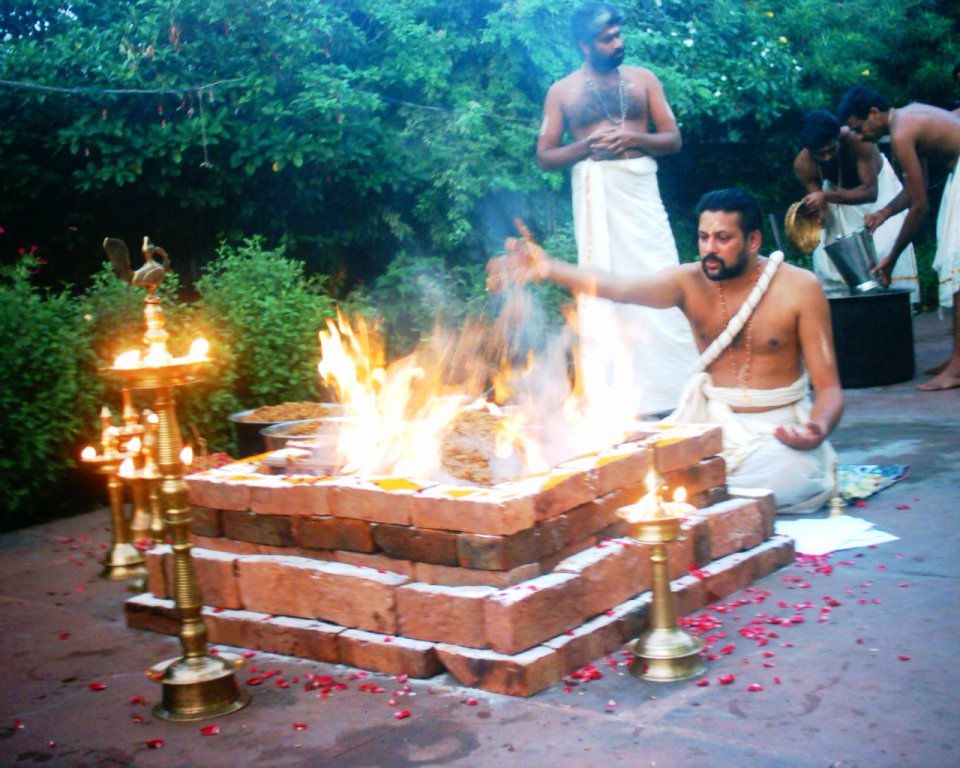
Specific rituals and sacrifices of the Vedic religion include, among others: the Soma rituals; Fire rituals involving oblations (havir); and the Ashvamedha (horse sacrifice).[5][6] The rites of grave burials as well as cremation are seen since the Rigvedic period.[7] Deities emphasized in the Vedic religion include Dyaus, Indra, Agni, and Varuna, and important ethical concepts include satya and ṛta.
Terminology
Vedism refers to the oldest form of the Vedic religion, when Indo-Aryans entered into the valley of the Indus River in multiple waves during the 2nd millennium BCE. Brahmanism refers to the further developed form which took shape at the Ganges basin around c. 1000 BCE.[8]Template:Sfn According to Heesterman, "It is loosely known as Brahmanism because of the religious and legal importance it places on the brāhmaṇa (priestly) class of society."[8]
Origins and development
Indo-Aryan Vedic religion
The Vedic religion refers to the religious beliefs of some of the Vedic Indo-Aryan tribes, the aryas,Template:SfnTemplate:SfnTemplate:Efn who migrated into the Indus River valley region of the Indian subcontinent after the collapse of the Indus Valley Civilization.Template:SfnTemplate:Efn The Vedic religion, and subsequent Brahmanism center on the myths and ritual ideologies of the Vedas, as distinguished from Agamic, Tantric and sectarian forms of Indian religion, which take recourse to the authority of non-Vedic textual sources.Template:Sfn The Vedic religion is described in the Vedas and associated voluminous Vedic literature including the early Upanishads, preserved into the modern times by the different priestly schools.[9]Template:Sfn It existed in the western Ganges plain in the early Vedic period from c. 1500–1100 BCE,Template:SfnTemplate:Efn and developed into Brahmanism in the late Vedic period (1100–500 BCE).Template:SfnTemplate:Sfn The eastern Ganges-plain was dominated by another Indo-Aryan complex, which rejected the later Brahmanical ideology, and gave rise to Jainism and Buddhism, and the Mauryan Empire.Template:SfnTemplate:Sfn
The Indo-Aryans were speakers of a branch of the Indo-European language family, which originated in the Sintashta culture and further developed into the Andronovo culture, which in turn developed out of the Kurgan culture of the Central Asian steppes.Template:SfnTemplate:EfnTemplate:Efn The commonly proposed period of earlier Vedic age is dated back to 2nd millennium BCE.[10]
The Vedic beliefs and practices of the pre-classical era were closely related to the hypothesised Proto-Indo-European religion,[11]Template:Efn and shows relations with rituals from the Andronovo culture, from which the Indo-Aryan people descended.Template:Sfn According to Anthony, the Old Indic religion probably emerged among Indo-European immigrants in the contact zone between the Zeravshan River (present-day Uzbekistan) and (present-day) Iran.Template:Sfn It was "a syncretic mixture of old Central Asian and new Indo-European elements"Template:Sfn which borrowed "distinctive religious beliefs and practices"Template:Sfn from the Bactria–Margiana Culture (BMAC).Template:Sfn This syncretic influence is supported by at least 383 non-Indo-European words that were borrowed from this culture, including the god Indra and the ritual drink Soma.Template:Sfn According to Anthony, Template:Blockquote
The oldest inscriptions in Old Indic, the language of the Rig Veda, are found not in northwestern India and Pakistan, but in northern Syria, the location of the Mitanni kingdom.Template:Sfn The Mitanni kings took Old Indic throne names, and Old Indic technical terms were used for horse-riding and chariot-driving.Template:Sfn The Old Indic term r'ta, meaning "cosmic order and truth", the central concept of the Rig Veda, was also employed in the Mitanni kingdom.Template:Sfn Old Indic gods, including Indra, were also known in the Mitanni kingdom.Template:SfnTemplate:SfnTemplate:Sfn
The Vedic religion was the product of "a composite of the Indo-Aryan and Harappan cultures and civilizations".Template:Sfn White (2003) cites three other scholars who "have emphatically demonstrated" that Vedic religion is partially derived from the Indus Valley Civilization.Template:Sfn The Vedic religion texts are cerebral, orderly and intellectual, but it is unclear if the theory in diverse Vedic texts actually reflect the folk practices, iconography and other practical aspects of the Vedic religion.
The Vedic religion changed when Indo-Aryan people migrated into the Ganges Plain after c. 1100 BCE and became settled farmers,Template:SfnTemplate:SfnTemplate:Sfn further syncretising with the native cultures of northern India.Template:SfnTemplate:Page neededTemplate:Sfn The evidence suggests that the Vedic religion evolved in "two superficially contradictory directions", state Jamison and Witzel, namely an ever more "elaborate, expensive, and specialized system of rituals",[12] which survives in the present-day srauta-ritual,[13] and "abstraction and internalization of the principles underlying ritual and cosmic speculation" within oneself,[12]Template:Sfn akin to the Jain and Buddhist tradition.
Aspects of the historical Vedic religion survived into modern times. The Nambudiri Brahmins continue the ancient Śrauta rituals. The complex Vedic rituals of Śrauta continue to be practiced in Kerala and coastal Andhra.Template:Sfn The Kalash people residing in northwest Pakistan also continue to practice a form of ancient Hinduism.[13]Template:Efn
According to Heinrich von Stietencron, in the 19th century, in western publications, the Vedic religion was believed to be different from and unrelated to Hinduism. The Hindu religion was thought to be linked to the Hindu epics and the Puranas through sects based on purohita, tantras and Bhakti. In the 20th century, a better understanding of the Vedic religion and its shared heritage and theology with contemporary Hinduism has led scholars to view the historical Vedic religion as ancestral to modern Hinduism.Template:Sfn The historical Vedic religion is now generally accepted to be a predecessor of Hinduism, but they are not the same because the textual evidence suggests significant differences between the two,Template:Efn such as the belief in an afterlife instead of the later developed reincarnation and samsāra concepts.Template:SfnTemplate:Page needed The Hindu reform movements and the Neo-Vedanta have emphasized the Vedic heritage and "ancient Hinduism", and this term has been co-opted by some Hindus.Template:Sfn
Brahmanism
Historical Brahminism
Brahmanism, also called Brahminism, developed out of the Vedic religion, incorporating non-Vedic religious ideas, and expanding to a region stretching from the northwest Indian subcontinent to the Ganges valley.Template:SfnTemplate:Sfn Brahmanism included the Vedic corpus, but also post-Vedic texts such as the Dharmasutras and Dharmasastras, which gave prominence to the priestly (Brahmin) class of the society,Template:Sfn Heesterman also mentions the post-Vedic Smriti (Puranas and the Epics),Template:Sfn which are also incorporated in the later Smarta tradition. The emphasis on ritual and the dominant position of Brahmans developed as an ideology developed in the Kuru-Pancala realm, and expanded over a wider area after the demise of the Kuru-Pancala kingdom.Template:Sfn It co-existed with local religions, such as the Yaksha cults.Template:SfnTemplate:Sfn[14]
The word Brahmanism was coined by Gonçalo Fernandes Trancoso (1520–1596) in the 16th century.[15] Historically, and still by some modern authors, the word 'Brahmanism' was used in English to refer to the Hindu religion, treating the term Brahmanism as synonymous with Hinduism, and using it interchangeably.[16][17] In the 18th and 19th centuries, Brahminism was the most common term used in English for Hinduism. Brahmanism gave importance to Absolute Reality (Brahman) speculations in the early Upanishads, as these terms are etymologically linked, which developed from post-Vedic ideas during the late Vedic era.[1][18][19][20] The concept of Brahman is posited as that which existed before the creation of the universe, which constitutes all of existence thereafter, and into which the universe will dissolve, followed by similar endless creation-maintenance-destruction cycles.[21]Template:Sfn[22]Template:Efn
The post-Vedic period of the Second Urbanisation saw a decline of Brahmanism.Template:SfnTemplate:Sfn With the growth of cities, which threatened the income and patronage of the rural Brahmins; the rise of Buddhism; and the Indian campaign of Alexander the Great (327–325 BCE), the rise of the Mauryan Empire (322–185 BCE), and the Saka invasions and rule of northwestern India (2nd c. BC – 4th c. CE), Brahmanism faced a grave threat to its existence.Template:SfnTemplate:Sfn This was overcome by providing new servicesTemplate:Sfn and incorporating the non-Vedic Indo-Aryan religious heritage of the eastern Ganges plain and local religious traditions, giving rise to contemporary Hinduism.Template:Sfn[4]Template:SfnTemplate:SfnTemplate:SfnTemplate:SfnTemplate:Efn This "new Brahmanism" appealed to rulers, who were attracted to the supernatural powers and the practical advice Brahmis could provide,Template:Sfn and resulted in a resurgence of Brahmanical influence, dominating Indian society since the classical Age of Hinduism in the early centuries CE.Template:SfnTemplate:Sfn
As a polemical term
Nowadays, the term Brahmanism, used interchangeably with Brahminism, is used in several ways. It denotes the specific Brahmanical rituals and worldview as preserved in the Śrauta ritual, as distinct from the wide range of popular cultic activity with little connection with them. Brahminism also refers specifically to the Brahminical ideology, which sees Brahmins as naturally privileged people entitled to rule and dominate society.[23] The term may be used by anti-Brahminical opponents, who object against their domination of Indian society and their exclusivist ideology.[24] They follow the outline of 19th century colonial rulers, who viewed India's culture as corrupt and degenerate, and its population as irrational. In this view, derived from a Christian understanding of religion, the original "God-given religion" was corrupted by priests, in this case Brahmins, and their religion, "Brahminism", which was supposedly imposed on the Indian population.[25] Reformist Hindus, and others such as Ambedkar, structured their criticism along similar lines."[25]
Textual history

Texts dating to the Vedic period, composed in Vedic Sanskrit, are mainly the four Vedic Samhitas, but the Brahmanas, Aranyakas, and some of the older UpanishadsTemplate:Efn are also placed in this period. The Vedas record the liturgy connected with the rituals and sacrifices. These texts are also considered as a part of the scripture of contemporary Hinduism.[26]
<poem> Who really knows? Who will here proclaim it? Whence was it produced? Whence is this creation? The gods came afterwards, with the creation of this universe. Who then knows whence it has arisen? — Nasadiya Sukta, Rig Veda, 10:129-6[27][28]Template:Sfn </poem>
Characteristics
The idea of reincarnation, or saṃsāra, is not mentioned in the early layers of the historic Vedic religion texts such as the Rigveda.[29][30] The later layers of the Rigveda do mention ideas that suggest an approach towards the idea of rebirth, according to Ranade.Template:Sfn[31]
The early layers of the Vedas do not mention the doctrine of Karma and rebirth but mention the belief in an afterlife.Template:Sfn[32] According to Sayers, these earliest layers of the Vedic literature show ancestor worship and rites such as sraddha (offering food to the ancestors). The later Vedic texts such as the Aranyakas and the Upanisads show a different soteriology based on reincarnation, they show little concern with ancestor rites, and they begin to philosophically interpret the earlier rituals.[33][34][35] The idea of reincarnation and karma have roots in the Upanishads of the late Vedic period, predating the Buddha and the Mahavira.[36]Template:Sfn Similarly, the later layers of the Vedic literature such as the Brihadaranyaka Upanishad (c. 800 BCE) – such as in section 4.4 – discuss the earliest versions of the Karma doctrine as well as causality.[37][38]
The ancient Vedic religion lacked the belief in reincarnation and concepts such as Saṃsāra or Nirvana. It was a complex animistic religion with polytheistic and pantheistic aspects. Ancestor worship was an important, maybe the central component, of the ancient Vedic religion. Elements of the ancestors cult are still common in modern Hinduism in the form of Śrāddha.Template:SfnTemplate:Page needed[39]
According to Olivelle, some scholars state that the renouncer tradition was an "organic and logical development of ideas found in the Vedic religious culture", while others state that these emerged from the "indigenous non-Aryan population". This scholarly debate is a longstanding one, and is ongoing.Template:Sfn
Rituals

Specific rituals and sacrifices of the Vedic religion include, among others:[5]Template:Vn
- Fire rituals involving oblations (havir):
- The Agnyadheya, or installation of the fire[40]
- The Agnihotra or oblation to Agni, a sun charm[40]
- The Darshapurnamsa, the new and full moon sacrifices[40]
- The four seasonal (Cāturmāsya) sacrifices[40]
- The Agnicayana, the sophisticated ritual of piling the fire altar[40]
- The Pashubandhu, the (semi-)annual animal sacrifice[40]
- The Soma rituals, which involved the extraction, utility and consumption of Soma:[40]
- The royal consecration (Rajasuya) sacrifice
- The Ashvamedha (horse sacrifice) or a Yajna dedicated to the glory, wellbeing and prosperity of the kingdom or empire[6]
- The Purushamedha[40]
- The rituals and charms referred to in the Atharvaveda are concerned with medicine and healing practices[42]
- The Gomedha or cow sacrifice:
- The Taittiriya Brahmana of the Yajur Veda gives instructions for selecting the cow for the sacrifice depending on the deity.[43]
- Panchasaradiya sava – celebration where 17 cows are immolated once every five years. The Taittiriya Brahmana advocates the Panchasaradiya for those who want to be great.[43]
- Sulagava – sacrifice where roast beef is offered. It is mentioned in the Grihya Sutra[43]
- According to Dr. R. Mitra, the offered animal was intended for consumption as detailed in the Asvalayana Sutra. The Gopatha Brahmana lists the different individuals who are to receive the various parts like Pratiharta (neck and hump), the Udgatr, the Neshta, the Sadasya, the householder who performs the sacrifice (the two right feet), his wife (the two left feet) and so on.[43]
The Hindu rites of cremation are seen since the Rigvedic period; while they are attested from early times in the Cemetery H culture, there is a late Rigvedic reference invoking forefathers "both cremated (agnidagdhá-) and uncremated (ánagnidagdha-)". (RV 10.15.14)
Pantheon

Though a large number of names for devas occur in the Rigveda, only 33 devas are counted, eleven each of earth, space, and heaven.[44] The Vedic pantheon knows two classes, Devas and Asuras. The Devas (Mitra, Varuna, Aryaman, Bhaga, Amsa, etc.) are deities of cosmic and social order, from the universe and kingdoms down to the individual. The Rigveda is a collection of hymns to various deities, most notably heroic Indra, Agni the sacrificial fire and messenger of the gods, and Soma, the deified sacred drink of the Indo-Iranians.[45] Also prominent is Varuna (often paired with Mitra) and the group of "All-gods", the Vishvadevas.[46]
Sages
In the Hindu tradition, the revered sages of this era were Yajnavalkya,[47][48] Atharvan,[49] Atri,[50] Bharadvaja,[51] Gautama Maharishi, Jamadagni,[52] Kashyapa,[53] Vasistha,[54] Bhrigu,[55] Kutsa,[56] Pulastya, Kratu, Pulaha, Vishwamitra Narayana, Kanva, Rishabha, Vamadeva, and Angiras.Template:Citation needed
Ethics – satya and rta
Ethics in the Vedas are based on concepts like satya and ṛta.[57]
In the Vedas and later sutras, the meaning of the word satya (Template:Linktext) evolves into an ethical concept about truthfulness and is considered an important virtue.[58][59] It means being true and consistent with reality in one's thought, speech and action.[58]
Vedic Template:IAST and its Avestan equivalent Template:Lang are both thought by some to derive from Proto-Indo-Iranian *Hr̥tás "truth",[60] which in turn may continue from a possible Proto-Indo-European *Template:PIE "properly joined, right, true", from a presumed root *Template:PIE. The derivative noun ṛta is defined as "fixed or settled order, rule, divine law or truth".[61] As Mahony (1998) notes, however, the term can be translated as "that which has moved in a fitting manner" – although this meaning is not actually cited by authoritative Sanskrit dictionaries it is a regular derivation from the verbal root -, and abstractly as "universal law" or "cosmic order", or simply as "truth".[62] The latter meaning dominates in the Avestan cognate to Ṛta, aša.[63]
Owing to the nature of Vedic Sanskrit, the term Ṛta can be used to indicate numerous things, either directly or indirectly, and both Indian and European scholars have experienced difficulty in arriving at fitting interpretations for Ṛta in all of its various usages in the Vedas, though the underlying sense of "ordered action" remains universally evident.[64]
The term is also found in the Proto-Indo-Iranian religion, the religion of the Indo-Iranian peoples.[65] The term dharma was already used in the later Brahmanical thoughts, where it was conceived as an aspect of ṛta.[66]
Vedic mythology
The central myth at the base of Vedic ritual surrounds Indra who, inebriated by Soma, slays the dragon (ahi) Vritra, freeing the rivers, the cows, and Dawn.
Vedic mythology contains numerous elements which are common to Indo-European mythological traditions, like the mythologies of Persia, Greece, and Rome, and those of the Celtic, Germanic, Baltic, and Slavic peoples. The Vedic god Indra in part corresponds to Dyaus Pitar, the Sky Father, Zeus, Jupiter, Thor and Tyr, or Perun. The deity Yama, the lord of the dead, is hypothesized to be related to Yima of Persian mythology. Vedic hymns refer to these and other deities, often 33, consisting of 8 Vasus, 11 Rudras, 12 Adityas, and in the late Rigvedas, Prajapati. These deities belong to the 3 regions of the universe or heavens, the earth, and the intermediate space.
Some major deities of the Vedic tradition include Indra, Dyaus, Surya, Agni, Ushas, Vayu, Varuna, Mitra, Aditi, Yama, Soma, Sarasvati, Prithvi, and Rudra.[67]
Post-Vedic religions

The Vedic period is held to have ended around 500 BCE. The period between 800 BCE and 200 BCE is the formative period for later Hinduism, Jainism and Buddhism.Template:SfnTemplate:Sfn According to Michaels, the period between 500 BCE and 200 BCE is a time of "ascetic reformism",Template:Sfn while the period between 200 BCE and 1100 CE is the time of "classical Hinduism", since there is "a turning point between the Vedic religion and Hindu religions".Template:Sfn Muesse discerns a longer period of change, namely between 800 BCE and 200 BCE, which he calls the "Classical Period", when "traditional religious practices and beliefs were reassessed. The Brahmins and the rituals they performed no longer enjoyed the same prestige they had in the Vedic period".Template:Sfn
Brahmanism evolved into Hinduism, which is significantly different from the preceding Brahmanism,Template:Refn though "it is also convenient to have a single term for the whole complex of interrelated traditions."Template:Sfn The transition from ancient Brahmanism into schools of Hinduism was a form of evolution in interaction with non-Vedic traditions, one that preserved many of the central ideas and theosophy in the Vedas, and synergistically integrated non-Vedic ideas.[70]Template:SfnTemplate:SfnTemplate:SfnTemplate:Refn While part of Hinduism, Vedanta, Samkhya and Yoga schools of Hinduism share their concern with escape from the suffering of existence with Buddhism.[71]
Continuation of orthodox ritual
According to German Professor Axel Michaels, the Vedic gods declined but did not disappear, and local cults were assimilated into the Vedic-brahmanic pantheon, which changed into the Hindu pantheon. Deities such as Shiva and Vishnu became more prominent and gave rise to Shaivism and Vaishnavism.Template:Sfn
According to David Knipe, some communities in India have preserved and continue to practice portions of the historical Vedic religion, such as in Kerala and Andhra Pradesh state of India and elsewhere.Template:Sfn According to the historian and Sanskrit linguist Michael Witzel, some of the rituals of the Kalash people have elements of the historical Vedic religion, but there are also some differences such as the presence of fire next to the altar instead of "in the altar" as in the Vedic religion.[2][3]
Mīmāṃsā and Vedanta
Mīmāṃsā philosophers argue that there was no need to postulate a maker for the world, just as there was no need for an author to compose the Vedas or a god to validate the rituals.[72] Mīmāṃsā argues that the gods named in the Vedas have no existence apart from the mantras that speak their names. To that regard, the power of the mantras is what is seen as the power of gods.[73]
Of the continuation of the Vedic tradition in the Upanishads, Fowler writes the following: Template:Cquote
The Upanishads gradually evolved into Vedanta, which is regarded by some as the primary institution of Hinduism. Vedanta considers itself "the purpose or goal [end] of the Vedas".[74]
Sramana tradition
The non-Vedic śramaṇa traditions existed alongside Brahmanism.[75][76]Template:Efn[77][78] These were not direct outgrowths of Vedism, but movements with mutual influences with Brahmanical traditions,[75] reflecting "the cosmology and anthropology of a much older, pre-Aryan upper class of northeastern India".Template:Sfn Jainism and Buddhism evolved out of the Shramana tradition.[79]
There are Jaina references to 22 prehistoric tirthankaras. In this view, Jainism peaked at the time of Mahavira (traditionally put in the 6th century BCE).[80][81] Buddhism, traditionally put from c. 500 BCE, declined in India over the 5th to 12th centuries in favor of Puranic Hinduism[82] and Islam.[83][84]
See also
Template:EB1911 poster Template:Col div
- Pushyamitra Shunga
- Ancient Iranian religion
- Hinduism in Iran
- Iranian mythology
- Rishikesh Complex of Ruru Kshetra – Vedic ritual site in Nepal
- Vedic mythology
- Vedic priesthood
- A Vedic Word Concordance
- Zoroastrianism
Notes
- ↑ 1.0 1.1 Template:Cite encyclopedia
- ↑ 2.0 2.1 The Vedas: Texts, language, and ritual{{#if:|, {{{last}}}}. Forsten(2004)
- ↑ 3.0 3.1 Kalasha religion.
- ↑ 4.0 4.1 Template:Cite encyclopedia
- ↑ 5.0 5.1 Indian Scriptures{{#if:Prasoon|, Prasoon}. Pustak Mahal(11 August 2010). ISBN 978-81-223-1007-8
- ↑ 6.0 6.1 The Texts of the White Yajurveda. Translated with a popular commentary{{#if:Griffith|, Griffith}. E. J. Lazarus and Co.(1987). ISBN 81-215-0047-8
- ↑ The Rigveda — Earliest Religious Poetry of India{{#if:|, {{{last}}}}. Oxford University Press(2015). ISBN 978-0190633394
- ↑ 8.0 8.1 Jan C. Heesterman (1987) (1987), Vedism and Brahmanism, MacMillan Encyclopedia of Religion
- ↑ Cite error: Invalid
<ref>tag; no text was provided for refs namedjamisonwitzelp2 - ↑ The History of India{{#if:|, {{{last}}}}. Britannica Educational Publishing(2010)
- ↑ Indo-European Sacred Space: Vedic and Roman Cult{{#if:|, {{{last}}}}. University of Illinois Press(18 August 2006). ISBN 978-0-252-09295-4
- ↑ 12.0 12.1 Vedic Hinduism. Harvard University. Retrieved 4 August 2018.
- ↑ 13.0 13.1 Cite error: Invalid
<ref>tag; no text was provided for refs namedWest2010 - ↑ Template:Cite encyclopedia
- ↑ Missionary Tropics: The Catholic Frontier in India (16th–17th Centuries){{#if:Županov|, Županov}. University of Michigan Press(2005). ISBN 0-472-11490-5
- ↑ An Introduction to Philosophy{{#if:|, {{{last}}}}. Rowman & Littlefield(2005). ISBN 978-0-7425-5053-7
- ↑ Interpretations of the Bhagavad-Gita and Images of the Hindu Tradition: The song of the Lord{{#if:Robinson|, Robinson}. Routledge(2014). ISBN 978-1-134-27891-6
- ↑ An Introduction to Philosophy{{#if:Maritain|, Maritain}. Rowman & Littlefield(2005). ISBN 978-0-7425-5053-7
- ↑ Eastern Philosophy: Key Readings{{#if:Leaman|, Leaman}. Routledge(2002). ISBN 978-1-134-68918-7
- ↑ Hinduism: The anthropology of a civilization{{#if:Biardeau|, Biardeau}. Oxford University Press(1994)
- ↑ Brāhmanism and Hindūism: Or, Religious Thought and Life in India, as Based on the Veda and Other Sacred Books of the Hindūs{{#if:Monier-Williams|, Monier-Williams}. J. Murray(1891)
- ↑ The Illustrated Encyclopedia of Hinduism{{#if:Lochtefeld|, Lochtefeld}. Rosen Publishing(2001). ISBN 978-0823931798
- ↑ Template:Cite q
- ↑ 'Hindutva Is Nothing But Brahminism', Outlook, 5 April 2002.
- ↑ 25.0 25.1 Raf Gelders, Willem Delders (2003),Mantras of Anti-Brahmanism: Colonial Experience of Indian Intellectuals, Economic and Political Weekly 38(43):4611-4617. DOI:10.2307/4414197
- ↑ Hindu Scriptures{{#if:Goodall|, Goodall}. Motilal Banarsidass(2001). ISBN 978-81-208-1770-8
- ↑ World Scriptures: An Introduction to Comparative Religions{{#if:Kramer|, Kramer}. Paulist Press(January 1986). ISBN 978-0-8091-2781-8
- ↑ Maps of Time: An Introduction to Big History{{#if:|, {{{last}}}}. University of California Press(1 September 2011). ISBN 978-0-520-95067-2
- ↑ Etude sur l'origine de la doctrine du samsara. Journal Asiatique({Template:Year).
- ↑ Bharatiya Vidya Bhavan{{#if:Krishan|, Krishan}(1997). ISBN 978-81-208-1233-8
- ↑ A Constructive Survey of Upanishadic Philosophy{{#if:Ranade|, Ranade}. Bharatiya Vidya Bhavan(1926)
- ↑ Circulation of Fire in the Veda{{#if:|, {{{last}}}}. LIT Verlag Münster(2014). ISBN 978-3-643-90472-0
- ↑ Feeding the Dead: Ancestor worship in ancient India{{#if:Sayers|, Sayers}. Oxford University Press(2013). ISBN 978-0-19-989643-1
- ↑ Template:Cite thesis
- ↑ Feeding the Dead: Ancestor worship in ancient India. The Journal of Hindu Studies({Template:Date).
- ↑ Buddhism: A very short introduction{{#if:Keown|, Keown}. Oxford University Press(2013). ISBN 978-0-19-966383-5
- ↑ The Vedic Origins of Karma: Cosmos as man in ancient Indian myth and ritual{{#if:Tull|, Tull}. State University of New York Press(1989). ISBN 978-0-7914-0094-4
- ↑ Brihadaranyaka Upanishad 4.4.5-6. Georgetown University.
- ↑ The Śrāddha: The Development of Ancestor Worship in Classical Hinduism. Religion Compass({Template:Date).
- ↑ 40.00 40.01 40.02 40.03 40.04 40.05 40.06 40.07 40.08 40.09 40.10 40.11 40.12 40.13 40.14 40.15 Vedic India{{#if:Renou|, Renou}. Susil Gupta(1947)
- ↑ The Rigveda: The Earliest Religious Poetry of India{{#if:Jamison|, Jamison}. Oxford University Press(2014)
- ↑ Hymns of the Atharva Veda{{#if:Bloomfield|, Bloomfield}. Kessinger Publishing(1 June 2004). ISBN 1419125087
- ↑ 43.0 43.1 43.2 43.3 The Vedas: With Illustrative Extracts{{#if:|, {{{last}}}}. Book Tree, 2003(2003). ISBN 9781585092239
- ↑ The Ancient History of India{{#if:|, {{{last}}}}. Atlantic Publishers and Distributors(2003). ISBN 8126902868
- ↑ Template:Cite encyclopedia
- ↑ L'Inde Classique{{#if:|, {{{last}}}}(1985). ISBN 2-7200-1035-9
- ↑ Discovering the Vedas: Origins, mantras, rituals, insights{{#if:Staal|, Staal}. Penguin Books(2008). ISBN 978-0-14-309986-4
- ↑ The Samnyasa Upanisads: Hindu scriptures on asceticism and renunciation{{#if:Olivelle|, Olivelle}. Oxford University Press(1992). ISBN 978-0-19-536137-7
- ↑ Hinduism: An Alphabetical Guide{{#if:Dalal|, Dalal}. Penguin Books(2010). ISBN 978-0-14-341421-6
- ↑ Hinduism: An alphabetical guide{{#if:Dalal|, Dalal}. Penguin Books(2010). ISBN 978-0-14-341421-6
- ↑ Hinduism: An alphabetical guide{{#if:Dalal|, Dalal}. Penguin Books(2010). ISBN 978-0-14-341421-6
- ↑ Hinduism: An alphabetical guide{{#if:Dalal|, Dalal}. Penguin Books(2010). ISBN 978-0-14-341421-6
- ↑ Hinduism: An alphabetical guide{{#if:Dalal|, Dalal}. Penguin Books(2010). ISBN 978-0-14-341421-6
- ↑ Hinduism: An alphabetical guide{{#if:Dalal|, Dalal}. Penguin Books(2010). ISBN 978-0-14-341421-6
- ↑ Hinduism: An alphabetical guide{{#if:Dalal|, Dalal}. Penguin Books(2010). ISBN 978-0-14-341421-6
- ↑ Hinduism: An alphabetical guide{{#if:Dalal|, Dalal}. Penguin Books(2010). ISBN 978-0-14-341421-6
- ↑ Vedic Cosmology and Ethics: Selected Studies{{#if:Bodewitz|, Bodewitz}. Brill(2019). ISBN 978-90-04-39864-1
- ↑ 58.0 58.1 Classical Indian Ethical Thought{{#if:Tiwari|, Tiwari}. Motilal Banarsidass(1998). ISBN 978-8120816077
- ↑ A Dhand (2002), The dharma of ethics, the ethics of dharma: Quizzing the ideals of Hinduism, Journal of Religious Ethics, 30(3), pages 347–372
- ↑ Template:Cite encyclopedia
- ↑ Monier-Williams (1899:223b)
- ↑ Mahony (1998:3).
- ↑ Oldenberg (1894) p 30. Cf. also Thieme (1960) p 308.
- ↑ Cf. Ramakrishna (1965) pp. 45–46
- ↑ Template:Harvnb.
- ↑ The Conception of Punishment in Early Indian Literature{{#if:|, {{{last}}}}. Wilfrid Laurier University Press(1982). ISBN 0-919812-15-5
- ↑ Vedic Mythology{{#if:|, {{{last}}}}. Motilal Banarsidass(1995). ISBN 81-208-1113-5
- ↑ The vivaha (marriage) Samskara as a paradigm for religio-cultural integration in Hinduism. Journal for the Study of Religion({Template:Year).
- ↑ Prabuddha Bharata{{#if:Vivekananda|, Vivekananda}. Prabuddha Bharata Press(2005)
- ↑ From Gautama Buddha to the Triumph of Christianity{{#if:Eliade|, Eliade}. University of Chicago Press(2011). ISBN 978-0-226-02735-7
- ↑ From Gautama Buddha to the Triumph of Christianity{{#if:Eliade|, Eliade}. University of Chicago Press(2011). ISBN 978-0-226-02735-7
- ↑ Religious Truth{{#if:Neville|, Neville}(2001). ISBN 9780791447789
- ↑ The perfectibility of human nature in eastern and western thought{{#if:|, {{{last}}}}(2008). ISBN 9780791473368
- ↑ The American College Dictionary{{#if:Hume|, Hume}. Random House(1966)
- ↑ 75.0 75.1 Philosophy East and West{{#if:Crawford|, Crawford}(1972)
- ↑ Study of Jainism{{#if:|, {{{last}}}}. Prakrit Bharti Academy(1988)
- ↑ A Comparative Study of Religions{{#if:Masih|, Masih}. Motilal Banarsidass(2000). ISBN 81-208-0815-0
- ↑ The Jaina Path to Purification{{#if:Jaini|, Jaini}. Motilal Banarsidass(1979)
- ↑ India : History, religion, vision and contribution to the world{{#if:|, {{{last}}}}(2008)
- ↑ Helmuth von Glasenapp, Shridhar B. Shrotri. 1999. Jainism: an Indian religion of salvation. P.24. "Thus not only nothing, from the philosophical and the historical point of view, comes in the way of the supposition that Jainism was established by Parsva around 800 BCE, but it is rather confirmed in everything that we know of the spiritual life of that period."
- ↑ The Jains{{#if:|, {{{last}}}}(2002)
- ↑ Template:Cite encyclopedia
- ↑ Freeing the Buddha: Diversity on a sacred path – large scale concerns{{#if:Ruhe|, Ruhe}
- ↑ A text book of the history of Theravāda Buddhism{{#if:Sarao|, Sarao}. University of Delhi
References
Sources
- The Horse, the Wheel, and Language. How Bronze-Age riders from the Eurasian steppes shaped the modern world{{#if:Anthony|, Anthony}. Princeton University Press(2007)
- The Origins and Development of Classical Hinduism{{#if:Basham|, Basham}. Oxford University Press(1989). ISBN 9780195073492
- Empires of the Silk Road. A history of central Eurasia from the Bronze Age to the present{{#if:Beckwith|, Beckwith}. Princeton University Press(2011)
- Buddhism in the Shadow of Brahmanism. BRILL.
- [{{{url}}} History and Religion:Narrating a Religious Past]. Walter deGruyter.
- How the Brahmains Won. BRILL.
- Brahmanism: Its place in ancient Indian society.
- The Quest for the Origins of Vedic Culture: The Indo-Aryan migration debate{{#if:Bryant|, Bryant}. Oxford University Press(2001)
- The Indo-Aryan Controversy: Evidence and inference in Indian history{{#if:|, {{{last}}}}. Routledge(2005). ISBN 0-7007-1463-4
- An Introduction to Hinduism{{#if:Flood|, Flood}. Cambridge University Press(1996)
- The Blackwell Companion to Hinduism{{#if:Flood|, Flood}. John Wiley & Sons(2008). ISBN 9780470998687
- Buddhism in India. In: Joseph Kitagawa, "The Religious Traditions of Asia: Religion, History, and Culture". Routledge.
- Tradition and Reflection. SUNY Press.
- The Encyclopedia of Religion{{#if:Heesterman|, Heesterman}. Macmillan Reference(2005). ISBN 0-02-865733-0
- The Religious Traditions of Asia: Religion, history, and culture{{#if:Hiltebeitel|, Hiltebeitel}. Routledge(2002). ISBN 9781136875977
- The Religious Traditions of Asia: Religion, History, and Culture{{#if:Hiltebeitel|, Hiltebeitel}. Routledge(2007). ISBN 9781136875908
- The Indo-Aryan controversy: Evidence and inference in Indian history. Journal of Indo-European Studies({Template:Year).
- Indo-Aryan Controversy: Evidence and Inference in Indian History{{#if:Kak|, Kak}. Routledge(2005)
- Orientalism and Religion: Post-Colonial Theory, India and "The Mystic East"{{#if:King|, King}. Routledge(1999)
- Vedic Voices: Intimate narratives of a living Andhra tradition{{#if:Knipe|, Knipe}. Oxford University Press(2015)
- [{{{url}}} The Origin of the Indo-Iranians]. Brill.
- An Introduction to Buddhist Philosophy{{#if:Laumakis|, Laumakis}. Cambridge University Press(21 February 2008). ISBN 9781139469661
- The Oxford Introduction to Proto-Indo-European and the Proto-Indo-European World{{#if:|, {{{last}}}}. Oxford University Press(2006)
- Religions of the World: A comprehensive encyclopedia of beliefs and practices{{#if:|, {{{last}}}}. ABC-CLIO(2010)
- Hinduism. Past and present{{#if:Michaels|, Michaels}. Princeton University Press(2004)
- Hinduism{{#if:Muesse|, Muesse}(2003)
- [{{{url}}} Accessing R.E. Founders & Leaders, Buddhism, Hinduism and Sikhism Teacher's Book Mainstream]. Folens Limited.
- The Origins of Yoga and Tantra. Indic religions to the thirteenth century{{#if:Samuel|, Samuel}. Cambridge University Press(2010)
- A History of Ancient and Early Medieval India: From the Stone Age to the 12th century{{#if:Singh|, Singh}. Pearson Education India(2008). ISBN 978-81-317-1120-0
- Godsdiensten van de wereld{{#if:Smart|, Smart}. Uitgeverij Kok(2003)
- Hindu Myth, Hindu History: Religion, art, and politics{{#if:von Stietencron|, von Stietencron}. Orient Blackswan(2005)
- The A to Z of Hinduism{{#if:Sullivan|, Sullivan}. Rowman & Littlefield(2001). ISBN 978-0-8108-4070-6
- Kiss of the Yogini{{#if:White|, White}. University of Chicago Press(2003). ISBN 0-226-89483-5
- Kiss of the Yogini: "Tantric Sex" in its South Asian Contexts{{#if:White|, White}. University of Chicago Press(2006). ISBN 9780226027838
- Early Sanskritization: Origin and Development of the Kuru state. EJVS({Template:Year).
- Phiosophies of India{{#if:Zimmer|, Zimmer}. Princeton University Press(1989)
Further reading
External links
Template:Hindudharma Template:Religion topicsTemplate:Authority control