
Central Europe is a geographical region of Europe between Eastern, Southern, Western and Northern Europe.[1][2] The concept of "Central Europe" appeared in the 19th century.[3][4] Countries in this region are considered to have historical, social, and cultural similarities.[5][6][7] With the exception of Germany, and Austria’s rule of Saint Croix from 1733 to 1735, Central European countries had no colonies or overseas territories.
The region comprises most of the former territories of the Holy Roman Empire and those of the two neighboring kingdoms of Poland and Hungary. Large parts of the Kingdom of Hungary were controlled by the Ottoman Empire. Hungary and parts of Poland were later part of the Habsburg monarchy.
The countries that make up Central Europe have historically been, and in some cases continue to be,[8] divided into either Eastern or Western Europe.[9][10] Respectively, countries in Central Europe have historical, cultural and geopolitical ties to these wider regions of Europe.[11][12][13][14][15]
The countries that make up Central Europe have historically been divided into either Eastern or Western Europe.[9][10] Respectively, countries in Central Europe have historical, cultural and geopolitical ties to these wider regions of Europe.[11][12][13][14][15]
After World War II, Central Europe was divided by the Iron Curtain (as agreed by the Big Three at the Yalta Conference and the Potsdam Conference) into two parts, the capitalist Western Bloc and the communist Eastern Bloc, although Switzerland, Yugoslavia, and Austria declared neutrality. The Berlin Wall was one of the most visible symbols of this division.
Central Europe began a "strategic awakening" in the late 20th and early 21st century,[16] with initiatives such as Central European Defence Cooperation, the Central European Initiative, Centrope, and the Visegrád Four Group. This awakening was triggered by writers and other intellectuals, who recognized the societal paralysis of decaying dictatorships and felt compelled to speak up against Soviet oppression.[17]
All of the Central European countries are presently listed as being "very highly developed" by the Human Development Index.
Historical perspective
Elements of cultural unity for Northwestern, Southwestern and Central Europe were Catholicism and Latin. However Eastern Europe, which remained Eastern Orthodox, was dominated by Byzantine cultural influence; after the East–West Schism in 1054, Eastern Europe developed cultural unity and resistance to Catholic (and later also Protestant) Western Europe within the framework of the Eastern Orthodox Church, Church Slavonic language, and the Cyrillic alphabet.Template:Sfn[18][19][20]
-
 Frankish Empire and its tributaries in 814
 -
 East Francia in 843
 -
 Possible furthest extent of Great Moravia under Svatopluk I (870–894)
 -
 Poland under the Piast Dynasty in 1000
 -
 Kingdom of Hungary in 1190
 -
 Holy Roman Empire in 1600
 -
 Polish-Lithuanian Commonwealth and its fiefs in 1619


.svg)
.png)
According to Hungarian historian Jenő Szűcs, the foundations of Central European history at the end of the first millennium were in close connection with Western European development. Szűcs argued that between the 11th and 15th centuries, not only Christianization and its cultural consequences were implemented, but well-defined social features emerged in Central Europe based on Western characteristics. The keyword of Western social development after the turn of the millennium was the spread of Magdeburg rights in some cities and towns of Western Europe. These began to spread in the middle of the 13th century in Central European countries, bringing about self-governments of towns and counties.[21]
In 1335, the Kings of Poland, Bohemia and Hungary met in the castle of Visegrád[22] and agreed to cooperate closely in the field of politics and commerce, inspiring the post-Cold War Visegrád Group.[22]
Before World War I

Before 1870, the industrialization that had started to develop in Northwestern and Central Europe and the United States did not extend in any significant way to the rest of the world. Even in Eastern Europe, industrialization lagged far behind. Russia, for example, remained largely rural and agricultural, and its autocratic rulers kept the peasants in serfdom.[24] The concept of Central Europe was already known at the beginning of the 19th century,[25] but its real life began in the 20th century and immediately became an object of intensive interest. However, the very first concept mixed science, politics and economy – it was strictly connected with the intensively growing German economy and its aspirations to dominate a part of European continent called Mitteleuropa. The German term denoting Central Europe was so fashionable that other languages started referring to it when indicating territories from Rhine to Vistula, or even Dnieper, and from the Baltic Sea to the Balkans.[26] An example of that-time vision of Central Europe may be seen in Joseph Partsch's book of 1903.[27]
On 21 January 1904, Mitteleuropäischer Wirtschaftsverein (Central European Economic Association) was established in Berlin with economic integration of Germany and Austria–Hungary (with eventual extension to Switzerland, Belgium and the Netherlands) as its main aim. Another time, the term Central Europe became connected to the German plans of political, economic and cultural domination. The "bible" of the concept was Friedrich Naumann's book Mitteleuropa[28] in which he called for an economic federation to be established after World War I. Naumann's idea was that the federation would have at its centre Germany and the Austro-Hungarian Empire but would also include all European nations outside the Triple Entente.Template:Cn The concept failed after the German defeat in World War I and the dissolution of Austria-Hungary. The revival of the idea may be observed during the Hitler era.
Interwar period
According to Emmanuel de Martonne, in 1927 the Central European countries included: Austria, Czechoslovakia, Germany, Hungary, Poland, Romania and Switzerland. The author uses both Human and Physical Geographical features to define Central Europe, but he doesn't take into account the legal development or the social, cultural, economic, infrastructural developments in these countries.[29]
The interwar period (1918–1938) brought a new geopolitical system, as well as economic and political problems, and the concept of Central Europe took on a different character. The centre of interest was moved to its eastern part – the countries that have (re)appeared on the map of Europe: Czechoslovakia, Hungary and Poland. Central Europe ceased to be the area of German aspiration to lead or dominate and became a territory of various integration movements aiming at resolving political, economic and national problems of "new" states, being a way to face German and Soviet pressures. However, the conflict of interests was too big and neither Little Entente nor Intermarium (Międzymorze) ideas succeeded. These matters were not helped by the fact that Czechoslovakia appeared alone as the only multicultural, democratic, and liberal state among its neighbors. The events preceding World War II in Europe—including the so-called Western betrayal/ Munich Agreement were very much enabled by the rising nationalism and ethnocentrism that typified that time period.
The interwar period brought new elements to the concept of Central Europe. Before World War I, it embraced mainly German states (Germany, Austria), non-German territories being an area of intended German penetration and domination – German leadership position was to be the natural result of economic dominance.[25] After the war, the Eastern part of Central Europe was placed at the centre of the concept. At that time the scientists took an interest in the idea: the International Historical Congress in Brussels in 1923 was committed to Central Europe, and the 1933 Congress continued the discussions.[30]
The avant-garde movements of Central Europe were an essential part of modernism's evolution, reaching its peak throughout the continent during the 1920s. The Sourcebook of Central European avantgards (Los Angeles County Museum of Art) contains primary documents of the avant-gardes in Austria, Czechoslovakia, Germany, Hungary, and Poland from 1910 to 1930.[31] The manifestos and magazines of Central European radical art circles are well known to Western scholars and are being taught at primary universities of their kind in the western world.
Mitteleuropa
With the dissolution of the Holy Roman Empire around 1800, there was a consolidation of power among the Habsburgs and Hohenzollerns as the two major states in the area. They had much in common and occasionally cooperated in various channels, but more often competed. One approach in the various attempts at cooperation, was the conception of a set of supposed common features and interests, and this idea led to the first discussions of a Mitteleuropa in the mid-nineteenth century, as espoused by Friedrich List and Karl Ludwig Bruck. These were mostly based on economic issues.Template:Sfn
Mitteleuropa may refer to an historical concept, or to a contemporary German definition of Central Europe. As an historical concept, the German term Mitteleuropa (or alternatively its literal translation into English, Middle EuropeTemplate:Sfn) is an ambiguous German concept.Template:Sfn It is sometimes used in English to refer to an area somewhat larger than most conceptions of 'Central Europe'; it refers to territories under Germanic cultural hegemony until World War I (encompassing Austria–Hungary and Germany in their pre-war formations but usually excluding the Baltic countries north of East Prussia).Template:Citation needed According to Fritz Fischer Mitteleuropa was a scheme in the era of the Reich of 1871–1918 by which the old imperial elites had allegedly sought to build a system of German economic, military and political domination from the northern seas to the Near East and from the Low Countries through the steppes of Russia to the Caucasus.Template:Sfn Later on, professor Fritz Epstein argued the threat of a Slavic "Drang nach Westen" (Western expansion) had been a major factor in the emergence of a Mitteleuropa ideology before the Reich of 1871 ever came into being.Template:Sfn
In Germany the connotation was also sometimes linked to the pre-war German provinces east of the Oder-Neisse line.Template:Citation needed
The term "Mitteleuropa" conjures up negative historical associations among some elderly people, although the Germans have not played an exclusively negative role in the region.Template:Sfn Most Central European Jews embraced the enlightened German humanistic culture of the 19th century.Template:Sfn German-speaking Jews from turn of the 20th century Vienna, Budapest and Prague became representatives of what many consider to be Central European culture at its best, though the Nazi version of "Mitteleuropa" destroyed this kind of culture instead.Template:Sfn However, the term "Mitteleuropa" is now widely used again in German education and media without negative meaning, especially since the end of communism. In fact, many people from the new states of Germany do not identify themselves as being part of Western Europe and therefore prefer the term "Mitteleuropa".
Central Europe during World War II
During World War II, Central Europe was largely occupied by Nazi Germany. Many areas were a battle area and were devastated. The mass murder of the Jews depopulated many of their centuries-old settlement areas or settled other people there and their culture was wiped out. Both Adolf Hitler and Joseph Stalin diametrically opposed the centuries-old Habsburg principles of "live and let live" with regard to ethnic groups, peoples, minorities, religions, cultures and languages and tried to assert their own ideologies and power interests in Central Europe.[32] There were various Allied plans for state order in Central Europe for post-war. While Stalin tried to get as many states under his control as possible, Winston Churchill preferred a Central European Danube Confederation to counter these countries against Germany and Russia. There were also plans to add Bavaria and Württemberg to an enlarged Austria.[33] There were also various resistance movements around Otto von Habsburg that pursued this goal. The group around the Austrian priest Heinrich Maier also planned in this direction, which also successfully helped the Allies to wage war by, among other things, forwarding production sites and plans for V-2 rockets, Tiger tanks and aircraft to the USA.[34][35] So Otto von Habsburg also tried to detach Hungary from its grasp by Nazi Germany and the USSR.[36][37] There were various considerations to prevent German power in Europe after the war. Churchill's idea of reaching the area around Vienna and Budapest before the Russians via an operation from the Adriatic had not been approved by the Western Allied chiefs of staff.[38] As a result of the military situation at the end of the war, Stalin's plans prevailed and much of Central Europe came under Russian control.[39][40]
Central Europe behind the Iron Curtain

Following World War II, large parts of Europe that were culturally and historically Western became part of the Eastern Bloc. Czech author Milan Kundera (emigrant to France) thus wrote in 1984 about the "Tragedy of Central Europe" in the New York Review of Books.[41] The boundary between the two blocks was called the Iron Curtain. Consequently, the English term Central Europe was increasingly applied only to the westernmost former Warsaw Pact countries (East Germany, Poland, Czechoslovakia, Hungary) to specify them as communist states that were culturally tied to Western Europe.Template:Cn This usage continued after the end of the Warsaw Pact when these countries started to undergo transition.
The post-World War II period brought blocking of research on Central Europe in the Eastern Bloc countries, as its every result proved the dissimilarity of Central Europe, which was inconsistent with the Stalinist doctrine. On the other hand, the topic became popular in Western Europe and the United States, much of the research being carried out by immigrants from Central Europe.[42] Following the Fall of Communism, publicists and historians in Central Europe, especially the anti-communist opposition, returned to their research.[43]
According to Karl A. Sinnhuber (Central Europe: Mitteleuropa: Europe Centrale: An Analysis of a Geographical Term)[44] most Central European states were unable to preserve their political independence and became Soviet satellites. Besides Switzerland and Austria, only the marginal European states of Cyprus, Finland, Malta, Sweden and Yugoslavia preserved their political sovereignty to a certain degree, being left out of any military alliances in Europe.
The opening of the Iron Curtain between Austria and Hungary at the Pan-European Picnic on 19 August 1989 then set in motion a peaceful chain reaction, at the end of which there was no longer an East Germany and the Eastern Bloc had disintegrated.[45][46] It was the largest escape movement from East Germany since the Berlin Wall was built in 1961. After the picnic, which was based on an idea by Otto von Habsburg to test the reaction of the USSR and Mikhail Gorbachev to an opening of the border, tens of thousands of media-informed East Germans set off for Hungary.[47] The leadership of the GDR in East Berlin did not dare to completely block the borders of their own country and the USSR did not respond at all. This broke the bracket of the Eastern Bloc and Central Europe subsequently became free from communism.[48][49][50]
Roles
According to American professor Ronald Tiersky, the 1991 summit held in Visegrád, Hungary and attended by the Polish, Hungarian and Czechoslovak presidents was hailed at the time as a major breakthrough in Central European cooperation, but the Visegrád Group became a vehicle for coordinating Central Europe's road to the European Union, while development of closer ties within the region languished.Template:Sfn
American professor Peter J. Katzenstein described Central Europe as a way station in a Europeanization process that marks the transformation process of the Visegrád Group countries in different, though comparable ways.Template:Sfn According to him, in Germany's contemporary public discourse "Central European identity" refers to the civilizational divide between Catholicism and Eastern Orthodoxy.Template:Sfn He says there is no precise, uncontestable way to decide whether Lithuania, Latvia, Estonia, Serbia, Croatia, Slovenia, Romania, or Bulgaria are parts of Central Europe.Template:Sfn
Definitions

Rather than a physical entity, Central Europe is a concept of shared history that contrasts with that of the surrounding regions. The issue of how to name and define the Central European area is subject to debates. Very often, the definition depends on the nationality and historical perspective of its author. The concept of “Central Europe” appeared in the 19th century. First, it was understood as a contact zone between the two main European regions of modern times – the Southern (Mediterranean and Catholic) and the Northern (Baltic and Protestant) areas. However, under the influenced of great power rivalry since the late 19th century, the term was redefined along the geopolitical divisions of Europe. Throughout the 20th century, thinkers portrayed “Central Europe” either as a separate region or a buffer zone between the Western and Eastern Europe, but disagreed either it was historically or culturally gravitating more towards the East or the West. The most recent wave of literature underlines the ties between Central and Western Europe.
In the early nineteenth century, the terms "Middle" or "Central" Europe (known as “Mitteleuropa” in German and “Europe centrale” in French) were introduced in geographical scholarship in both German and French languages. At first, these terms were linked to the regions spanning from the Pyrenees to the Danube, which, according to German authors, could be united under German authority. However, after the Franco-Prussian war of 1870, the French began to exclude France from this area, and later the Germans also adopted this perspective by the end of World War I.[51] The concept of “Central” or “Middle Europe,” understood as a region with strong German influence, lost a significant part of its popularity after WWI and was completely dismissed after WWII. Two defeats of Germany in the world wars, but also such Cold War realties as the division of Germany, together with the Communist-led isolation of Poland, Czechoslovakia, Hungary from the Western world as well as an almost complete disappearance of German-speaking communities in these countries, turned the concept of “Central/Middle Europe” into an anachronism. On the other side, the non-German areas of Central Europe were reconceptualised as belonging to the expanded “Eastern Europe,” primarily associated with the Soviet sphere of influence in the late 1940s–1980s. Unsurprisingly, this geographical framework lost its attraction after the end of the Cold War. Instead Poland, Czechoslovakia, Hungary and other post-Communist countries rather re-identified themselves in the 1990s as “Central European.” But avoiding the stained wording of “Middle Europe,” more strongly associated with the German-past of the region, this reinvented and reduced notion of “Central Europe” now straightforwardly excludes Germany. Altogether, if the original term “Central Europe” comprised areas from the Pyrenees to the Carpathians, it excluded France since 1870/1918, and Germany since 1918/1945, reducing its coverage chiefly to Poland, Czechia, Slovakia, and Hungary and to some their eastern and southern neighbours. See, Aleksov, & Piahanau. Introduction, p. 7-8.[9]
Academic
The main proposed regional definitions, gathered by Polish historian Jerzy Kłoczowski, include:[52]
- West-Central and East-Central Europe – this conception, presented in 1950,[53] distinguishes two regions in Central Europe: German West-Centre, with imperial tradition of the Reich, and the East-Centre covered by variety of nations from Finland to Greece, placed between great empires of Scandinavia, Germany, Italy and the Soviet Union.
- Central Europe as the area of cultural heritage of the Polish–Lithuanian Commonwealth – Ukrainian, Belarusian and Lithuanian historians, in cooperation (since 1990) with Polish historians, insist on the importance of the concept.
- Central Europe as a region connected to the Western civilisation since the foundation of the local states and churches, including countries such as the Polish–Lithuanian Commonwealth, Kingdom of Croatia, Holy Roman Empire, later German Empire and the Habsburg monarchy, the Kingdom of Hungary and the Crown of Bohemia. Central Europe understood in this way borders on Russia and South-Eastern Europe, but the exact frontier of the region is difficult to determine.

- Central Europe as the area of cultural heritage of the Habsburg Empire (later Austria-Hungary) – a concept which is popular in regions along the river Danube: Austria, the Czech Republic and Slovakia, Slovenia, large parts of Croatia, Romania and Serbia, also smaller parts of Poland and Ukraine. In Hungary, the narrowing of Central Europe into former Habsburg lands is not popular.
- A concept underlining the links connecting Belarus, Moldova and Ukraine with Russia and treating the Russian Empire together with the whole Slavic Orthodox population as one entity – this position is taken by the Russian historiography.
- A concept putting the accent on links with the West, especially from the 19th century and the grand period of liberation and formation of Nation-states – this idea is represented by the South-Eastern states, which prefer the enlarged concept of the "East Centre" expressing their links with Western culture.
Former University of Vienna professor Lonnie R. Johnson points out criteria to distinguish Central Europe from Western, Eastern and Southeast Europe:Template:Sfn
- One criterion for defining Central Europe is the frontiers of medieval empires and kingdoms that largely correspond to the religious frontiers between the Catholic West and the Orthodox East.Template:Sfn The pagans of Central Europe were converted to Catholicism while in Southeastern and Eastern Europe they were brought into the fold of the Eastern Orthodox Church.Template:Sfn
- Multinational empires were a characteristic of Central Europe.Template:Sfn Hungary and Poland, small and medium-size states today, were empires during their early histories.Template:Sfn The historical Kingdom of Hungary was until 1918 three times larger than Hungary is today,Template:Sfn while Poland was the largest state in Europe in the 16th century.Template:Sfn Both these kingdoms housed a wide variety of different peoples.Template:Sfn
He also thinks that Central Europe is a dynamic historical concept, not a static spatial one. For example, Lithuania, a fair share of Belarus and western Ukraine are in Eastern Europe today, but Template:Roundup years ago they were in Polish–Lithuanian Commonwealth.Template:Sfn
Johnson's study on Central Europe received acclaim and positive reviews[54][55] in the scientific community. However, according to Romanian researcher Maria Bucur this very ambitious project suffers from the weaknesses imposed by its scope (almost 1600 years of history).[56]
Encyclopedias, gazetteers, dictionaries
The Columbia Encyclopedia defines Central Europe as: Germany, Switzerland, Liechtenstein, Austria, Poland, the Czech Republic, Slovakia, and Hungary.[57] The World Factbook[58] uses a similar definition and adds also Slovenia. Encarta Encyclopedia and Encyclopædia Britannica do not clearly define the region, but Encarta places the same countries into Central Europe in its individual articles on countries, adding Slovenia in "south central Europe".[59]
The German Encyclopaedia Meyers Grosses Taschenlexikon (Meyers Big Pocket Encyclopedia), 1999, defines Central Europe as the central part of Europe with no precise borders to the East and West. The term is mostly used to denominate the territory between the Schelde to Vistula and from the Danube to the Moravian Gate. Usually the countries considered to be Central European are Austria, Croatia, the Czech Republic, Germany, Hungary, Liechtenstein, Poland, Slovakia, Slovenia, Switzerland.
According to Meyers Enzyklopädisches Lexikon,[60] Central Europe is a part of Europe composed of Austria, Belgium, the Czech Republic, Slovakia, Germany, Hungary, Luxembourg, Netherlands, Poland, Romania and Switzerland, and northern marginal regions of Italy and Yugoslavia (northern states – Croatia, Serbia and Slovenia), as well as northeastern France.
The German Template:Lang (Standing Committee on Geographical Names), which develops and recommends rules for the uniform use of geographical names, proposes two sets of boundaries. The first follows international borders of current countries. The second subdivides and includes some countries based on cultural criteria. In comparison to some other definitions, it is broader, including Luxembourg, Croatia, Estonia, Latvia, Lithuania, and in the second sense, parts of Russia, Belarus, Ukraine, Romania, Serbia, Italy, and France.[61]
Geographical

There is no general agreement either on what geographic area constitutes Central Europe, nor on how to further subdivide it geographically.Template:Sfn
At times, the term "Central Europe" denotes a geographic definition as the Danube region in the heart of the continent, including the language and culture areas which are today included in the states of Croatia, the Czech Republic, Hungary, Poland, Romania, Serbia, Slovakia, Slovenia and usually also Austria and Germany, but never Russia and other countries of the former Soviet Union towards the Ural mountains.Template:Sfn
Governmental and standards organisations
The terminology EU11 countries refer the Central, Eastern and Baltic European member states which accessed in 2004 and after: in 2004 Czech Republic, Estonia, Latvia, Lithuania, Hungary, Poland, Slovenia, and Slovakia; in 2007 Bulgaria, Romania; and in 2013 Croatia.[62]
Map gallery
-
-
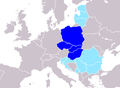
![According to The Economist and Ronald Tiersky, a strict definition of Central Europe means the Visegrád Group.Template:Sfn[63]](https://upload.wikimedia.org/wikipedia/commons/thumb/b/b6/Visegrad_group_countries.png/120px-Visegrad_group_countries.png) According to The Economist and Ronald Tiersky, a strict definition of Central Europe means the Visegrád Group.Template:Sfn[63]
According to The Economist and Ronald Tiersky, a strict definition of Central Europe means the Visegrád Group.Template:Sfn[63] -
 Map of Central Europe, according to Lonnie R. Johnson (2011):Template:SfnTemplate:LegendTemplate:Legend
 -
![Central European countries in Encarta Encyclopedia (2009):[59] Template:LegendTemplate:Legend](https://upload.wikimedia.org/wikipedia/commons/thumb/c/c3/Central-Europe-Encarta.png/120px-Central-Europe-Encarta.png)
-
 The Central European Countries according to Meyers Grosses Taschenlexikon (1999):
Template:LegendTemplate:LegendTemplate:Legend -
 Middle Europe (Brockhaus Enzyklopädie, 1998)
 -
![Central Europe according to Swansea University professors Robert Bideleux and Ian Jeffries (1998)[64]](https://upload.wikimedia.org/wikipedia/commons/thumb/7/73/Central-Europe-SwanseaUniv.png/120px-Central-Europe-SwanseaUniv.png) Central Europe according to Swansea University professors Robert Bideleux and Ian Jeffries (1998)[64]
Central Europe according to Swansea University professors Robert Bideleux and Ian Jeffries (1998)[64] -
![Central Europe, as defined by E. Schenk (1950)[65]](https://upload.wikimedia.org/wikipedia/commons/thumb/3/3e/Central_Europe_%28by_E._Schenk%29.PNG/120px-Central_Europe_%28by_E._Schenk%29.PNG) Central Europe, as defined by E. Schenk (1950)[65]
Central Europe, as defined by E. Schenk (1950)[65] -
 Central Europe, according to Alice F. A. Mutton in Central Europe. A Regional and Human Geography (1961)
 -
 Central Europe according to Meyers Enzyklopaedisches Lexikon (1980)

![According to The Economist and Ronald Tiersky, a strict definition of Central Europe means the Visegrád Group.Template:Sfn[63]](/wiki/File:Visegrad_group_countries.png)
2.PNG)
![Central European countries in Encarta Encyclopedia (2009):[59] Template:LegendTemplate:Legend](/wiki/File:Central-Europe-Encarta.png)
.PNG)
.PNG)
![Central Europe according to Swansea University professors Robert Bideleux and Ian Jeffries (1998)[64]](/wiki/File:Central-Europe-SwanseaUniv.png)
![Central Europe, as defined by E. Schenk (1950)[65]](/wiki/File:Central_Europe_(by_E._Schenk).PNG)
.PNG)
.PNG)
States
The comprehension of the concept of Central Europe is an ongoing source of controversy,[66] though the Visegrád Group constituents are almost always included as de facto Central European countries.[63] Although views on which countries belong to Central Europe are vastly varied, according to many sources (see section Definitions) the region includes the states listed in the sections below.
Depending on context, Central European countries are sometimes grouped as Eastern or Western European countries, collectively or individually[67][68][69][70] but some place them in Eastern Europe instead:[67][68][69] for instance Austria can be referred to as Central European, as well as Eastern EuropeanTemplate:Dubious[71] or Western European[72] and Slovenia can sometimes be placed in either Southeastern[73] or Eastern Europe.[71]
Other countries and regions
Some sources also add regions of neighbouring countries for historical reasons (the former Austro-Hungarian and German Empires, and modern Estonia, Latvia and Lithuania), or based on geographical and/or cultural reasons:
- CroatiaTemplate:Sfn[74][75][76][77] (alternatively placed in Southeast Europe)[78][79]
- Romania (Transylvania, along with Banat, Crișana, Maramureș,[80] Bukovina[81][82][83][84] and Muntenia along with Oltenia[85])
- Russia (Kaliningrad Oblast)
- Serbia (primarily Vojvodina and Northern Belgrade)[86][87][88][89]Template:Sfn[90]
- Ukraine (Transcarpathia,[91] Galicia and Northern Bukovina[81])
- Luxembourg
- The three Baltic countries (Lithuania, Latvia, and Estonia), geographically in Northern Europe, have been considered part of Central Europe in the German tradition of the term, Mitteleuropa. Benelux countries are generally considered a part of Western Europe, rather than Central Europe. Nevertheless, they are occasionally mentioned in the Central European context due to cultural, historical and linguistic ties.
- Italy (South Tyrol, Trentino, Trieste and Gorizia, Friuli, Lombardy, and Veneto or all of Northern Italy)[92]Template:Failed verification
- France (Alsace, Franconian Lorraine, occasionally the whole of Lorraine, Franche-Comté, the Ardennes and Savoy)
- Belgium (the Ardennes)
Geography

Geography defines Central Europe's natural borders with the neighbouring regions to the north across the Baltic Sea, namely Northern Europe (or Scandinavia), and to the south across the Alps, the Apennine peninsula (or Italy), and the Balkan peninsulaTemplate:Sfn across the Soča–Krka–Sava–Danube line. The borders to Western Europe and Eastern Europe are geographically less defined, and for this reason the cultural and historical boundaries migrate more easily west–east than south–north. The river Rhine, which runs south–north through Western Germany, is an exception.Template:Original research inline
Southwards, the Pannonian Plain is bounded by the rivers Sava and Danube – and their respective floodplains.[93] The Pannonian Plain stretches over the following countries: Austria, Croatia, Hungary, Romania, Serbia, Slovakia and Slovenia, and touches borders of Bosnia and Herzegovina and Ukraine ("peri- Pannonian states").
As southeastern division of the Eastern Alps,[94] the Dinaric Alps extend for 650 kilometres along the coast of the Adriatic Sea (northwest-southeast), from the Julian Alps in the northwest down to the Šar-Korab massif, north–south. According to the Freie Universität Berlin, this mountain chain is classified as South Central European.[95] The city of Trieste in this area, for example, expressly sees itself as a città mitteleuropea. This is particularly because it lies at the interface between the Latin, Slavic, Germanic, Greek and Jewish culture on the one hand and the geographical area of the Mediterranean and the Alps on the other. A geographical and cultural assignment is made.
The Central European flora region stretches from Central France (the Massif Central) to Central Romania (Carpathians) and Southern Scandinavia.[96]
Demography


Central Europe is one of the continent's most populous regions. It includes countries of varied sizes, ranging from tiny Liechtenstein to Germany, the second largest European country by population. Demographic figures for countries entirely located within notion of Central Europe ("the core countries") number around 165 million people, out of which around 82 million are residents of Germany.[97] Other populations include: Poland with around 38.5 million residents,[98] Czech Republic at 10.5 million,[99] Hungary at 10 million,[100] Austria with 8.8 million, Switzerland with 8.5 million,[101] Slovakia at 5.4 million,[102] Slovenia with 2.1 million[103] and Liechtenstein at a bit less than 40,000.[104]
If the countries which are occasionally included in Central Europe were counted in, partially or in whole – Croatia (4.3 million),[105] Romania (20 million), Lithuania (2.9 million), Latvia (2 million), Estonia (1.3 million), Serbia (7.1 million) [106] – it would contribute to the rise of between 25 and 35 million, depending on whether regional or integral approach was used.[107] If smaller, western and eastern historical parts of Central Europe would be included in the demographic corpus, further 20 million people of different nationalities would also be added in the overall count, it would surpass the 200 million people figure.
Economy
Currencies
Currently, the members of the Eurozone include Austria, Croatia, Germany, Luxembourg, Slovakia, and Slovenia. The Czech Republic, Hungary and Poland use their own currencies (Czech koruna, Hungarian forint, Polish złoty), but are obliged to adopt the Euro. Switzerland uses its own currency (Swiss franc), as does Serbia (Serbian dinar) and Romania (Romanian leu).
Human Development Index

| Template:Legend | Template:Legend |
| Template:Legend | Template:Legend |
| Template:Legend |
In 2018, Switzerland topped the HDI list among Central European countries, also ranking #2 in the world. Serbia rounded out the list at #11 (67 world).
Globalisation

The index of globalization in Central European countries (2016 data):[108] Switzerland topped this list as well (#1 world).
Prosperity Index
Legatum Prosperity Index demonstrates an average and high level of prosperity in Central Europe (2018 data).[109] Switzerland topped the index (#4 world).
Corruption

| Template:Legend0 | Template:Legend0 | Template:Legend0 | Template:Legend0 |
| Template:Legend0 | Template:Legend0 | Template:Legend0 | Template:Legend0 |
| Template:Legend0 | Template:Legend0 | Template:Legend0 |
Most countries in Central Europe tend to score above the average in the Corruption Perceptions Index (2018 data),[110] led by Switzerland, Germany, and Austria.
Infrastructure
Industrialisation occurred early in Central Europe. That caused construction of rail and other types of infrastructure.
Rail

Central Europe contains the continent's earliest railway systems, whose greatest expansion was recorded in Austro-Hungarian and German territories between 1860-1870s.Template:Sfn By the mid-19th century Berlin, Vienna, and Buda/Pest were focal points for network lines connecting industrial areas of Saxony, Silesia, Bohemia, Moravia and Lower Austria with the Baltic (Kiel, Szczecin) and Adriatic (Rijeka, Trieste).Template:Sfn Rail infrastructure in Central Europe remains the densest in the world. Railway density, with total length of lines operated (km) per 1,000 km2, is the highest in the Czech Republic (198.6), Poland (121.0), Slovenia (108.0), Germany (105.5), Hungary (98.7), Serbia (49.2), Slovakia (73.9) and Croatia (72.5).[111][112][113][114]
River transport and canals
Before the first railroads appeared in the 1840s, river transport constituted the main means of communication and trade.Template:Sfn Earliest canals included Plauen Canal (1745), Finow Canal, and also Bega Canal (1710) which connected Timișoara to Novi Sad and Belgrade via Danube.Template:Sfn The most significant achievement in this regard was the facilitation of navigability on Danube from the Black sea to Ulm in the 19th century.
The economies of Austria, Croatia, the Czech Republic, Germany, Hungary, Poland, Slovakia, Slovenia and Switzerland tend to demonstrate high complexity. Industrialisation reached Central Europe relatively early: the Czech lands by 1797,[115] Luxembourg and Germany by 1860, Poland, Slovakia and Switzerland by 1870, Austria, Croatia, Hungary, Liechtenstein, Romania, Serbia and Slovenia by 1880.[116]
Agriculture
Central European countries are some of the most significant food producers in the world. Germany is the world's largest hops producer with 34.27% share in 2010,[117] third producer of rye and barley, 5th rapeseed producer, sixth largest milk producer, and fifth largest potato producer. Poland is the world's largest triticale producer, second largest producer of raspberries, currants, third largest of rye, the fifth apple and buckwheat producer, and seventh largest producer of potatoes. Czech Republic is world's fourth largest hops producer and 8th producer of triticale. Hungary is world's fifth hops and seventh largest triticale producer. Serbia is world's second largest producer of plums and second largest of raspberries.[118][119] Slovenia is world's sixth hops producer.
Business
Central European business has a regional organisation, Central European Business Association (CEBA), founded in 1996 in New York as a non-profit organization dedicated to promoting business opportunities within Central Europe and supporting the advancement of professionals in America with a Central European background.[120]
Tourism
Central European countries, especially Austria, Croatia, Germany and Switzerland are some of the most competitive tourism destinations.[121]
Outsourcing destination
Template:As of Kraków, Warsaw, and Wrocław (Poland), Prague and Brno (Czech Republic), Budapest (Hungary), Bucharest (Romania), Bratislava (Slovakia), Ljubljana (Slovenia), Belgrade (Serbia) and Zagreb (Croatia) were among the world's top 100 outsourcing destinations.[122]
Education
Languages
Various languages are taught in Central Europe, with certain languages being more popular in different countries.Template:VagueTemplate:Cn
Education performance
Student performance has varied across Central Europe, according to the Programme for International Student Assessment. In the 2012 study, countries scored medium, below or over the average scores in three fields studied.[123]
Higher education
.jpg)
Universities
The first university established east of France and north of the Alps was in Prague in 1348 by Charles IV, Holy Roman Emperor. The Charles University was modeled upon the University of Paris and initially included the faculty of law, medicine, philosophy, and theology.[124]
Central European University

In 1991, Ernest Gellner proposed the establishment of a truly Central European institution of higher learning in Prague (1991–1995).[125] Eventually, the Central European University (CEU) project was taken on and financially supported by the Hungarian philanthropist George Soros, who had provided an endowment of US$880 million, making the university one of the wealthiest in Europe.[126] Over its 30 year history CEU has become one of the most internationally diverse and recognisable universities in the world. For example, as of 2019, 1217 students were enrolled in the university, of which 962 were international students, making the student body the fourth most international in the world. [127] CEU offers highly selective programs with a student to faculty ratio of 7:1.[128] In 2021, the admission rate into its programs was 13%. [129] CEU has thus become a leading global university in Europe promoting a distinctively Central European perspective whilst emphasizing academic rigor, applied research, and academic honesty and integrity.[130] CEU is a founding member of CIVICCA, a group of prestigious European higher education institutions in the social sciences, humanities, business management and public policy, such as Sciences Po (France), The London School of Economics and Political Science (UK), Bocconi University (Italy) and the Stockholm School of Economics (Sweden).[131] In 2019, Central European University leadership announced their preparatory work on moving CEU to Vienna due to legal constraints against academic freedom in Hungary.[132]
Culture and society
Research
Research centres of Central European literature include Harvard University (Cambridge, MA),[133] Purdue University,[134] and Central European Studies Programme (CESP), Masaryk University, Brno, Czech Republic.[135]
Architecture
Religion
Central European countries are mostly Catholic (Austria, Croatia, Liechtenstein, Luxembourg, Poland, Slovakia, Slovenia) or historically both Catholic and Protestant, (the Czech Republic, Germany, Hungary and Switzerland). Large Protestant groups include Lutheran, Calvinist, and the Unity of the Brethren affiliates. Significant populations of Eastern Catholicism and Old Catholicism are also prevalent throughout Central Europe.
Central Europe has been the center of the Protestant movement for centuries, with the majority of Protestants suppressed and annihilated during the Counterreformation.[136][137]
Historically, people in Bohemia in today's Czech Republic were one of the very first Protestants in Europe. As a result of the Thirty Years' War following the Bohemian Revolt, many Czechs were either killed, executed (see for Old Town Square execution), forcibly turned into Roman Catholics, or emigrated to Scandinavia and the Low Countries. In the aftermath of the Thirty Years' War, the number of inhabitants in the Kingdom of Bohemia decreased from three million to only 800,000 due to multiple factors, including devastating ongoing battles such as the significant Battle of White Mountain and the Battle of Prague (1648). However, in recent years, most Czechs report as overwhelmingly non-religious, with some describing themselves as Catholic (10.3%).
Before the Holocaust (1941–45), there was also a sizeable Ashkenazi Jewish community in the region, numbering approximately 16.7 million people.[138]
Currently, a number of Central European countries present themselves as more secular or non-religious, including a atheists, undeclared, and non-religious people. For example, people in the Czech Republic report the following figures (non-religious 34.2% and undeclared 45.2%), meanwhile persons in Germany (non-religious 38%), and Slovenia (atheist 14.7%[139]), Luxembourg (23.4% non-religious[139]), Switzerland (20.1%), Hungary (27.2% undeclared, 16.7% "non-religious" and 1.5% atheists), Slovakia (atheists and non-religious 13.4%, "not specified" 10.6%) Austria (19.7% of "other or none"), Liechtenstein (10.6% with no religion), Croatia (4%) and Poland (3% of non-believers/agnostics and 1% of undeclared).
Cuisine
Central European cuisine has evolved through centuries due to social and political change. Most countries share many dishes. The most popular dishes typical to Central Europe are sausages and cheeses, where the earliest evidence of cheesemaking in the archaeological record dates back to 5,500 BCE (Kuyavia region, Poland).[140] Other foods widely associated with Central Europe are goulash and beer. The list of countries by beer consumption per capita is led by the Czech Republic, followed by Germany and Austria. Poland comes 5th, Croatia 7th and Slovenia 13th.
Human rights
Generally, the countries in the region are progressive on the issue of human rights: death penalty is illegal in all of them, corporal punishment is outlawed in most of them and people of both genders can vote in elections. However, Central European countries are divided on the subject of same-sex marriage and abortion. Austria, the Czech Republic, Germany, and Poland also have a history of participation in the CIA's extraordinary rendition and detention program, according to the Open Society Foundations.[141][142]
Literature
Regional writing tradition revolves around the turbulent history of the region, as well as its cultural diversity.[143][144] Its existence is sometimes challenged.[145] Specific courses on Central European literature are taught at Stanford University,[146] Harvard University[147] and Jagiellonian University[148] The as well as cultural magazines dedicated to regional literature.[149] Angelus Central European Literature Award is an award worth 150,000.00 PLN (about $50,000 or £30,000) for writers originating from the region.[150] Likewise, the Vilenica International Literary Prize is awarded to a Central European author for "outstanding achievements in the field of literature and essay writing".[151]
Media
Sport
There is a number of Central European Sport events and leagues. They include:
- Central European Tour Miskolc GP (Hungary)*
- Central European Tour Budapest GP (Hungary)
- 2008 Central Europe Rally (Romania and Hungary)*
- 2023 Central Europe Rally (Germany, Austria and Czech Republic)
- Central European Football League (Austria, Croatia, Hungary, Serbia, Slovakia, Slovenia and Turkey)
- Central European International Cup (Austria, Czechoslovakia, Hungary, Italy, Poland, Switzerland and Yugoslavia; 1927–1960)
- Central Europe Throwdown*[152]
Football is one of the most popular sports. Countries of Central Europe hosted several major competitions. Germany hosted two FIFA World Cups (1974 and 2006) and the UEFA Euro 1988. Yugoslavia hosted the UEFA Euro 1976 before the competition expanded to 8 teams. Recently, the 2008 and 2012 UEFA European Championships were held in Austria & Switzerland and Poland & Ukraine respectively. The UEFA Euro 2024 will be hosted by Germany.
Politics
Organisations
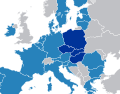
Central Europe is a birthplace of regional political organisations:
- Visegrád Group
- Central European Defence Cooperation
- Three Seas Initiative
- Centrope
- Central European Initiative
- Middleeuropean Initiative
- Central European Free Trade Agreement
-
-
-

-
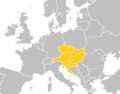
 Central European Initiative
 -
 CEFTA founding states
 -
 CEFTA members in 2003, before joining the EU
 -
 Current CEFTA members


Democracy Index

Central Europe is a home to some of world's oldest democracies. However, most of them have been impacted by totalitarianism, particularly Fascism and Nazism. Germany and Italy occupied all Central European countries, except Switzerland. In all occupied countries, the Axis powers suspended democracy and installed puppet regimes loyal to the occupation forces. Also, they forced conquered countries to apply racial laws and formed military forces for helping German and Italian struggle against Communists. After World War II, almost the whole of Central Europe (the Eastern and Middle part) had been transformed into communist states, most of which had been occupied and later allied with the Soviet Union, often against their will through forged referendum (e.g., Polish people's referendum in 1946) or force (northeast Germany, Poland, Hungary et alia). Nevertheless, these experiences have been dealt in most of them. Most of Central European countries score very highly in the Democracy Index.[153]
Global Peace Index

In spite of its turbulent history, Central Europe is currently one of world's safest regions. Most Central European countries are in top 20%.[154]
Central European Time

The time zone used in most parts of the European Union is a standard time which is 1 hour ahead of Coordinated Universal Time. It is commonly called Central European Time because it has been first adopted in Central Europe (by year):Template:Citation needed
- Hungary
- Slovakia
- Czech Republic
- Germany
- Austria
- Poland (1893)[155]
- Serbia (1884)[156]
- Slovenia
- Switzerland
- Liechtenstein
In popular culture
Central Europe is mentioned in the 35th episode of Lovejoy, entitled "The Prague Sun", filmed in 1992. While walking over the well-regarded and renowned Charles Bridge in Prague, the main character, Lovejoy, says: "I've never been to Prague before. Well, it is one of the great unspoiled cities in Central Europe. Notice: I said: 'Central', not 'Eastern'! The Czechs are a bit funny about that, they think of Eastern Europeans as turnip heads."[157]
Wes Anderson's Oscar-winning film The Grand Budapest Hotel depicts a fictional grand hotel located somewhere in Central Europe which is in actuality modeled on the Grandhotel Pupp in Karlovy Vary in the Czech Republic. The film is a celebration of the 1920s and 1930s Central Europe with its artistic splendor and societal sensibilities.[158][159]
See also
Template:Portal Template:Div col
- Central and Eastern Europe
- Central European Initiative
- Central European Time (CET)
- Central European University
- East-Central Europe
- Eurovoc
- Geographical midpoint of Europe
- Life zones of central Europe
- Międzymorze (Intermarum)
- Mitteleuropa
References
Citations
- ↑ Lecture 14: The Origins of the Cold War. Historyguide.org. Retrieved 29 October 2011.
- ↑ Central Europe –The future of the Visegrad group. The Economist(14 April 2005). Retrieved 7 March 2009.
- ↑ The Tragedy of Central Europe. www.europarl.europa.eu(1984). Retrieved 23 August 2023.
- ↑ Karl A. Sinnhuber, Central Europe: Mitteleuropa: Europe Centrale: An Analysis of a Geographical Term, Transactions and Papers 20 (1954), 20-21.https://www.gla.ac.uk/0t4/crcees/files/summerschool/readings/school10/reading_list/Sinnhuber.pdf
- ↑ Central European Identity in Politics – Jiří Pehe. Conference on Central European Identity, Central European Foundation, Bratislava. Retrieved 31 January 2010.
- ↑ Comparative Central European culture{{#if:|, {{{last}}}}. Purdue University Press(2002). ISBN 978-1-55753-240-4
- ↑ An Introduction to Central Europe: History, Culture, and Politics – Preparatory Course for Study Abroad Undergraduate Students at CEU. Central European University(Fall 2006).
- ↑ U.N. Classification of Geographical Regions. United Nation Statistics Division. Retrieved 12 September 2023.
- ↑ 9.0 9.1 2.16 Traditional Regions of Europe({Template:Date).
- ↑ 10.0 10.1 Regions Of Europe. WorldAtlas(2021-05-10). Retrieved 2023-08-23.
- ↑ 11.0 11.1 Historiography of the Countries of Eastern Europe. The American Historical Review({Template:Date).
- ↑ 12.0 12.1 Fall of Communism in Eastern Europe, 1989. U.S. Department of State.
- ↑ 13.0 13.1 Identity and Culture in Ottoman Hungary. Repository of the Academy’s Library(2017).
- ↑ 14.0 14.1 Western European Union - Archive of European Integration. aei.pitt.edu. Retrieved 2023-08-25.
- ↑ 15.0 15.1 Southeast European Cooperative Initiative (SECI). United Nations Economics Commission for Europe. Retrieved 25 August 2023.
- ↑ The Mice that Roared: Central Europe Is Reshaping Global Politics(26 February 2006). Retrieved 31 January 2010.
- ↑ The tragedy of Central Europe. Retrieved 20 March 2021.
- ↑ Religion and Culture in Early Modern Europe{{#if:|, {{{last}}}}. Oxford University Press(2007). ISBN 978-0-19-804384-3
- ↑ East Central Europe in the Middle Ages, 1000–1500{{#if:|, {{{last}}}}. University of Washington Press(1994). ISBN 0-295-97291-2
- ↑ Cite error: Invalid
<ref>tag; no text was provided for refs namedshape of europe - ↑ Similarities and Differences in Polish and Hungarian History. Retrieved 15 January 2015.
- ↑ 22.0 22.1 European values at the turn of the millennium{{#if:Halman|, Halman}. Brill Publishers(2004). ISBN 978-90-04-13981-7
- ↑ Source: Geographisches Handbuch zu Andrees Handatlas, vierte Auflage, Bielefeld und Leipzig, Velhagen und Klasing, 1902.
- ↑ Jackson J. Spielvogel: Western Civilization: Alternate Volume: Since 1300. p. 618.
- ↑ 25.0 25.1 "Mitteleuropa" is a multi-facetted concept and difficult to handle. Retrieved 31 January 2010.
- ↑ A. Podraza, Europa Środkowa jako region historyczny, 17th Congress of Polish Historians, Jagiellonian University 2004
- ↑ Joseph Franz Maria Partsch, Clementina Black, Halford John Mackinder, Central Europe, New York 1903
- ↑ F. Naumann, Mitteleuropa, Berlin: Reimer, 1915
- ↑ [1], [2] and [3]; Géographie universelle (1927), edited by Paul Vidal de la Blache and Lucien Gallois
- ↑ The Versailles System and Central Europe. The English Historical Review({Template:Year).
- ↑ Between Worlds. The MIT Press. Retrieved 31 January 2010.
- ↑ Igor Lukes, "Central Europe Has Joined NATO: The Continuing Search for a More Perfect Habsburg Empire." SAIS Review (1999): 47-59.
- ↑ Churchill und die Deutschen - DER SPIEGEL - Geschichte. Der Spiegel(13 August 2010).
- ↑ Peter Broucek "Die österreichische Identität im Widerstand 1938–1945" (2008), p 163.
- ↑ Suberversion deutscher Herrschaft. Der britische Geheimdienst SOE und Österreich{{#if:Pirker|, Pirker}. V & R Unipress(2012). ISBN 9783862349906
- ↑ Olga S. Opfell "Royalty Who Wait: The 21 Heads of Formerly Regnant Houses of Europe" (2001), p 133.
- ↑ "Unternehmen Margarethe": Wehrmacht besetzt 1944 Ungarn. Die Welt(19 March 2019).
- ↑ 1945/2020: Die Sowjets und die Österreich-Idee. news.ORF.at(26 April 2020). Retrieved 26 April 2020.
- ↑ Gerald Stourzh "Geschichte des Staatsvertrages 1945-1955" (1980), p 4.
- ↑ Wolfgang Mueller "Die sowjetische Besatzung in Österreich 1945-1955 und ihre politische Mission" (German - "The Soviet occupation in Austria 1945-1955 and its political mission"), 2005, p 24.
- ↑ ISES. ises.hu.
- ↑ One of the main representatives was Oscar Halecki and his book The limits and divisions of European history, London and New York 1950
- ↑ A. Podraza, Europa Środkowa jako region historyczny, 17th Congress of Polish Historians, Jagiellonian University 2004
- ↑ Central Europe: Mitteleuropa: Europe Centrale: An Analysis of a Geographical Term. Transactions and Papers (Institute of British Geographers)({Template:Date).
- ↑ Hilde Szabo: Die Berliner Mauer begann im Burgenland zu bröckeln (The Berlin Wall began to crumble in Burgenland - German), in Wiener Zeitung 16 August 1999; Otmar Lahodynsky: Paneuropäisches Picknick: Die Generalprobe für den Mauerfall (Pan-European picnic: the dress rehearsal for the fall of the Berlin Wall - German), in: Profil 9 August 2014.
- ↑ Ludwig Greven "Und dann ging das Tor auf", in Die Zeit, 19 August 2014.
- ↑ Miklós Németh in Interview, Austrian TV - ORF "Report", 25 June 2019.
- ↑ Otmar Lahodynsky "Eiserner Vorhang: Picknick an der Grenze" (Iron curtain: picnic at the border - German), in Profil 13 June 2019.
- ↑ Thomas Roser: DDR-Massenflucht: Ein Picknick hebt die Welt aus den Angeln (German - Mass exodus of the GDR: A picnic clears the world) in: Die Presse 16 August 2018.
- ↑ Andreas Rödder, Deutschland einig Vaterland – Die Geschichte der Wiedervereinigung (2009).
- ↑ Aleksov, & Piahanau. Introduction, in: Wars & Betweeness. Big Powers in Middle Europe, 1918-45. New York-Budapest: CEU Press, 2020, 7-8 pp.[4]
- ↑ Jerzy Kłoczowski, Actualité des grandes traditions de la cohabitation et du dialogue des cultures en Europe du Centre-Est, in: L'héritage historique de la Res Publica de Plusieurs Nations, Lublin 2004, pp. 29–30 Template:ISBN
- ↑ Oskar Halecki, The Limits and Divisions of European History, Sheed & Ward: London and New York 1950, chapter VII
- ↑ Template:Cite magazine
- ↑ Selected as "Editor's Choice" of the History Book Club. Retrieved 20 May 2009.Template:Dead linkTemplate:Cbignore
- ↑ The Myths and Memories We Teach By, Bucur, Maria. Indiana University(June 1997). Retrieved 23 December 2011.
- ↑ Template:Cite encyclopedia
- ↑ Cite error: Invalid
<ref>tag; no text was provided for refs namedFact - ↑ 59.0 59.1 Template:Cite encyclopedia
- ↑ Band 16, Bibliographisches Institut Mannheim/Wien/Zürich, Lexikon Verlag 1980
- ↑ Großgliederung Europas nach kulturräumlichen Kriterien. Europa Regional({Template:Year).
- ↑ Macroeconomic Legal Trends in the EU11 Countries. Public Governance, Administration and Finances Law Review({Template:Year).
- ↑ 63.0 63.1 From Visegrad to Mitteleuropa. The Economist(14 April 2005).
- ↑ A History of Eastern Europe: Crisis and Change{{#if:|, {{{last}}}}. Routledge(10 April 2006). ISBN 978-1-134-71984-6
- ↑ Erich Schenk, Mitteleuropa. Düsseldorf, 1950
- ↑ For the Record. The Washington Post(3 May 1990). Retrieved 31 January 2010.
- ↑ 67.0 67.1 United Nations Statistics Division – Standard Country and Area Codes Classifications (M49). United Nations(31 October 2013). Retrieved 4 August 2014.
- ↑ 68.0 68.1 World Population Ageing: 1950–2050. United Nations. Retrieved 15 January 2015.
- ↑ 69.0 69.1 Browse MT 7206. Europa (web portal). Retrieved 4 August 2014.
- ↑ The Puzzle of Central Europe. Visegradgroup.eu(18 March 1999). Retrieved 4 August 2014.
- ↑ 71.0 71.1 Highlights of Eastern Europe (Vienna through Slovenia, Croatia, Hungary, Slovakia, Poland, Germany and the Czech Republic). a-ztours.com. Retrieved 15 January 2015.
- ↑ Mastication Monologues: Western Europe(11 June 2014). Retrieved 15 January 2015.
- ↑ Map of europe. TheFreeDictionary.com. Retrieved 2 June 2021.
- ↑ In the Heavy Shadow of the Ukraine/Russia Crisis, page 10(September 2014). Retrieved 15 January 2015.
- ↑ UNHCR in Central Europe.
- ↑ Central European Green Corridors – Fast charging cross-border infrastructure for electric vehicles, connecting Austria, Slovakia, Slovenia, Germany and Croatia(October 2014).
- ↑ Interreg Central Europe Homepage. Retrieved 15 March 2015.
- ↑ Andrew Geddes, Charles Lees, Andrew Taylor : "The European Union and South East Europe: The Dynamics of Europeanization and multilevel governance", 2013, Routledge
- ↑ Klaus Liebscher, Josef Christl, Peter Mooslechner, Doris Ritzberger-Grünwald : "European Economic Integration and South-East Europe: Challenges and Prospects", 2005, Edward Elgar Publishing Limited
- ↑ Sven Tägil, Regions in Central Europe: The Legacy of History, C. Hurst & Co. Publishers, 1999, p. 191
- ↑ 81.0 81.1 Klaus Peter Berger, The Creeping Codification of the New Lex Mercatoria, Kluwer Law International, 2010, p. 132
- ↑ Alan Rogers Central Europe 2007 – Quality Camping & Caravanning Sites{{#if:|, {{{last}}}}. Alan Rogers Guides, Ltd.(2007). ISBN 9780955048685
- ↑ United States. Foreign Broadcast Information Service Daily report: East Europe
- ↑ Council of Europe. Parliamentary Assembly. Official Report of Debates{{#if:|, {{{last}}}}. Council of Europe(1994). ISBN 978-92-871-2516-3
- ↑ Unitatile fizico-geografice din Europa Centrala – Profu' de geogra'. Retrieved 2022-06-02.
- ↑ About Serbia. UNDP in Serbia. United Nations Development Programme. Retrieved 13 November 2015.
- ↑ Irena Kogan: Delayed Transition: Education and Labor Market in Serbia [5], Making the Transition: Education and Labor Market Entry in Central and Eastern Europe, 2011, chapter 6
- ↑ Serbia: the country at the crossroads of Europe, Shadbolt, Peter. CNN(11 December 2014).
- ↑ WMO, UNCCD, FAO, UNW-DPC [6], Country Report: Drought conditions and management strategies in Serbia, 2013, p. 1
- ↑ Government of Hungary, Prime Minister Viktor Orbán's speech at the Energy Forum following a joint meeting of the Serbian and Hungarian cabinets [7] Template:Webarchive, Government of Hungary on Serbia, 2018
- ↑ Transcarpathia: Perephiral Region at the "Centre of Europe"{{#if:|, {{{last}}}}. Routledge(2013). ISBN 978-1-136-34323-0
- ↑ Accidental Occidental: Economics and Culture of Transition in Mitteleuropa, the Baltic and the Balkan Area{{#if:Bokros|, Bokros}. Central European University Press(15 January 2013). ISBN 9786155225246
- ↑ Danube Facts and Figures. Bosnia and Herzegovina (April 2007) (PDF file)
- ↑ Template:Cite encyclopedia
- ↑ Die Alpen – Höhenstufen und Vegetation – Hauptseminararbeit{{#if:|, {{{last}}}}. GRIN(14 April 2005). ISBN 9783638365840
- ↑ Wolfgang Frey and Rainer Lösch; Lehrbuch der Geobotanik. Pflanze und Vegetation in Raum und Zeit. Elsevier, Spektrum Akademischer Verlag, München 2004 Template:ISBN
- ↑ Demography report 2010. Retrieved 12 May 2012.
- ↑ Główny Urząd Statystyczny / Spisy Powszechne / NSP 2011 / Wyniki spisu NSP 2011(14 July 2014).
- ↑ Czech Republic: The Final Census Results to be Released in the Third Quarter of 2012(7 May 2012). Retrieved 15 October 2015.
- ↑ Template:Cite press release
- ↑ Swiss Statistics – Overview. Bfs.admin.ch(27 August 2015). Retrieved 24 September 2015.
- ↑ Development in the number of inhabitants – 2011, 2001, 1991, 1980, 1970.
- ↑ Population and household censuses. SiStat Database. Retrieved 15 January 2022.
- ↑ Landesverwaltung Liechtenstein. Llv.li. Retrieved 24 September 2015.
- ↑ Central Bureau of Statistics. Dzs.hr. Retrieved 27 September 2015.
- ↑ ПОЧЕТНА | Републички завод за статистику Србије. www.stat.gov.rs. Retrieved 13 February 2019.
- ↑ Total population, Candidate countries and potential candidates.
- ↑ 2018 KOF Globalization Index. Retrieved 5 August 2019.
- ↑ Rankings. Legatum Prosperity Index 2018. Retrieved 25 July 2019.
- ↑ Corruption Perceptions Index 2018, e.V, Transparency International. transparency.org(29 January 2019). Retrieved 25 July 2019.
- ↑ Launch of railway projects puts Serbia among EU member states. Railway Pro(27 February 2013). Retrieved 4 August 2014.
- ↑ Response to questionnaire for: Assessment of strategic plans and policy measures on Investment and Maintenance in Transport Infrastructure Country: Serbia. Retrieved 15 October 2015.
- ↑ Inland transport infrastructure at regional level – Statistics Explained. European Commission. Retrieved 4 August 2014.
- ↑ Statistical Database – United Nations Economic Commission for Europe. W3.unece.org(29 December 1980). Retrieved 4 August 2014.
- ↑ On the industrial history of the Czech Republic. Retrieved 20 May 2021.
- ↑ Spread of the Industrial Revolution. Srufaculty.sru.edu(16 August 2001). Retrieved 4 August 2014.
- ↑ Gnel Gabrielyan, Domestic and Export Price Formation of U.S. Hops Template:Webarchive School of Economic Sciences at Washington State University. PDF file, direct download 220 KB. Retrieved 25 April 2014.
- ↑ Statistical Yearbook of the Republic of Serbia. Statistical Office of the Republic of Serbia. Retrieved 22 October 2022.
- ↑ Serbia Overview. Food and Agriculture Organization of the United Nations. Retrieved 14 June 2013.
- ↑ Welcome centraleurope.org – Hostmonster.com. centraleurope.org. Retrieved 28 March 2016.
- ↑ The Travel & Tourism Competitiveness Report 2011: Beyond the Downturn. Retrieved 16 October 2015.
- ↑ 2013 Top 100 Outsourcing Destinations: Rankings and Report Overview(January 2013). Retrieved 16 October 2015.
- ↑ PISA 2012 Results in Focus: What 15-year-olds know and what they can do with what they know. Retrieved 16 October 2015.
- ↑ Joachim W. Stieber: "Pope Eugenius IV, the Council of Basel and the secular and ecclesiastical authorities in the Empire: the conflict over supreme authority and power in the church", Studies in the history of Christian thought, Vol. 13, Brill, 1978, Template:ISBN, p.82; Gustav Stolper: "German Realities", Read Books, 2007, Template:ISBN, p. 228; George Henry Danton: "Germany ten years after", Ayer Publishing, 1928, Template:ISBN, p. 210; Vejas Gabriel Liulevicius: "The German Myth of the East: 1800 to the Present", Oxford Studies in Modern European History Series, Oxford University Press, 2009, Template:ISBN, p. 109; Levi Seeley: "History of Education", BiblioBazaar, Template:ISBN, p. 141
- ↑ Transnational Philanthropy and Nationalism: The Early Years of Central European University. Retrieved 20 May 2021.
- ↑ For President of Central European University, All Roads Led to Budapest(2 May 2010). Retrieved 15 January 2015.
- ↑ World University Rankings 2020. Top Universities. Retrieved 2023-06-05.
- ↑ Central European University. Top Universities. Retrieved 2023-06-05.
- ↑ Institutional Factbook: Student Admissions | Central European University. www.ceu.edu. Retrieved 2023-06-05.
- ↑ CEU Facts and Figures. Central European University. Retrieved 20 May 2021.
- ↑ About CIVICA - The European University of Social Sciences. www.civica.eu. Retrieved 2023-06-05.
- ↑ Central European University Announces New Vienna Campus. Retrieved 20 May 2021.
- ↑ Central European Studies. Static.fas.harvard.edu. Retrieved 24 September 2015.
- ↑ Project MUSE – Comparative Central European Culture{{#if:|, {{{last}}}}. Muse.jhu.edu. ISBN 9781612490175
- ↑ Central European Studies Programme (CESP). Retrieved 20 May 2021.
- ↑ Map: The Religious Divisions of Europe ca. 1555. Pearson. Retrieved 16 October 2015.
- ↑ Map of Europe in 1560: Religion. Emersonkent.com. Retrieved 24 September 2015.
- ↑ American Jewish Year Book{{#if:|, {{{last}}}}. American Jewish Committee
- ↑ 139.0 139.1 Eurobarometer 90.4 (December 2018): Attitudes of Europeans towards Biodiversity, Awareness and Perceptions of EU customs, and Perceptions of Antisemitism. European Commission.
- ↑ Art of cheese-making is 7,500 years old. Nature News & Comment({Template:Year).
- ↑ CIA Secret Detention and Torture. Retrieved 24 September 2015.
- ↑ Transcend Media Service. Retrieved 24 September 2015.
- ↑ In praise of writers' bloc: How the tedium of life under Communism gave rise to a literature alive with surrealism and comedy. The Independent. Retrieved 24 September 2015.
- ↑ Comparative Central European Culture. Thepress.purdue.edu. Retrieved 24 September 2015.
- ↑ Czech mates. Retrieved 24 September 2015.
- ↑ [8] Template:Webarchive
- ↑ Secondary Fields. Slavic.fas.harvard.edu. Retrieved 24 September 2015.
- ↑ Literatura Środkowoeuropejska w poszukiwaniu tożsamości. Usosweb.uj.edu.pl. Retrieved 24 September 2015.
- ↑ literalab. Retrieved 24 September 2015.
- ↑ Regulations. Angelus.com.pl. Retrieved 24 September 2015.
- ↑ About Vilenica. Vilenica Literary Festival. Retrieved 14 February 2018.
- ↑ Central Europe Throwdown 2015. Retrieved 24 September 2015.
- ↑ Democracy index 2012: Democracy at a standstill: A report from The Economist Intelligence Unit. The Economist. Retrieved 15 October 2015.
- ↑ Vision of Humanity | Destination for Peace. Vision of Humanity.
- ↑ Since Poland was partitioned since 1922 (official adoption), the dates of introduction in Germany (1893) and Austria (1893) should be understood as de facto adoption
- ↑ Time Zone & Clock Changes in Belgrade, Serbia. timeanddate.com. Retrieved 19 July 2018.
- ↑ Lovejoy – Season 3, Episode 13: The Prague Sun. TV.com. Retrieved 26 November 2014.
- ↑ Template:Cite magazine
- ↑ Oscars 2015 live updates: J.K. Simmons, 'Grand Budapest Hotel' win first awards(22 February 2015). Retrieved 24 September 2015.
![[1]](https://web.archive.org/web/20100212050523/http://img73.imageshack.us/img73/5269/file0039ao0.jpg)
![[2]](https://web.archive.org/web/20100212050523/http://img12.imageshack.us/img12/4384/martonne1.jpg)
![[3]](https://web.archive.org/web/20100212050523/http://img98.imageshack.us/img98/1867/martonne2a.jpg)

General and cited references
- The Versailles System and Central Europe Variorum Collected Studies{{#if:Ádám|, Ádám}. Ashgate(2003). ISBN 0-86078-905-5
- The Little Entente and Europe(1920–1929){{#if:Ádám|, Ádám}. Akadémiai Kiadó(1993). ISBN 963-05-6420-3
- The politics of Central Europe{{#if:Ágh|, Ágh}. Sage(1998). ISBN 0-7619-5032-X
- Wars & Betweeness. Big Powers in Middle Europe, 1918-45{{#if:Piahanau|, Piahanau}. CEU Press(2020). ISBN 978-963-386-335-0
- Bismarck and Mitteleuropa{{#if:Hayes|, Hayes}. Fairleigh Dickinson University Press(1994). ISBN 978-0-8386-3512-4
- Austria, Hungary, and the Habsburgs: Central Europe c.1683-1867{{#if:Evans|, Evans}. Oxford(2006). ISBN 9780199281442
- Central Europe: enemies, neighbors, friends{{#if:Johnson|, Johnson}. Oxford University Press(1996). ISBN 978-0-19-510071-6
- Mitteleuropa: Between Europe and Germany{{#if:Katzenstein|, Katzenstein}. Berghahn Books(1997). ISBN 978-1-57181-124-0
- Historical Atlas of Central Europe{{#if:Magocsi|, Magocsi}. University of Toronto Press(2002). ISBN 978-0-8020-8486-6
- Between Worlds. A Sourcebook of Central European Avant-Gardes, 1910–1930{{#if:O. Benson, Forgacs|, O. Benson, Forgacs}. MIT Press(2002). ISBN 978-0-262-02530-0
- Europe today{{#if:Tiersky|, Tiersky}. Rowman & Littlefield(2004). ISBN 978-0-7425-2805-5
- Comparative Hungarian Cultural Studies{{#if:|, {{{last}}}}. Purdue University Press(2011). ISBN 978-1-55753-593-1
- Shared Pasts in Central and Southeast Europe, 17th–21st Centuries. Eds. G. Demeter, P. Peykovska. 2015
Further reading
- Ágh, Attila. Declining Democracy in East-Central Europe: The Divide in the EU and Emerging Hard Populism (Edward Elgar Publishing, 2019).
- Baldersheim, Harald, ed. Local democracy and the processes of transformation in East-Central Europe (Routledge, 2019).
- Brophy, James M. "Bookshops, Forbidden Print and Urban Political Culture in Central Europe, 1800–1850". German History 35.3 (2017): 403–430.
- Case, Holly. "The strange politics of federative ideas in East-Central Europe." Journal of Modern History 85.4 (2013): 833–866.
- Centre of Central European Studies, Agrarianism in Central and Eastern Europe in the 19th and 20th Centuries (2013) online review.
- Donert, Celia, Emily Greble, and Jessica Wardhaugh. "New Scholarship on Central and Eastern Europe". Contemporary European History 26.3 (2017): 507-507. DOI: New Scholarship on Central and Eastern Europe
- Gardner, Hall, ed. Central and South-central Europe in Transition (Praeger, 2000)
- BORDERLANDS OF WESTERN CIVILIZATION A History of East Central Europe, Halecki, Oscar. Oscar Halecki. Retrieved 8 August 2010.
- Kenney, Padraic. "What is the history of 1989? New scholarship from East-Central Europe." East European Politics & Societies (1999), 13#2 pp 419–431.
- Lederer, David. Early Modern Central European History (2011) online review by Linnéa Rowlatt
- Margreiter, Klaus. "The Notion of Nobility and the Impact of Ennoblement on Early Modern Central Europe." Central European History 52.3 (2019): 382–401.
- Tieanu, Alexandra. "Shared Culture, Peace and Bridging: Western Influences on the Dissident Idea of Central Europe in the Communist States during the 1980s." Valahian Journal of Historical Studies 20 (2013): 215–232.
- Vachudova, Milada Anna. "From competition to polarization in central Europe: How populists change party systems and the European Union." Polity 51.4 (2019): 689–706. online
- Vachudova, Milada Anna. "Ethnopopulism and democratic backsliding in Central Europe." East European Politics 36.3 (2020) pp: 318–340. online
- Zimmerman, Andrew. "Race against Revolution in Central and Eastern Europe: From Hegel to Weber, from Rural Insurgency to "Polonization"." East Central Europe 43.1-2 (2016): 14–40.
- 'Mapping Central Europe' in hidden europe, 5, pp. 14–15 (November 2005)
External links
- Journal of East Central Europe
- Central European Political Science Association's journal "Politics in Central Europe"
- CEU Political Science Journal (PSJ)
- Central European Journal of International and Security Studies
- Central European Political Studies Review
- The Centrope region
- Maps of Europe and European countries
- CENTRAL EUROPE 2020 Template:Webarchive
- Central Europe Economy
- UNHCR Office for Central Europe
Template:Regions of the world Template:European Union topics Template:Europe topics (small) Template:Authority control