




Template:Infobox official post
The Chairman of the Indian Space Research Organisation is the highest-ranked official of the Indian Space Research Organisation (ISRO). He is secretary to government of India and executive of Department of Space (DOS) which directly reports to the prime minister of India.[1]
The Indian National Committee for Space Research (INCOSPAR) was founded in 1962 under Department of Atomic Energy (DAE) with Vikram Sarabhai as its chairperson which in 1969 became ISRO.[2] In 1972, government of India had set up a space commission and DOS and brought ISRO under DOS.[3]
Since Sarabhai has assumed the position, there have been ten chairmen of the ISRO, with Prof. Satish Dhawan serving the longest term of 12 years as the chairman.
List of chairmen
| Template:Tooltip | Portrait | Name Template:Small |
Term | Ref(s) | ||
|---|---|---|---|---|---|---|
| Start | End | Term length | ||||
| 1 | 
|
Template:Sortname Template:Small |
Template:Dts | Template:Dts | 9 years | [4] |
| Founder of INCOSPAR and widely regraded as father of Indian space program. His efforts led to creation of Indian Space Research Organisation. | ||||||
| 2 | Template:Sortname Template:Small |
Template:Dts | Template:Dts | 9 months | [5] | |
| He was notable mostly for his work on cosmic rays and particle physics particularly on the high-energy inter-actions of elementary particles. | ||||||
| 3 | Template:Sortname Template:Small |
Template:Dts | Template:Dts | 12 years | [6] | |
| Satish Dhawan is known for his work on fluid dynamics and his tenure as longest serving chief of ISRO. His era marked with India attaining orbital launch capability in 1980 for the first time and start of INSAT program which became base for further development of spacecraft technologies. | ||||||
| 4 | 
|
Template:Sortname Template:Small |
Template:Dts | Template:Dts | 10 years | [7][8] |
| Also served as chancellor of Indian Institute of Space Science and Technology; Rao pushed for launch vehicle development which subsequently lead to realisation of PSLV and later GSLV rockets, marked as key boosts to India's space capabilities. Launch capabilities with INSAT program eventually turned India into a major spacefaring nation. | ||||||
| 5 | 
|
Template:Sortname Template:Small |
Template:Dts | Template:Dts | 9 years | [9] |
| His era marked development of improved spacecraft in INSAT series and development of IRS series of remote sensing satellites and major improvements in earth observation satellite technologies. His tenure also saw operationalisation of PSLVs and first flight of GSLV which made India self sufficient launching its smaller & medium EO satellites. | ||||||
| 6 | 
|
Template:Sortname Template:Small |
Template:Dts | Template:Dts | 6 years | [10] |
| Nair holds significant expertise on development of multi-stage launch vehicles and his era witnessed operationalisation of various variants of PSLV rocket. His tenure saw commencement of Indian Human Spaceflight Programme and launch of extraterrestrial exploration mission Chandrayaan-I. Following a controversial S-band spectrum deal involving Antrix Corporation, he had to step down. | ||||||
| 7 | 
|
Template:Sortname Template:Small |
Template:Dts | Template:Dts | Template:Age in years and days | [11][12][13] |
| He joined VSSC as a development engineer for electro-mechanical devices of launch vehicles and later oversaw annual budget and plans and database for resources. Introduction of IRNSS made India one of few countries with own navigation systems while introduction of GSLV Mk III later enabled India to launch its heavier satellites also. His era also witnessed successful launch and orbital insertion of Mangalyaan, India's first mars mission and cancellation of collaboration with Russia and redefining Chandrayaan-2 with Indian design and systems. Successful flight of India's own cryogenic stage on GSLV-D5 made it one of six countries with full launch capabilities.Template:Efn | ||||||
| 8 | 
|
Template:Sortname Template:Small |
Template:Dts | Template:Dts | Template:Age in years and days | [14] |
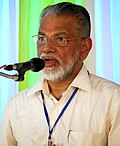
| He was primarily engaged studies related to oceanography and remote sensing and served as interim chief of ISRO for a brief period of 11 days. | ||||||
| 9 | 
|
Template:Sortname Template:Small |
Template:Dts | Template:Dts | Template:Age in years and days | [15] |
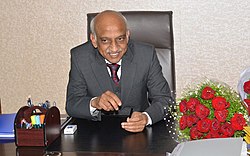
| His tenure is attributed with HEX which marks with beginning of development of reusable-launch vehicle, first orbital flight of GSLV Mk III, completion of NAVIC and launch of Astrosat, India's first space based observatory. | ||||||
| 10 | _Chairman,_Dr._K._Sivan_addressing_a_press_conference_on_issues_related_to_Department_of_Space,_in_New_Delhi_on_August_28,_2018.JPG)
|
Template:Sortname Template:Small |
Template:Dts | Incumbent | Template:Age in years and days | [16] |
| He earlier served as director of VSSC and LPSC and participated in development of PSLV rockets. His tenure has been marked with launch of Chandrayaan-2 and acceleration of India's manned space program. Short term goals include launch of Chandrayaan-3 to attempt a successful soft lunar landing, putting humans in space, launching missions to Venus and sun and development of SCE-200 rocket engine to facilitate realisation of India's heavy lift launch vehicle and increase commercial operations. | ||||||
See also
Notes and references
References
- ↑ Space commission. Department of Space. Retrieved 2020-09-26.
- ↑ Mangalorean.Com- Serving Mangaloreans Around The World!. mangalorean.com. Retrieved 2014-02-14.
- ↑ Department of Space and ISRO HQ - ISRO. Retrieved 2020-09-26.
- ↑ Welcome To ISRO :: Former Chairman :: Dr. Vikram Sarabhai - Introduction. isro.org. Retrieved 2014-02-14.
- ↑ Welcome To ISRO :: Former Chairman - Prof. M G K Menon. isro.org. Retrieved 2014-02-14.
- ↑ Welcome To ISRO :: Former Chairmen :: Prof Satish Dhawan. isro.org. Retrieved 2014-02-14.
- ↑ Welcome To ISRO :: Former Chairman - Prof.Udupi Ramachandra Rao. isro.org. Retrieved 2014-02-14.
- ↑ Archived copy. Retrieved 2020-09-28.
- ↑ Welcome To ISRO :: Former Chairman :: Dr. Krishnaswamy Kasturirangan - Introduction. isro.org. Retrieved 2014-02-14.
- ↑ Shri G Madhavan Nair. Indian Space Research Organisation(2008-11-11). Retrieved 2009-11-01.
- ↑ Dr. K. Radhakrishnan. Indian Space Research Organisation(2008-11-11). Retrieved 2009-11-01.
- ↑ India's space odyssey: ISRO creates history in 2014. The Indian Express(2014-12-27). Retrieved 2020-09-28.
- ↑ ISRO's Timeline from 1960s to Today - ISRO. Indian Space Research Organisation. Retrieved 2020-09-28.
- ↑ Shailesh Nayak appointed as new ISRO chairman, Radhakrishnan retires
- ↑ A S Kiran Kumar takes over as Secretary, Department of Space, Chairman, Space Commission and Chairman, ISRO - ISRO. www.isro.gov.in. Retrieved 2016-10-17.
- ↑ K. Sivan takes charge as new ISRO chairman. The Hindu(16 January 2018). Retrieved 1 November 2018.