
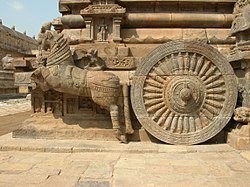


Odd toed ungulate, or hoofed mammals, such as horses, rhinos, and tapirs, may have their evolutionary origins in Indian subcontinent.[web 1] While horse remains and related artifacts have been found in Late Harappan (1900-1300 BCE) sites, indicating that horses may have been present at Late Harappan times,Template:Sfn horses did not play an essential role in the Harappan civilisation,Template:Sfn in contrast to the Vedic period (1500-500 BCE).Template:Sfn The importance of the horse for the Indo-Aryans is indicated by the Sanskrit word Ashva, "horse," which is often mentioned in the Vedas and Hindu scriptures.
Paleolithic
Odd toed ungulate, or hoofed mammals, such as horses, rhinos, and tapirs, may have their evolutionary origins in the Indian Subcontinent.[web 1] Remains of the Equus namadicus have been found from Pleistocene levels in India.Template:Sfn The Equus namadicus is closely related to the Equus sivalensis.[web 2] The Equus sivalensis lived in the Himalayan foothills in prehistoric times and it is assumed it was extinct during the last Ice Age.
Domestication
Domestication of the horse before the second millennium appears to be confined to its native habitat, the Great Steppe. An increasing amount of evidence supports the hypothesis that horses were domesticated in the Eurasian Steppes approximately 3500 BCE.Template:Sfn[web 3][web 4] Recent discoveries in the context of the Botai culture suggest that Botai settlements in the Akmola Province of Kazakhstan are the location of the earliest domestication of the horse.Template:Sfn
Use of horses spread across Eurasia for transportation, agricultural work, and warfare. The horse only appears in Mesopotamia from around 1800 BC as a ridden animal and acquires military significance with the invention of the chariot.
Indus Valley Civilisation
Proponents of Indigenous Aryanism believe that the Indus Valley Civilisation was Aryan and Vedic.Template:Sfn There are two common objections against such a correlation: "the Rg Vedic culture was pastoral and horse-centered, while the Harappan culture was neither horse-centered nor pastoral";Template:RefnTemplate:Sfn and "the complete absence of the horse (equus caballus)."Template:Refn Support for the idea of an indigenous Indo-Aryan origin of the Indus Valley Civilisation mostly exists among Indian scholars of Hindu religion and the history and archaeology of India,Template:SfnTemplate:SfnTemplate:Sfn[1] and has no support in mainstream scholarship.Template:Refn
The paucity of horse remains in pre-Vedic times could be explained by India's climatic factors which lead to decay of horse bones. Horse bones may also be rare because horses were probably not eaten or used in burials by the Harappans.Template:Sfn[2] Remains and artifacts ascribed to domesticated horses are limited to Late Harappan timesTemplate:SfnTemplate:SfnTemplate:Refn indicating that horses may have been present at Late Harappan times,Template:Sfn "when the Vedic people had settled in the north-west part of the subcontinent."Template:Sfn It can therefore not be concluded that the horse was regularly used, or played a significant role, in the Harappan society.Template:Sfn
Horse remains from the Harappan site Surkotada (dated to 2400-1700 BC) have been identified by A.K. Sharma as Equus ferus caballus.Template:Refn The horse specialist Sandor Bökönyi (1997) later confirmed these conclusions, and stated the excavated tooth specimens could "in all probability be considered remnants of true horses [i.e. Equus ferus caballus]".Template:Refn Bökönyi, as cited by B.B. Lal, stated that "The occurrence of true horse (Equus caballus L.) was evidenced by the enamel pattern of the upper and lower cheek and teeth and by the size and form of incisors and phalanges (toe bones)."Template:Refn However, archaeologists like Meadow (1997) disagree, on the grounds that the remains of the Equus ferus caballus horse are difficult to distinguish from other equid species such as Equus asinus (donkeys) or Equus hemionus (onagers).Template:Sfn
Colin Renfrew (1999) remarked that "the significance of the horse [...] has been much exaggerated."Template:SfnTemplate:Refn
Vedic period
.png)
Sites such as the BMAC complex are at least as poor in horse remains as the Harappan sites.Template:SfnTemplate:Refn The earliest undisputed finds of horse remains in South Asia are from the Gandhara grave culture, also known as the Swat culture (c. 1400-800 BCE),Template:Sfn related to the Indo-AryansTemplate:Sfn and coinciding with their arrival in India.Template:Sfn Swat valley grave DNA analysis provides evidence of "connections between [Central Asian] Steppe population and early Vedic culture in India".Template:Sfn
Horses were of significant importance for the lifestyle of the Indo-Europeans.Template:Sfn Ashva, a Sanskrit word for a horse, is one of the significant animals finding references in the Vedas and several Hindu scriptures, and many personal names in the Rig Veda are also centered on horses.Template:Sfn Derived from asva, its cognates are found in Indo-European languages like Sanskrit, Avestan, Latin and Greek.Template:Sfn There are repeated references to the horse in the Vedas (c. 1500-500 BC). In particular the Rigveda has many equestrian scenes, often associated with chariots. The Ashvamedha or horse sacrifice is a notable ritual of the Yajurveda.
The difficulty of breeding large numbers of horses in the Indian climate meant they needed to be imported in large numbers, usually from Central Asia, but also elsewhere. Horse traders are already mentioned in Atharvaveda 2.30.29. A painting at Ajanta shows horses and elephants that are transported by ship.[3] Trautmann (1982) thus remarked the supply and import of horses has "always" been a preoccupation of the Indians and "it is a structure of its history, then, that India has always been dependent upon western and central Asia for horses."Template:Sfn
See also
Notes
- ↑ Cite error: Invalid
<ref>tag; no text was provided for refs namedElst_2016 - ↑ S.P. Gupta. The dawn of civilization, in G.C. Pande (ed.)(History of Science, Philosophy and Culture in Indian Civilization, ed., D.P. Chattophadhyaya, vol I Part 1) (New Delhi:Centre for Studies in Civilizations, 1999)
- ↑ Himanshu Prabha Ray, Early Coastal Trade in the Bay of Bengal, In: Julian Reade (ed.) The Indian Ocean in Antiquity. London: Kegan Paul Intl. 1996
References
Sources
- Printed sources
- The Quest for the Origins of Vedic Culture{{#if:Bryant|, Bryant}. Oxford University Press(2001). ISBN 0-19-513777-9
- The Indo-Aryan Controversy: Evidence and Inference in Indian History{{#if:|, {{{last}}}}. Routledge(2005)
- Horse Riding in the Rgveda and Atharvaveda. Journal of the American Oriental Society({Template:Date).
- Falconer H. and Cautley, Fauna Antiqua Sivalensis, Being the Fossil Zoology of the Siwalik Highlands in the North of India, 1849, London.
- [{{{url}}} God-Apes and Fossil Men: Palaeoanthropology of South Asia]. University of Michigan Press.
- [{{{url}}} The Indo-Aryans of Ancient South Asia: Language, Material Culture and Ethnicity]. Walter de Gruyter.
- New Light on the Indus Civilization{{#if:Lal|, Lal}. Aryan Books(1998)
- [{{{url}}} The Homeland of the Aryans. Evidence of Rigvedic Flora and Fauna & Archaeology]. Aryan Books International.
- Shaping World History. Routledge.
- The Genomic Formation of South and Central Asia. bioRxiv({Template:Date).</ref>
- The Earliest Horse Harnessing and Milking. Science({Template:Date).
- [{{{url}}} Indian History]. Tata McGraw-Hill Education.
- [{{{url}}} History of Ancient and Early Medieval India: From the Stone Age to the 12th Century]. Longman.
- [{{{url}}} The theory of Aryan race and India]. Social Scientist.
- India: Historical Beginnings and the Concept of the Aryan{{#if:Thapar|, Thapar}. National Book Trust(2006). ISBN 9788123747798
- [{{{url}}} The Aryan Debate in India].
- Autochthonous Aryans? The Evidence from Old Indian and Iranian Texts. Electronic Journal of Vedic Studies({Template:Date).
- Web-sources
Further reading
- Horse Remains from the Prehistoric Site of Surkotada, Kutch, Late 3rd Millennium BC. South Asian Archaeology({Template:Year).
- Dictionary of Hindu Lore and Legend{{#if:Dallapiccola|, Dallapiccola}. ISBN 0-500-51088-1
- The Aśvamedha: The rite and its logic{{#if:|, {{{last}}}}. Motilal Banarsidass(2004)
External links
- The Asvamedha Horse of India
- From Harappan horse to camel, R. Nagaswamy in The Hindu
Template:HinduMythology
Template:Equine
Cite error: <ref> tags exist for a group named "web", but no corresponding <references group="web"/> tag was found