
Template:Infobox ethnic group
The Gujarati people, or Gujaratis, are an Indo-Aryan ethnolinguistic group native to the Indian state of Gujarat. They primarily speak Gujarati, an Indo-Aryan language. Gujaratis have diaspora across India as well in a large number of countries around the world.[1][2][3][4]
Geographical locations
Despite significant migration primarily for economic reasons, most Gujaratis in India live in the state of Gujarat in Western India.[5] Gujaratis also form a significant part of the populations in the neighbouring metropolis of Mumbai and union territory of Dadra and Nagar Haveli and Daman and Diu, formerly colonial possessions of Portugal.[6] There are very large Gujarati immigrant communities in other parts of India, most notably in Mumbai,[7] Pune, Delhi, Kolkata, Chennai, Bangalore[8] and other cities like Kochi.[9][10] All throughout history.[11] Gujaratis have earned a reputation as merchants, industrialists and business entrepreneurs[12] and have therefore been at forefront of migrations all over the world, particularly to regions that were part of the British Empire such as Fiji, Hong Kong, Malaya, Singapore, East Africa, and South Africa.[13] Diasporas and transnational networks in many of these countries date back to more than a century.[14][15] In recent decades, larger numbers of Gujaratis have migrated to English-speaking countries such as the United States (especially New Jersey), United Kingdom, Australia, New Zealand, and Canada.[16][17]
History

In anthropological surveys conducted in India about 60% of the people claim that their community is a migrant to their state or region. In Gujarat that number is around 70%. In the state, 124 Hindu communities out of 186 claim a migrant past. For example, the Audichya Brahmins claim migration from present day Uttar Pradesh. With Muslims in Gujarat, 67 out of 86 communities claim a migrant past.[18]
Early European travellers like Ludovico di Varthema (15th century) travelled to Gujarat and wrote on the people of Gujarat. He noted that Jainism had a strong presence in Gujarat and opined that Gujaratis were deprived of their kingdom by Mughals because of their kind heartedness. His description of Gujaratis was:[19]
In 1790 and 1791, an epidemic devastated numerous parts of Gujarat during which 100,000 Gujaratis were killed in Surat alone.[20]
An outbreak of bubonic plague in 1812 has been claimed to have killed about half the Gujarati population.[21][22]
Gujarati mercantile history
Ports on the western coast of India have been engaged in trade for millennia. During the medieval and early modern period, ports in Gujarat such as Diu, Surat, Mandavi, Cambay, and Porbandar became important. Gujarati merchants operating from these ports operated not only in the Indian Ocean in the west but also in Southeast Asia. It is estimated that there were 1000 Gujarati merchants resident in Malacca in fifteenth century with a thousand others operating in the Bay of Bengal and Indonesian archipelago. Most of the Gujarati traders were Muslims but there were Hindu and Jains too despite religious prohibitions.[23] Gujarati merchants operating in Southeast Asia were primarily involved exporting India cotton to Southeast Asia in exchange for spices from the islands which were then exported to Persia. Surat was the principal port for this trade.[24] Gujaratis played a big part in the Indian ocean trade. The Portuguese explorer Vasco de Gama noted presence of Muslim and Hindu navigators and merchants from Gujarat in Zanzibar and Pemba and along the East Africa coast in towns such as Kilwa, Bagamoyo, Mombasa and Malindi.[25] International trade by Gujarati merchants increased with the advent of the Gujarat Sultanate at the beginning of the 1400s. The trade involved gold, ivory and slaves from Africa in exchange for cotton and glass beads from India.[26] The important Gujarati traders active in the Indian Ocean trade at different periods of history included Jains; Hindu Bhatias and Lohanas; Muslim Khojas, Memons, and Bohras; and the Parsee communities.[25] The Jains were active during the Solannki period trading with Arabian and Red sea ports. The Portuguese also preferred Jains to the Arab traders.[27]
Social stratification
Orthodox Gujarati society, which was mercantile by nature,[28] was historically organised along ethno-religious lines and shaped into existence on the strength of its Mahajan ("guild assemblies"),[29][30] and for its institution of Nagarsheth ("head of the guild assembly"); a 16th-century Mughal system akin to medieval European guilds which self-regulated the mercantile affairs of multi-ethnic, multi-religious communities in the Gujarati bourgeoisie long before municipal state politics was introduced.[31][32] Historically, Gujaratis belonging to numerous faiths and castes, thrived in an inclusive climate surcharged by a degree of cultural syncretism, in which Hindus and Jains dominated occupations such as shroffs and brokers whereas, Muslims, Hindus and Parsis largely dominated sea shipping trade. This led to religious interdependence, tolerance, assimilation and community cohesion ultimately becoming the hallmark of modern-day Gujarati society.[33][34][35]
Religion
The Gujarati people are predominantly Hindu. There are also minority communities of Muslims, Jains, Christians, Sikhs, Buddhists, Parsis, Jews, and followers of the Baháʼí Faith amongst the Gujaratis.[36][37][38]
Hindu communities
The major communities in Gujarat are farmers and livestock herders (such as Patidar, Koli, Rabari, Bharvad, Ahir), traders (such as Bania, Bhatia, Soni), sailor and seafood exporters (such as Kharwa), artisan and business communities (such as Prajapati, Varaiya, Mochi), Brahmin communities (such as Joshi, Anavil, Nagar, Modh, Shrimali), genealogists (such as Barot), Kshatriya communities (such as Koli Thakor,[39] Bhanushali, Karadia, Nadoda, Jadeja, Dabhi, Chudasama, Maher, Lohana), Tribal communities (such as Bhils, Meghwal, Gamit, Konkani, varli) and Devipujak (such as Dataniya, Dantani, Chunara, Patni).Template:Citation needed
Muslim communities
Template:Further The majority of Gujarati Muslims are Sunni Muslim. Minority communities include Twelver, Nizari Ismailis, Daudi Bohra, Khoja, Pathans, Shaikhs, Maliks.
Diaspora
Template:Main article Gujaratis have a long tradition of seafaring and a history of overseas migration to foreign lands, to Yemen[40] Oman[41] Bahrain,[42] Kuwait, Zanzibar[43] and other countries in the Persian Gulf[44] since a mercantile culture resulted naturally from the state's proximity to the Arabian Sea.[45] The countries with the largest Gujarati populations are Pakistan, United Kingdom, United States, Canada and many countries in Southern and East Africa.[46] Globally, Gujaratis are estimated to constitute around 33% of the Indian diaspora worldwide and can be found in 129 of 190 countries listed as sovereign nations by the United Nations.[47] Non Resident Gujaratis (NRGs) maintain active links with the homeland in the form of business, remittance, philanthropy, and through their political contribution to state governed domestic affairs.[48][49][50]
Gujarati parents in the diaspora are not comfortable with the possibility of their language not surviving them.[51] In a study, 80% of Malayali parents felt that "children would be better off with English", compared to 36% of Kannada parents and only 19% of Gujarati parents.[51]
Pakistan
Template:Main Significant Gujarati communities existed here before 1947 Partition of India. Many of them migrated after the Partition of India and subsequent creation of Pakistan in 1947. These Pakistani Gujaratis belong mainly to the Ismāʿīlī, Khoja, Dawoodi Bohra, Chundrigar, Charotar Sunni Vohra, Khatri Muslims Kutchi Memons and Khatiawari Memons; however, many Gujaratis are also a part of Pakistan's small Hindu community. A number of them belong to the Dalit community.[52][53]
Estimated to number 3.5 million they virtually all live in Karachi.[54] Community leaders estimate that it roughly amounts to some 15% of Karachi's total population, while also highlighting the dire state of the Gujarati language in the country, with only two newspapers, Vatan and Millat, still serving the community.[55]
United States

The United States has the second-largest Gujarati diaspora after Pakistan. The highest concentration of the population of over 200,000 is in the New York City Metropolitan Area, notably in the growing Gujarati diasporic center of India Square in Jersey City, New Jersey, and Edison in Middlesex County in Central New Jersey. Significant immigration from India to the United States started after the landmark Immigration and Nationality Act of 1965.[60][61] Early immigrants after 1965 were highly educated professionals. Since US immigration laws allow sponsoring immigration of parents, children and particularly siblings on the basis of family reunion, the numbers rapidly swelled.[62] A number of Gujarati are twice or thrice-migrant because they came directly from the former British colonies of East Africa or from East Africa via Great Britain respectively.[63] Given the Gujarati propensity for business enterprise, a number of them opened shops and motels. While they may make up only around 0.1% of the population in the United States, Gujarati Americans control over 40% of the hospitality market in the country, for a combined net worth of over US$40 billion and employing over one million employees.[64][65][66] Gujaratis, especially the Patidar Samaj, also dominate as franchisees of fast food restaurant chains such as Subway and Dunkin' Donuts.[67]
Europe
United Kingdom

The third largest overseas diaspora of Gujaratis, after Pakistan and United States, is in the United Kingdom. At a population of around 600,000 Gujaratis form almost more than half of the Indian community who live in the UK (1.2 million). Gujaratis first went to the UK in the 19th century with the establishment of the British Raj in India. Prominent members of this community such as Shyamji Krishna Varma played a vital role in exerting political pressure upon colonial powers during the Indian independence movement.[68]
Gujaratis in Britain are regarded as affluent middle-class peoples who have assimilated into the milieu of British society.[69][70] They are celebrated for revolutionising the corner shop, and energising the British economy which changed Britain's antiquated retail laws forever.[71][72] Demographically, Hindus form a majority along with a significant number of Jains and Muslims,[73] and smaller numbers of Gujarati Christians.[74] They are predominantly settled in metropolitan areas like Greater London, East Midlands, West Midlands, Lancashire and Yorkshire.[68] Cities with significant Gujarati populations include Leicester and London boroughs of Harrow, Barnet and Brent. There is also a small, but vibrant Gujarati-speaking Parsi community of Zoroastrians present in the country, dating back to the bygone era of Dadabhai Navroji, Shapurji Saklatvala and Pherozeshah Mehta.[75] Both Hindus and Muslims have established caste or community associations, temples, and mosques to cater for the needs of their respective communities. A well known temple popular with Gujaratis is the BAPS Swaminarayan Temple in Neasden, London. A popular mosque that caters for the Gujarati Muslim community in Leicester is the Masjid Umar. Leicester has a Jain Temple that is also the headquarters of Jain Samaj Europe.[76]
Gujarati Hindus in the UK have maintained many traditions from their homeland. The community remains religious with more than 100 temples catering for their religious needs. All major Hindu festivals such as Navratri, Dassara, and Diwali are celebrated with a lot of enthusiasm even from the generations brought up in UK. Gujarati Hindus also maintain their caste affiliation to some extent with most major castes having their own community association in each population center with significant Gujarati population such as Leicester and London suburbs. Patidars form the largest community in the diaspora including Kutch Leva Patels,[77] followed closely by Lohanas of Saurashtra origin.[78] Gujarati Rajputs from various regional backgrounds are affiliated with several independent British organisations dependent on caste such as Shree Maher Samaj UK,[79] and the Gujarati Arya Kshatriya Mahasabha-UK.[80]
Endogamy remains important to Gujaratis in UK with the existence of matrimonial services specifically dedicated to their community.[81] The Gujarati Muslim society in the UK have kept the custom of Jamat Bandi, literally meaning communal solidarity. This system is the traditional expression of communal solidarity. It is designed to regulate the affairs of the community and apply sanctions against infractions of the communal code. Gujarati Muslim communities, such as the Ismāʿīlī, Khoja, Dawoodi Bohra, Sunni Bohra, and Memon have caste associations, known as jamats that run mosques and community centers for their respective communities.[82]
Belgium
Two Gujarati business communities, the Palanpuri Jains and the Kathiawadi Patels from Surat, have come to dominate the diamond industry of Belgium.[83] They have largely displaced the Orthodox Jewish community which previously dominated this industry in Belgium.[84]
Portugal
The 1961 takeover of Portuguese Goa by India made life difficult for the Indian population in the then Portuguese colony of Mozambique. The independence of Mozambique like in other African countries led to many Gujaratis to move to Portugal.[85] Many Hindu Gujaratis have moved from Portugal to Great Britain since the 1990s.[86]
Canada
.jpg)
Canada, just like its southern neighbour, is home to a large Gujarati community. As per the 2021 Canadian census, Gujarati Canadians number approximately 210,000 and account for roughly 0.6% of Canada's population.[87]Template:Efn The majority of them live in Toronto and its suburbs - home to the second largest Gujarati community in North America, after the New York Metropolitan Area. Gujarati Hindus are the second largest linguistic/religious group in Canada's Indian community after Punjabi Sikhs, and Toronto is home to the largest Navratri raas garba festival in North America.[88] The Muslim Ismaili Khoja form a significant part of the Canadian diaspora estimated to be about 80,000 in numbers overall.[89] Most of them arrived in Canada in the 1970s as either refugees or immigrants from Uganda and other countries of East Africa.[90][91]


| Religious group | 2021[98]Template:Efn | |
|---|---|---|
| Template:Abbr | Template:Abbr | |
| Hinduism | 27,950 | Template:Percentage |
| Islam | 5,915 | Template:Percentage |
| Irreligion | 1,140 | Template:Percentage |
| Christianity | 425 | Template:Percentage |
| Sikhism | 145 | Template:Percentage |
| Buddhism | 15 | Template:Percentage |
| Indigenous spirituality | 10 | Template:Percentage |
| Judaism | 0 | Template:Percentage |
| Other | 1,365 | Template:Percentage |
| Total Gujarati Canadian responses | 36,970Template:Efn | Template:Percentage |
| Total Gujarati Canadian population | 209,410Template:Efn | Template:Percentage |
East Africa
Former British colonies in East Africa had many residents of South Asian descent. The primary immigration was mainly from Gujarat and to a lesser extent from Punjab. They were brought there by the British Empire from India to do clerical work in Imperial service, or unskilled and semi-skilled manual labour such as construction or farm work. In the 1890s, 32,000 labourers from British India were brought to the then British East African colonies under indentured labour contracts to work on the construction of the Uganda Railway that started in the Kenyan port city of Mombasa and ended in Kisumu on Kenyan side of Lake Victoria. Most of the surviving Indians returned home, but 6,724 individuals decided to remain in the African Great Lakes after the line's completion.
Many Asians, particularly the Gujaratis, in these regions were in the trading businesses. They included Gujaratis of all religions as well many of the castes and Quoms. Since the representation of Indians in these occupations was high, stereotyping of Indians in Kenya, Uganda, and Tanganyika as shopkeepers was common. A number of people worked for the British run banks. They also worked in skilled labour occupations, as managers, teachers and administrators. Gujarati and other South Asians had significant influence on the economy, constituting 1% of the population while receiving a fifth of the national income. For example, in Uganda, the Mehta and Madhvani families controlled the bulk of the manufacturing businesses. Gated ethnic communities served elite healthcare and schooling services. Additionally, the tariff system in Uganda had historically been oriented toward the economic interests of South Asian traders.[99] One of the oldest Jain overseas diaspora was of Gujarat. Their number was estimated at 45,000 at the independence of the East African countries in the early 1960s.[100] Most members of this community belonged to Gujarati speaking Halari Visa Oshwal Jain community originally from the Jamnagar area of Saurashtra.[100][101]
The countries of East Africa gained independence from Britain in the early 1960s. At that time most Gujarati and other Asians opted to remain as British Subjects. The African politicians at that time accused Asians of economic exploitation and introduced a policy of Africanization. The 1968 Committee on "Africanisation in Commerce and Industry" in Uganda made far-reaching Indophobic proposals. A system of work permits and trade licences was introduced in 1969 to restrict the role of Indians in economic and professional activities. Indians were segregated and discriminated against in all walks of life.[102] During the middle of the 1960s many Asians saw the writing on the wall and started moving either to UK or India. However, restrictive British immigration policies stopped a mass exodus of East African Asians until Idi Amin came to power in 1971. He exploited pre-existing Indophobia and spread propaganda against Indians involving stereotyping and scapegoating the Indian minority. Indians were stereotyped as "only traders" and "inbred" to their profession. Indians were labelled as "dukawallas" (an occupational term that degenerated into an anti-Indian slur during Amin's time), and stereotyped as "greedy, conniving", without any racial identity or loyalty but "always cheating, conspiring and plotting" to subvert Uganda. Amin used this propaganda to justify a campaign of "de-Indianization", eventually resulting in the expulsion and ethnic cleansing of Uganda's Indian minority.[102]
Kenya
Gujarati and other Indians started moving to the Kenya colony at the end of the 19th century when the British colonial authorities started opening up the country with the laying down of the railroads. A small colony of merchants, however, had existed on the port cities such Mombasa on the Kenyan coast for hundreds of years prior to that.[103] The immigrants who arrived with the British were the first ones to open up businesses in rural Kenya a century ago. These dukanwalas or shopkeepers were mainly Gujarati (Mostly Jains and Hindus and a minority of Muslims). Over the following decades the population, mainly Gujarati but also a sizeable number of Punjabi, increased in size. The population started declining after the independence of Kenya in the 1960s. At that time the majority of Gujaratis opted for British citizenship and eventually moved there, especially to cities like Leicester or London suburbs. Famous Kenyans of Gujarati heritage who contributed greatly to the development of East Africa include Thakkar Bapa, Manu Chandaria,[104]
Uganda
Template:Main There is a small community of people of Indian origin living in Uganda, but the community is far smaller than before 1972 when Ugandan ruler Idi Amin expelled most Asians, including Gujaratis.[105] In the late 19th century, mostly Sikhs, were brought on three-year contracts, with the aid of Imperial British contractor Alibhai Mulla Jeevanjee to build the Uganda Railway from Mombasa to Kisumu by 1901, and to Kampala by 1931. Some died, while others returned to India after the end of their contracts, but few chose to stay. They were joined by Gujarati traders called "passenger Indians",[106] both Hindu and Muslim free migrants who came to serve the economic needs of the indentured labourers, and to capitalise on the economic opportunities.
After the 1972 expulsion, most Indians and Gujaratis migrated to the United Kingdom. Due to the efforts of the Aga Khan, many Khoja Nizari Ismaili refugees from Uganda were offered asylum in Canada.[107]
Tanzania
Template:Main Indians have a long history in Tanzania starting with the arrival of Gujarati traders in the 19th century.[108] There are currently over 50,000 people of Indian origin in Tanzania. Many of them are traders and they control a sizeable portion of the Tanzanian economy. They came to gradually control the trade in Zanzibar. Many of the buildings constructed then still remain in Stone Town, the focal trading point on the island.
South Africa
The Indian community in South Africa is more than 150 years old and is concentrated in and around the city of Durban.[109] The vast majority of immigrant pioneer Gujaratis who came in the latter half of the 19th century were passenger Indians who paid for their own travel fare and means of transport to arrive and settle South Africa, in pursuit of fresh trade and career opportunities and as such were treated as British subjects, unlike the fate of a class of Indian indentured labourers who were transported to work on the sugarcane plantations of Natal Colony in dire conditions. Passenger Indians, who initially operated in Durban, expanded inland, to the South African Republic (Transvaal), establishing communities in settlements on the main road between Johannesburg and Durban. After wealthy Gujarati Muslim merchants began experiencing discrimination from repressive colonial legislation in Natal,[110] they sought the help of one young lawyer, Mahatma Gandhi to represent the case of a Memon businessman. Umar Hajee Ahmed Jhaveri was consequently elected the first president of the South African Indian Congress. Indians in South Africa could traditionally be bifurcated as either indentured labourers (largely from Tamil Nadu, with smaller amounts from UP and Bihar) and merchants (exclusively from Gujarat).
Indians have played an important role in the anti-apartheid movement of South Africa.[111] Many were incarcerated alongside Nelson Mandela following the Rivonia Trial, and many became martyred fighting to end racial discrimination.
Mozambique
In the second half of the 1800s, many Gujarati Hindus belonging to the Vaniya community migrated to the South of Mozambique, in particular to the provinces of Inhambane and Lourenço Marques to run businesses. This was followed by migration of Hindus of various artisan castes from Diu to the region. Later in 1800s, immigration restrictions imposed by the colonial authorities in neighbouring South Africa and the Boer republic made Mozambique the preferred destination for many Gujarati Hindus from the Saurashtra (namely, Rajkot and Porbandar) and Surat regions.[112][113]
The 1961 takeover of Portuguese Goa by India made life difficult for the Indian population in the then Portuguese colony of Mozambique. The independence of Mozambique like in other African countries led to many Gujaratis to move to Portugal.[85]
Oman
Template:Main Oman, holding a strategically important position at the mouth of the Persian Gulf, has been the primary focus of trade and commerce for medieval Gujarati merchants for much of its history and Gujaratis, along with various other ethnic groups, founded and settled its capital port city, Muscat.[114] Some of the earliest Indian immigrants to settle in Oman were the Bhatias of Kutch, who have had a powerful presence in Oman dating back to the 16th century.[115] At the turn of the 19th century, Gujaratis wielded enough clout that Faisal bin Turki, the great-grandfather of the current ruler, spoke Gujarati and Swahili along with his native Arabic[116] and Oman's sultan Syed Said (1791-1856) was persuaded to shift his capital from Muscat to Zanzibar, more than two thousand miles from the Arabian mainland, on the recommendation of Shivji Topan and Bhimji families who lent money to the Sultan.[117] In modern times, business tycoon Kanaksi Khimji, from the famous Khimji family of Gujarat[118] was conferred title of Sheikh by the Sultan, the first ever use of the title for a member of the Hindu community.[119][120] The Muscati Mahajan is one of the oldest merchants associations founded more than a century ago.[121][122]
Southeast Asia
Gujaratis had a flourishing trade with Southeast Asia in the 15th and 16th centuries, and played a pivotal role in establishing Islam in the region.[123] Miller (2010) presented a theory that the indigenous scripts of Sumatra (Indonesia), Sulawesi (Indonesia) and the Philippines are descended from an early form of the Gujarati script. Tomé Pires reported a presence of a thousand Gujaratis in Malacca (Malaysia) prior to 1512.[124] The Gujarati language continues to be spoken in Singapore and Malaysia.[125][126]
Hong Kong
Gujaratis also dominate the diamond trade in the city. As of 2012 350 diamond firms in Hong Kong were owned by Gujaratis. [127]
Malaysia
Template:Main There estimated around 31,500 Gujarati in Malaysia. Most of this community work as traders and settled in the urban parts of Malaysia like Melaka, George Town, Kuala Lumpur and Ipoh.[126]
Fiji
Gujaratis in Fiji represent an important trading community within the large Indian population.[128]
Culture
Literature

Kavi Kant, Kalapi and Abbas Abdulali Vasi are Gujarati language poets. Ardeshar Khabardar, Gujarati-speaking Parsi who was president of Gujarati Sahitya Parishad was a nationalist poet. His poem, Jya Jya Vase Ek Gujarati, Tya Tya Sadakal Gujarat (Wherever a Gujarati resides, there forever is Gujarat) depicts Gujarati ethnic pride and is widely popular in Gujarat.[129]
Swaminarayan paramhanso, like Bramhanand, Premanand, contributed to Gujarati language literature with prose like Vachanamrut and poetry in the form of bhajans. Kanji Swami a spiritual mystic who was honoured with the title, 'Koh-i-Noor of Kathiawar' made literary contributions to Jain philosophy and promoted Ratnatraya.[130]
Gujarati theatre owes a lot to bhavai. Bhavai is a musical performance of stage plays. Ketan Mehta and Sanjay Leela Bhansali explored artistic use of bhavai in films such as Bhavni Bhavai, Oh Darling! Yeh Hai India and Hum Dil De Chuke Sanam. Dayro (gathering) involves singing and conversation reflecting on human nature.
Gujarati language is enriched by the Adhyatmik literature written by the Jain scholar, Shrimad Rajchandra and Pandit Himmatlal Jethalal Shah. This literature is both in the form of poetry and prose.[131]
Cuisine

Gujarati food has famously been described as "the haute cuisine of vegetarianism" and meals have a subtle balance of sweet, tart and mild hot sensations on the palate.[132] Gujarati Jains, as well as many Hindus and Buddhists in Gujarat, are vegetarian. However, many Gujarati Hindu communities such as Ghanchi, Koli Patel, and Kharwa consume fish as part of their diet.[133] Christians, and Muslims have traditionally eaten a variety of meats and seafood, although Muslims don't eat pork and Hindus don't eat beef.[134] Gujarati cuisine follows the traditional Indian full meal structure of rice, cooked vegetables, lentil dal or curry and roti. The different types of flatbreads that a Gujarati cooks are rotli or chapati, bhakhri, puri, thepla, rotla, dhebara, maal purah, and puran-pohli. Popular snacks such as Khaman, Dhokla, Dhokli, dal-dhokli, Undhiyu, Jalebi, fafda, chevdoh, Muthia, Bhajia, Patra, bhusu, locho, sev Template:Not a typo, fafda gathiya, vanela gathiya and Sev mamra, Sev Khaman, Dabeli are traditional Gujarati dishes savoured by many communities across the world.[135]
Khichdi — a mix of rice and mung dal, cooked with spice — is a popular and nutritious dish which has regional variations. Quite often the khichdi is accompanied by Kadhi. It is found satisfying by most Gujaratis, and cooked very regularly in most homes, typically on a busy day due to its ease of cooking. It can also become an elaborate meal such as a thali when served with several other side dishes such as a vegetable curry, yogurt, sabzi shaak, onions, mango pickle and papad.[136]
Spices have traditionally been made on grinding stones, however, since villages have seen rapid growth and industrialisation in recent decades, today people may use a blender or grinder. People from north Gujarat use dry red chili powder, whereas people from south Gujarat prefer using green chili and coriander in their cooking. There is no standard recipe for Gujarati dishes, however the use of tomatoes and lemons is a consistent theme throughout Gujarat.[137] Traditionally Gujaratis eat mukhwas at the end of a meal to enhance digestion, and desserts such as aam shrikhand made using mango salad and hung curd are very popular.[137] In many parts of Gujarat, drinking chaas (chilled buttermilk) or soda after lunch or dinner is also quite common.
Surti delicacies include ghari which is a puri filled with khoa and nuts that is typically eaten during the festival Chandani Padva. Khambhat delicacies include famous sutarfeni — made from fine strands of sweet dough (rice or maida) garnished with pistachios, and halwasan which are hard squares made from broken wheat, khoa, nutmeg and pistachios.[138] A version of English custard is made in Gujarat that uses cornstarch instead of the traditional eggs. It is cooked with cardamom and saffron, and served with fruit and sliced almonds.[139] Gujarati families celebrate Sharad Purnima by having dinner with doodh-pauva under moonlight.[140]
Folk dance and music
The folk dances of Gujarat are Garba, Dandiya, Padhar, Tippani, Dangi, etc. which are done during festivals.[141]


Gujarati folklore
Folklore is an important part of Gujarati culture. The folktales of Kankavati are religious in nature because they sprung from the ordinary day-to-day human cycle of life independent of, and sometimes deviating from the scriptures. They are part of the Hindu rituals and practices for marriage, baby shower, naming ceremony, the harvest and death, and are not merely religious acts but they reflect the lived life of people in rural and urban societies. The anthologies of Dadaji Ni Vato and Raang Chhe Barot are pragmatic with practical and the esoteric wisdom. Saurashtra Ni Rasdhar is a collection of love legends and depicts every shade of love and love is the main emotion which makes human world beautiful because it calls forth patience, responsibility, sense of commitment and dedication. Also the study of Meghani's works is quintessential because he was a trailblazer in exploring the vast unexplored heritage of Gujarati folklore. His folktales mirror the milieu of Gujarat, dialects, duhas, decors, humane values, sense of sacrifice and spirit of adventure, enthusiasm and, of course, the flaws in people. Meghani's folktales are verbal miniature of Gujarati culture.[142]
Images
-
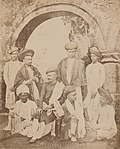 Nagar Brahmins in western India (c. 1855–1862)
 -
 Bhatias in western India (c. 1855–1862)
 -
 Gujarati brokers in western India (c. 1855–1862)
 -
 Gujarati accountants in western India (c. 1855–1862)
 -
 Rajputs in western India (c. 1855–1862)
 -
 Parsis in western India (c. 1855–1862)
 -
 Parsi priests in western India (c. 1855–1862)
 -
 Lohanas in western India (c. 1855–1862)
 -
 Bohras in western India (c. 1855–1862)
 -
 Banians of Damnaggar (Kutch)
 -
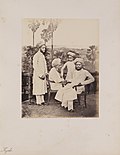 Khojas of Western India ca. 1855-1862
 -
 Memon men - photographs of Western India Series 1855-1862
.jpg)
.jpg)
.jpg)
.jpg)
.jpg)
.jpg)
.jpg)
.jpg)
.jpg)
_(9938983803).jpg)
.jpg)
.jpg)
See also
- List of people from Gujarat
- Gujarati diaspora
- Jethwa Rajputs
- Rajputs of Gujarat
- Dharasana Satyagraha
- Navnirman Andolan
- Mahagujarat Movement
- Hind Swaraj or Indian Home Rule
- Genetic studies on Gujarati people
- Khatiawari Memons
Notes
References
- ↑ Hind Swaraj: Indian Home Rule{{#if:|, {{{last}}}}. Sarva Seva Sangh Prakashan(2014). ISBN 9789383982165
- ↑ Ethnic groups of South Asia and the Pacific : an encyclopedia{{#if:|, {{{last}}}}. ABC-CLIO(2012). ISBN 978-1598846591
- ↑ The shaping of modern Gujarat : plurality, Hindutva, and beyond{{#if:|, {{{last}}}}. Penguin Books(2005). ISBN 978-0144000388
- ↑ Gujarati communities across the globe : memory, identity and continuity{{#if:|, {{{last}}}}. Trentham Books(2012). ISBN 9781858565026
- ↑ Politics of Migration: Indian Emigration in a Globalised World{{#if:|, {{{last}}}}. Routledge(6 November 2015). ISBN 9781317412243
- ↑ Daman & Diu{{#if:|, {{{last}}}}. Kalpaz publ.(2006). ISBN 978-81-7835-389-0
- ↑ Mullahs on the Mainframe: Islam and Modernity Among the Daudi Bohras{{#if:|, {{{last}}}}. The University of Chicago Press(15 March 2002). ISBN 978-0-226-05677-7
- ↑ A New Face of Hinduism: The Swaminarayan Religion{{#if:|, {{{last}}}}. Cambridge University Press 1984(15 March 1984). ISBN 978-0-521-25454-0
- ↑ Rubber Boom Raises Hope Of Repatriates. Counter Currents. Retrieved 16 February 2015.
- ↑ Gujarat should learn from Kerala - The New Indian Express. Retrieved 16 February 2015.
- ↑ Ivory and Slaves: Changing Pattern of International Trade in East Central Africa{{#if:|, {{{last}}}}. University of California Press(1975). ISBN 978-0-520-02689-6
- ↑ Indian merchants and entrepreneurs in historical perspective : with special reference to shroffs of Gujarat, 17th to 19th centuries{{#if:|, {{{last}}}}. Academic Foundation(1991). ISBN 978-8171880171
- ↑ Indian Family Businesses in Natal, 1870 – 1950{{#if:|, {{{last}}}}. Natal Society Foundation 2010
- ↑ Modern Migrations Gujarati Indian Networks in New York and London.{{#if:|, {{{last}}}}. Stanford University Press(2010). ISBN 978-0804775830
- ↑ Diaspora Purana: The Indic Presence in World Culture. Retrieved 22 October 2015.
- ↑ Seeing Krishna in America The Hindu Bhakti Tradition of Vallabhacharya in India and Its Movement to the West.{{#if:|, {{{last}}}}. McFarland Publishing(2014). ISBN 9780786459735
- ↑ Towards an Understanding of Transnational Community Forms and Their Impact on Immigrant Incorporation. research & seminars. Retrieved 25 October 2015.
- ↑ The Shaping of Modern Gujarat: Plurality, Hindutva, and Beyond{{#if:|, {{{last}}}}. Penguin Books India(2005). ISBN 978-0-14-400038-8
- ↑ André Wink (1997) Al-Hind, the Making of the Indo-Islamic World: The Slavic Kings and the Islamic conquest, BRILL Template:ISBN pp.355–356
- ↑ Eighteenth-Century Gujarat: The Dynamics of Its Political Economy, 1750-1800{{#if:|, {{{last}}}}. BRILL(2009). ISBN 978-9004172029
- ↑ Infectious Diseases: A Geographic Guide{{#if:|, {{{last}}}}. Wiley(14 February 2017). ISBN 978-1-119-08573-7
- ↑ The Indian Medical Gazette July 1906({Template:Date).
- ↑ Maritime Passenger Traffic in the Indian Ocean Region Before the Nineteenth Century. The Great Circle({Template:Date).
- ↑ Tracy, J. D. (1999). Asian Despotism? Mughal Government as Seen From the Dutch East India Company Factory in Surat. Journal of Early Modern History, 3(3), 256-280. Template:Doi
- ↑ 25.0 25.1 Gujarati Business Communities in East African Diaspora: Major Historical Trends. Economic and Political Weekly({Template:Date).
- ↑ Gujarat and the Trade of East Africa, c. 1500-1800. The International Journal of African Historical Studies({Template:Date).
- ↑ Straddling the Arabian Sea: Gujarati Trade with West Asia 17th and 18th Centuries. Proceedings of the Indian History Congress({Template:Date).
- ↑ Gujarat & India Same, Different But Same. outlookindia.com(5 February 2022).
- ↑ Routledge Handbook of Contemporary India{{#if:|, {{{last}}}}. Routledge(11 August 2015). ISBN 9781317403586
- ↑ Merchants and Rulers in Gujarat: The Response to the Portuguese in the Sixteenth Century{{#if:|, {{{last}}}}. University of California Press(1 January 1976). ISBN 9780520028098
- ↑ Going global. The Economist(19 December 2015).
- ↑ Business and Community: The Story of Corporate Social Responsibility in India{{#if:|, {{{last}}}}. SAGE Publications India(24 January 2013). ISBN 9788132111535
- ↑ The South Asian Diaspora: Transnational Networks and Changing Identities{{#if:|, {{{last}}}}. Routledge(25 July 2008). ISBN 9781134105953
- ↑ Indian Culture and Work Organisations in Transition{{#if:|, {{{last}}}}. Routledge(20 April 2016). ISBN 9781317232025
- ↑ The Modern Anthropology of India: Ethnography, Themes and Theory{{#if:|, {{{last}}}}. Routledge(3 June 2013). ISBN 978-1134061112
- ↑ Gujarat Religion Census 2011. Census of India, 2011. The Registrar General & Census Commissioner, India.
- ↑ India Guide Gujarat{{#if:|, {{{last}}}}. India Guide Publications(2007). ISBN 9780978951702
- ↑ Globalisation, diaspora and belonging : exploring transnationalism and Gujarati identity{{#if:|, {{{last}}}}(2014). ISBN 9788131606322
- ↑ Gujarat{{#if:|, {{{last}}}}. Popular Prakashan(2003). ISBN 9788179911068
- ↑ Ocean of Trade: South Asian merchants, Africa and the Indian Ocean, Template:Circa{{#if:|, {{{last}}}}. Cambridge University Press(2014). ISBN 978-1-107-07026-4
- ↑ Ultimate Handbook Guide to Muscat : (Oman) Travel Guide{{#if:|, {{{last}}}}(5 October 2014)
- ↑ City of Strangers: Gulf Migration and the Indian Community in Bahrain{{#if:|, {{{last}}}}. Cornell University Press(1969). ISBN 978-0-8014-7602-0
- ↑ An African Indian Community in Hyderabad: Siddi Identity, Its Maintenance and Change{{#if:|, {{{last}}}}. Cuvillier Verlag(2004). ISBN 978-3-86537-206-2
- ↑ Economic History of Medieval India, 1200-1500{{#if:|, {{{last}}}}. Pearson Education India(2011). ISBN 978-81-317-2791-1
- ↑ Encyclopedia of Canada's Peoples{{#if:|, {{{last}}}}. University of Toronto Press(1999). ISBN 978-0-8020-2938-6
- ↑ Gujaratis in the West: evolving identities in contemporary society{{#if:|, {{{last}}}}. Cambridge Scholars Pub(2007). ISBN 9781847183682
- ↑ Global Gujaratis: Now in 129 nations. The economic times(4 January 2015).
- ↑ Thanks to NRIs, 3 small Gujarat villages each have Rs 2,000cr bank deposits. the times of india(17 June 2015). Retrieved 26 October 2015.
- ↑ NRI deposits in Gujarat cross Rs 50K crore mark. the times of India(July 2015). Retrieved 26 October 2015.
- ↑ The State and the Grassroots: Immigrant Transnational Organizations in Four Continents{{#if:|, {{{last}}}}. Berghahn Books(1 July 2015). ISBN 9781782387350
- ↑ 51.0 51.1 Language in South Asia{{#if:|, {{{last}}}}. Cambridge University Press(2008). ISBN 9781139465502
- ↑ Gazdar, Haris, and Hussain Bux Mallah. "Traditional municipal sweepers in Faisalabad and Karachi." (2022).[1]
- ↑ Boivin, Michel. "The Hindus in Sindh." Brill's Encyclopedia of Hinduism, Editor-in-Chief: Knut A. Jacobsen Associate Editors: Helene Basu, Angelika Malinar, and Vasudha Narayanan (2023).[2]
- ↑ Karachi's Gujarati speaking youth strive to revive Jinnah's language, Khan, Naimat. Arab News(3 October 2018).
- ↑ With a handful of subbers,two newspapers barely keeping Gujarati alive in Karachi, ur Rehman, Zia. The News International(18 August 2015).
- ↑ Yearbook of Immigration Statistics: 2013 Supplemental Table 2. U.S. Department of Homeland Security. Retrieved 18 June 2014.
- ↑ Yearbook of Immigration Statistics: 2012 Supplemental Table 2. U.S. Department of Homeland Security. Retrieved 5 July 2013.
- ↑ Yearbook of Immigration Statistics: 2011 Supplemental Table 2. U.S. Department of Homeland Security. Retrieved 5 July 2013.
- ↑ Yearbook of Immigration Statistics: 2010 Supplemental Table 2. U.S. Department of Homeland Security. Retrieved 5 July 2013.
- ↑ Effects of the immigration act of 1965 on selected population characteristics of immigrants to the United States. Demography({Template:Date).
- ↑ The politics of space in South asian Diaspora, Chapter 7 Indian immigrants in Queens, New York City: patterns of spatial concentration and distribution, 1965–1990 - Nation and migration: - books.google.com{{#if:|, {{{last}}}}. University of Pennsylvania(1995). ISBN 978-0-8122-3259-2
- ↑ South Asians Overseas: Migration and Ethnicity{{#if:|, {{{last}}}}. Cambridge University Press(26 October 1990). ISBN 978-0-521-37543-6
- ↑ Indian Americans{{#if:|, {{{last}}}}. Chelsea House(2007). ISBN 9780791087862
- ↑ Multiunit organization and multimarket strategy{{#if:|, {{{last}}}}. Elsevier(15 June 2001). ISBN 978-0-7623-0721-0
- ↑ Why Indian Americans Dominate the U.S. Motel Industry. The Wall Street Journal. Retrieved 2 February 2015.
- ↑ 42% of US hotel business is Gujarati. The Times of India(18 October 2006). Retrieved 5 February 2015.
- ↑ Namaste America: Indian Immigrants in an American Metropolis{{#if:|, {{{last}}}}. Pennsylvania State University press(2000). ISBN 978-0271--01980-2
- ↑ 68.0 68.1 Gujaratis in Britain: Profile of a Dynamic Community. NATIONAL CONGRESS OF GUJARATI ORGANISATIONS (UK). Retrieved 4 February 2015.
- ↑ The Problem With Immigrants{{#if:|, {{{last}}}}. Biteback Publishing(2015). ISBN 978-1849548779
- ↑ India has much to learn from Britain and Germany. dnaindia.com. Retrieved 22 October 2015.
- ↑ Family is key to success of Gujarati businessmen in Britain. The Times of India(23 May 2012). Retrieved 4 February 2015.
- ↑ How Gujaratis changed corner shop biz in UK. The Economic Times(8 January 2013). Retrieved 4 February 2015.
- ↑ 'Narratives of South Asian women in Leicester 1964 - 2004', no. 2, pp... Oral History({Template:Date).
- ↑ London's Gujarati Christians celebrate milestone birthday. www.eauk.org.
- ↑ India and Britain: Recent Past and Present Challenges{{#if:|, {{{last}}}}. Allied Publishers(1994). ISBN 9788170233503
- ↑ Jain Samaj Europe.
- ↑ Shree Kutch Leva Patel Community (UK). sklpc.com/.
- ↑ Transnationalism: Diasporas and the Advent of a New (Dis)order{{#if:|, {{{last}}}}. BRILL(2009). ISBN 978-90-04-17470-2
- ↑ Shree Maher Samaj UK. maheronline.org/. Retrieved 3 April 2015.
- ↑ Gujarati Arya Kshatriya Mahasabha-UK. gakm.co.uk/?p=about. Retrieved 3 April 2015.
- ↑ Impact of restricted marital practices on genetic variation in an endogamous Gujarati group. American Journal of Physical Anthropology({Template:Date).
- ↑ Gujarati Muslim Marriage Template:Webarchive, a dedicated service to assist Gujarati Muslims to marry within the community.
- ↑ BIG in Asia - Understanding Asia's Overseas Indians{{#if:|, {{{last}}}}. Palgrave Macmillan(2003). ISBN 978-0-230-00027-8
- ↑ The rise and rise of Belgium's Indian diamond dynasties(16 October 2014).
- ↑ 85.0 85.1 Baumann, M.B., 1998. The Hindu Presence in Europe and Implications of Interfaith Dialogue. Journal of Hindu-Christian Studies, 11(1), p.8.[3]
- ↑ Lourenço, I., 2013. From Goans to Gujaratis: a study of the Indian community in Portugal.[4]
- ↑ 87.0 87.1 Knowledge of languages by age and gender: Canada, provinces and territories, census metropolitan areas and census agglomerations with parts, Government of Canada, Statistics Canada. www12.statcan.gc.ca(17 August 2022). Retrieved 12 October 2022.
- ↑ Toronto Garba: North America's Largest Raas-Garba. www.torontogarba.com. Retrieved 29 June 2018.
- ↑ Africa's winds of change : memoirs of an international Tanzanian{{#if:|, {{{last}}}}. I.B. Tauris(2007). ISBN 978-1-84511-583-8
- ↑ Template:Cite thesis
- ↑ 'Gujarati diaspora integral to state's success'. theindiandiaspora.com. Retrieved 22 October 2015.
- ↑ Census Profile, 2016 Census Canada [Country and Canada [Country]](8 February 2017).
- ↑ NHS Profile, Canada, 2011, Government of Canada, Statistics Canada. www12.statcan.gc.ca(27 November 2015). Retrieved 12 September 2022.
- ↑ 2006 Census Topic-based tabulations Various Languages Spoken (147), Age Groups (17A) and Sex (3) for the Population of Canada, Provinces, Territories, Census Metropolitan Areas and Census Agglomerations, 2006 Census - 20% Sample Data, Government of Canada, Statistics Canada. www12.statcan.gc.ca(1 May 2020). Retrieved 12 September 2022.
- ↑ 2001 Census Topic-based tabulations Various Non-official Languages Spoken (76), Age Groups (13) and Sex (3) for Population, for Canada, Provinces, Territories, Census Metropolitan Areas and Census Agglomerations, 2001 Census - 20% Sample Data, Government of Canada, Statistics Canada. www12.statcan.gc.ca(23 December 2013). Retrieved 12 September 2022.
- ↑ Data tables, 1996 Census Population Able to Speak Various Non-official Languages (73), Showing Age Groups (13A) and Sex (3), for Canada, Provinces, Territories and Federal Electoral Districts (1996 Representation Order), 1996 Census (20% Sample Data), Government of Canada, Statistics Canada. www12.statcan.gc.ca(4 June 2019). Retrieved 12 September 2022.
- ↑ 1991 Census: The nation Knowledge of languages, Government of Canada, Statistics Canada. www12.statcan.gc.ca(3 April 2013). Retrieved 12 September 2022.
- ↑ Religion by ethnic or cultural origins: Canada, provinces and territories and census metropolitan areas with parts, Government of Canada, Statistics Canada. www12.statcan.gc.ca(10 May 2023). Retrieved 4 May 2024.
- ↑ JSTOR{{#if:|, {{{last}}}}<Expulsion of a minority: essays on Ugandan Asians.>
- ↑ 100.0 100.1 Quest for equality: Asian politics in East Africa, 1900-1967. Orient Longman Limited(1993).
- ↑ Gujarati Business Communities in East African Diaspora: Major Historical Trends. Economic and Political Weekly({Template:Date).
- ↑ 102.0 102.1 General Amin and the Indian Exodus from Uganda. Issue: A Journal of Opinion({Template:Year).
- ↑ US researcher looks for Gujarati influence in Kenya and East Africa. the times of india(5 April 2015). Retrieved 28 October 2015.
- ↑ Forbes India Magazine – Experiences of the Indian Diaspora in Africa(26 August 2009).
- ↑ Ugandan Asians are part of Britain's secret weapon for success. spectator.co.uk. Retrieved 28 October 2015.
- ↑ Indian Family Businesses in Natal, 1870–1950, Hiralal, Kalpana. Natal Society Foundation. Retrieved 25 August 2021.
- ↑ Out of Africa: Thousands of Ismaili Muslims expelled from their African homelands in the 1970s have thrived in Canada. www.canada.com. Calgary Herald. Retrieved 28 October 2015.
- ↑ Indian Doctors in Kenya, 1895-1940: The Forgotten History Cambridge Imperial and Post-Colonial Studies Series{{#if:|, {{{last}}}}. Palgrave Macmillan(2015). ISBN 9781137440532
- ↑ Rainbow Nation's colourful Indians. Times of India(4 July 2010). Retrieved 5 February 2015.
- ↑ Timeline. Retrieved 24 November 2011.
- ↑ Gujarat beyond Gandhi identity, society and conflict{{#if:|, {{{last}}}}. Routledge(2011). ISBN 978-1317988359
- ↑ BASTOS, J., 2003. In Search of Hidden Meanings: Identity Processes and Strategies from a triple point-of-view. Berckeley University, comunicação pessoal (texto policopiado).
- ↑ Bastos, S., 2005. Indian transnationalisms in colonial and postcolonial Mozambique. African Migrations: Historical Perspectives and Contemporary Dynamics, special issue. Stichproben: Vienna Journal of African Studies, 8, pp.277-306.[5]
- ↑ The Persian Gulf: Muscat – City, Society and Trade. Mage Publishers. Retrieved 5 February 2015.
- ↑ Social and Gender Inequality in Oman: The Power of Religious and Political Tradition.{{#if:|, {{{last}}}}. Routledge(2013). ISBN 978-0-415-67241-2
- ↑ Template:Cite magazine
- ↑ Oman was Gujaratis' first stop in their world sweep. The Times of India(3 January 2015). Retrieved 5 February 2015.
- ↑ Oman : politics and society in the Qaboos state{{#if:|, {{{last}}}}. C. Hurst(2009). ISBN 978-1-85065-933-4
- ↑ World's only Hindu Sheikh traces his roots to Gujarat. The Times of India(11 May 2013). Retrieved 5 February 2015.
- ↑ The Indian Ocean in World History{{#if:|, {{{last}}}}. Oxford University Press(31 October 2013). ISBN 9780199721795
- ↑ Muscat Early History. bhatia mahajan. Retrieved 5 February 2015.
- ↑ Migrations and Belongings{{#if:|, {{{last}}}}. Harvard University Press(2014). ISBN 9780674281318
- ↑ Gujarat helped establish Islam in SE Asia. The Times of India(27 December 2011).
- ↑ A Gujarati Origin for Scripts of Sumatra, Sulawesi and the Philippines. Annual Meeting of the Berkeley Linguistics Society({Template:Year).
- ↑ Template:E25
- ↑ 126.0 126.1 Journey of enrichment. Retrieved 29 June 2018.
- ↑ Gujarat glitter on Hong Kong business(2012). Retrieved 7 April 2012.
- ↑ Prasad, K. K. (1978). The Gujaratis of Fiji, 1900-1945 : a study of an indian immigrant trader community (T). University of British Columbia. Retrieved from https://open.library.ubc.ca/collections/ubctheses/831/items/1.0094513Template:Dead link
- ↑ A New Face of Hinduism: The Swaminarayan Religion{{#if:|, {{{last}}}}. CUP Archive(1984). ISBN 978-0-521-27473-9
- ↑ Poojya Gurudeve Shree Kanji Swami. mangalayatan.com. Retrieved 19 November 2015.
- ↑ Shrimad Rajchandra – A spiritual gem. www.rajsaubhag.org. Retrieved 27 October 2015.
- ↑ Mangoes & curry leaves culinary travels through the great subcontinent{{#if:|, {{{last}}}}. Artisan(2005). ISBN 9781579655655
- ↑ People of India: Gujarat{{#if:|, {{{last}}}}. Popular Prakashan(2003). ISBN 81-7991-104-7
- ↑ Butter Chicken in Ahmedabad. The New York Times(20 August 2013). Retrieved 24 October 2015.
- ↑ Western Indian Food: An explosion of Flavour. mapsofindia. Retrieved 27 October 2015.
- ↑ Gujarati kitchen : family recipes for the global palate{{#if:|, {{{last}}}}. Westland(2011). ISBN 9789380658490
- ↑ 137.0 137.1 10 Best Gujarati Recipes. ndtv.com. Retrieved 27 October 2015.
- ↑ The Oxford Companion to Sugar and Sweets Oxford Companions Series{{#if:|, {{{last}}}}. Oxford University Press(2015). ISBN 978-0199313396
- ↑ Sitafal basundi. khana khazana. Retrieved 25 October 2015.
- ↑ Passing on the Culture in the Diaspora: Inter-generational Communication of Cultural Identity Amongst Gujaratis in the USA.{{#if:|, {{{last}}}}(2007). ISBN 9780549413127
- ↑ Notes make a culture, Patil, Vatsala. India Today(13 February 2015). Retrieved 3 October 2022.
- ↑ A Translation of Jhaverchand Meghani's Nontranslated Folk Tales from Gujarati into English with a Critical Evaluation({Template:Date).
Further reading
- The Gujaratis: The People, Their History, and Culture{{#if:|, {{{last}}}}. Cosmo Publications(2003)